


Many people assume that the primary purpose of a business is to generate profits.
But as discussed in previous posts like this one, this view is overly simplistic. Building a successful, thriving enterprise requires consistently delivering value to customers, employees, and shareholders alike—what I term the First Law of Business.

Today I want to zero in on the shareholder corner of that triangle and explore what those shareholders truly prioritize.
Once again, the knee-jerk answer might be “profits.” Anyone who’s read their Friedman might agree, but if profits were the sole driver of shareholder value, we'd expect a perfect correlation between a company's net income and its market valuation. In reality, that correlation is only moderate. For instance, one analysis found that changes in net income explain just 26% of the variation in stock prices. This leaves a significant portion of value attributed to other factors.

Consider this: A substantial number of U.S. public companies operate without positive net income yet command billion-dollar market capitalizations. For example, as of September 2024, 42% of companies in the Russell 2000 index (which tracks small-cap stocks) reported negative earnings, while the figure was 14% for mid-caps and 6% for the S&P 500.
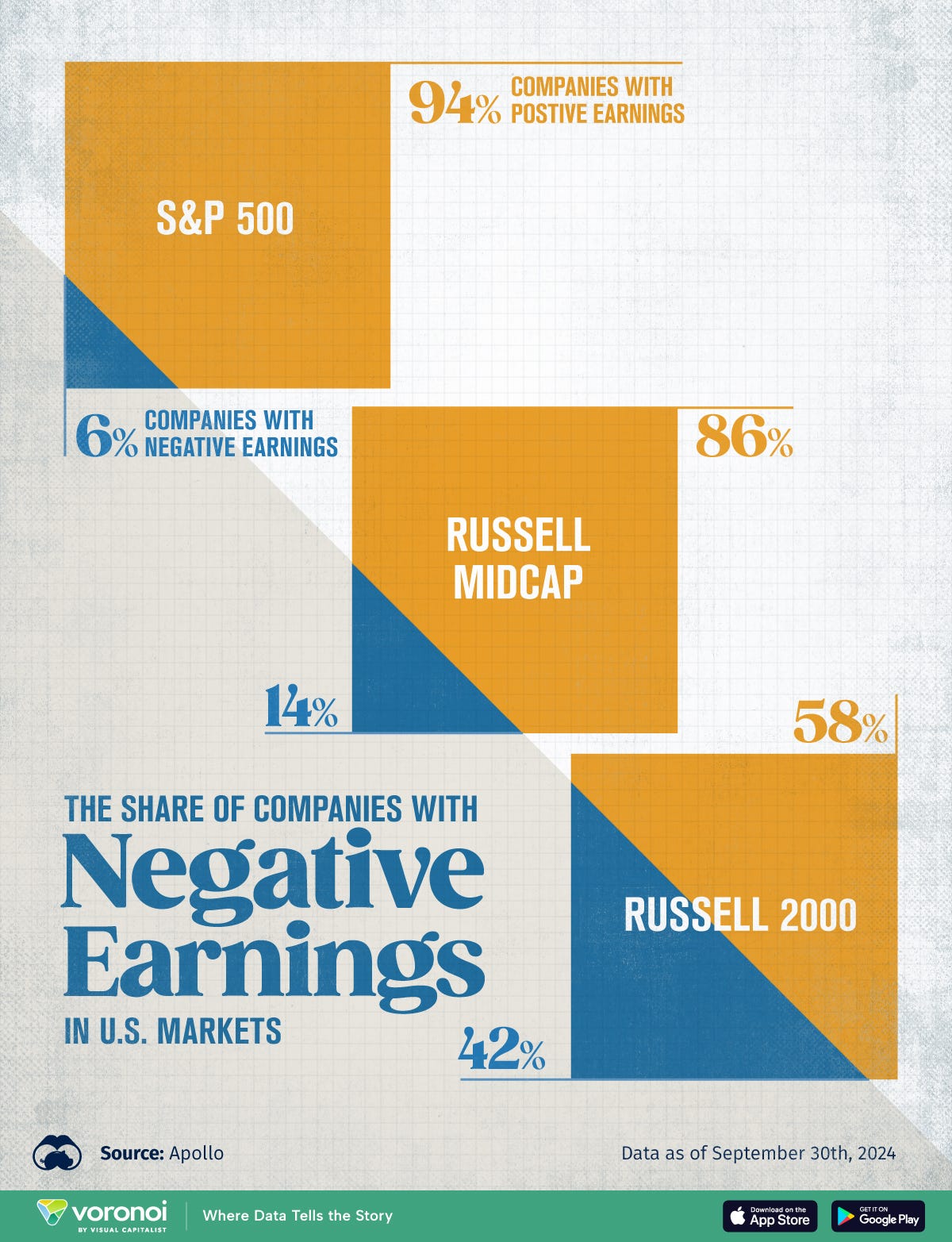
These “unprofitable” firms often thrive in growth-oriented sectors like technology, where investors bet on future potential rather than current earnings.
As a CEO, your role is to discern what your shareholders—and potential future investors or acquirers—value most. Is it:
Immediate profits?
Strong cash flow?
Rapid growth?
Recurring revenue streams?
Expanding market share?
Or a strategic mix of these?
The answer varies by industry, company stage, and investor profile. Focusing solely on short-term quarterly earnings (the “profits” we assume shareholders want) would simplify leadership immensely, but it risks missing the bigger picture.
This dynamic is especially critical for private companies, where CEOs must align closely with shareholders' expectations and optimize accordingly.
During my tenure leading NetQoS, a network performance management software firm I cofounded with my wife, our sole investor was a private equity firm that behaved more like a venture capital outfit in funding our growth. However, their private equity roots shone through: Some partners repeatedly pressed, “Where are the profits?” They were accustomed to valuations based on multiples of EBITDA (a proxy for cash flow) and viewed unprofitable companies as worthless.
I had to repeatedly reframe their perspective for the tech startup landscape. Prioritizing breakneck growth, without burning cash, was far more valuable than modest profitability. My annual planning mantra with the team was simple: “Grow as fast as we can while making $1 in profit.” This approach avoided cash burn and dilution from further funding rounds. I knew that a software company expanding at 50%+ annually would appeal more to acquirers than one growing at 20% with 20% margins. (NetQoS was ultimately acquired by CA Technologies in 2009 for $200 million, validating this strategy.)
The core takeaway? To maximize outcomes, CEOs must deeply understand their industry dynamics and shareholder preferences. Ask yourself: What metrics drive valuations in my sector? How do my investors measure success? Aligning on these “value vectors” not only builds trust but also positions the business for sustainable success.
In an era of evolving investor priorities, this nuanced approach separates enduring companies from the short-sighted ones.