


Can you believe how greedy Walmart is?
They rake in hundreds of billions every single year selling junk to working-class people! Meanwhile, they only pay their employees minimum wage!
Does this narrative sound familiar? I know I’ve heard similar rants innumerable times over the years.
A huge faction of our society loves to bemoan rich CEOs, selfish shareholders, and market dominators like Walmart. If Walmart and its ilk are on the “Evil” end of the spectrum, who’s on the “Virtuous” side?
For a lot of Americans, the answer is the nonprofit organization.
While business executives are “getting rich,” the leaders of nonprofits are “giving back.” Nonprofits are seen as equivalent to the concept of charity. They are often assumed to be staffed by selfless folks donating their time and treasure to helping society.
For a lot of reasons, I think this mental model is wrong, and can be pernicious.
Let’s pick apart the problems with it and arrive at a better model of the for-profit vs. the nonprofit.
1. The Greed of Walmart

What percentage of revenue do you think Walmart keeps each year? In accounting terms this is called their net profit.
Far from hoarding most of the money it takes in, Walmart’s net profit margin hovers between 1.9% and 2.5% each year. In other words, for every dollar it takes in, Walmart earns only a couple of cents in profit. If we go into the company’s P&L, we see that the rest goes to cost of goods sold, salaries, buildings, marketing, insurance, taxes—etc. (Notice this also means that lots of other parties are benefitting from these transactions Walmart is making.)
The average person decrying Walmart’s rapacity usually thinks they keep a lot more than 2% of all those billions. Interestingly, for every cent Walmart keeps, far more goes into governmental coffers. Sales tax, payroll tax, property taxes, and many other fees add up to an order of magnitude more money going to government entities than to Walmart shareholders.
And what about charges of selling junk to the poor? Well, try telling that to the people who shop at Walmart every day, deciding to voluntarily give up their hard-earned money in exchange for the goods it offers. When someone hands Walmart $100 of their paycheck, it’s because they believe they are getting $100 or more in value from the goods they are purchasing.
Plus, while many low-income households do rely on Walmart’s low-price model, wealthy households also shop there a lot, a trend that is increasing. In the company’s November 2024 earnings call, CEO Doug McMillon noted that households with more than $100,000 in income represented 75% of Walmart’s gains in market share.
And finally, Walmart pays most of its workers well above the federal minimum wage of $7.25. Pay has risen over the past decade because Walmart knows it must compete for labor. Starting pay for a store worker is now between $14 and $22 an hour. Store manager salaries average $128,000 a year in 2025. When Walmart opens a new store, the line of people waiting to apply for jobs is often overwhelming.
Looking closer at the basics of Walmart’s numbers shows that at least part of the “corporate greed” narrative is faulty. But there’s a lot more.
2. For-Profit & Nonprofit: Not as Different as You Think
Are nonprofits and for-profits inherently different types of organizations, with totally different ways of operating? The way most of us talk about them, you’d think they’re night and day.
In actuality, I think they sit side by side with each other, with a few distinctions between them.
A nonprofit needs resources to survive—donations, grants, or fees—just like a for-profit needs sales. Both pay salaries, rent, and overhead. Both have to manage these resources effectively or they collapse… even if talking about financial sustainability is seen as dirty business at many nonprofits. The big difference is that nonprofits—in theory—reinvest surplus into their mission, while for-profits can distribute profits to owners or shareholders. In a moment, we’ll get to why that profit-distribution factor isn’t a knock against businesses, but for now remember that the profit getting distributed is, for most businesses, a small fraction of the revenue they take in each year—if there’s any profit at all.
The idea that the nonprofit is a saint and the for-profit is a sinner also ignores the reality that, ultimately, both nonprofits and for-profits share a goal of delivering value to the same triangle of stakeholders:
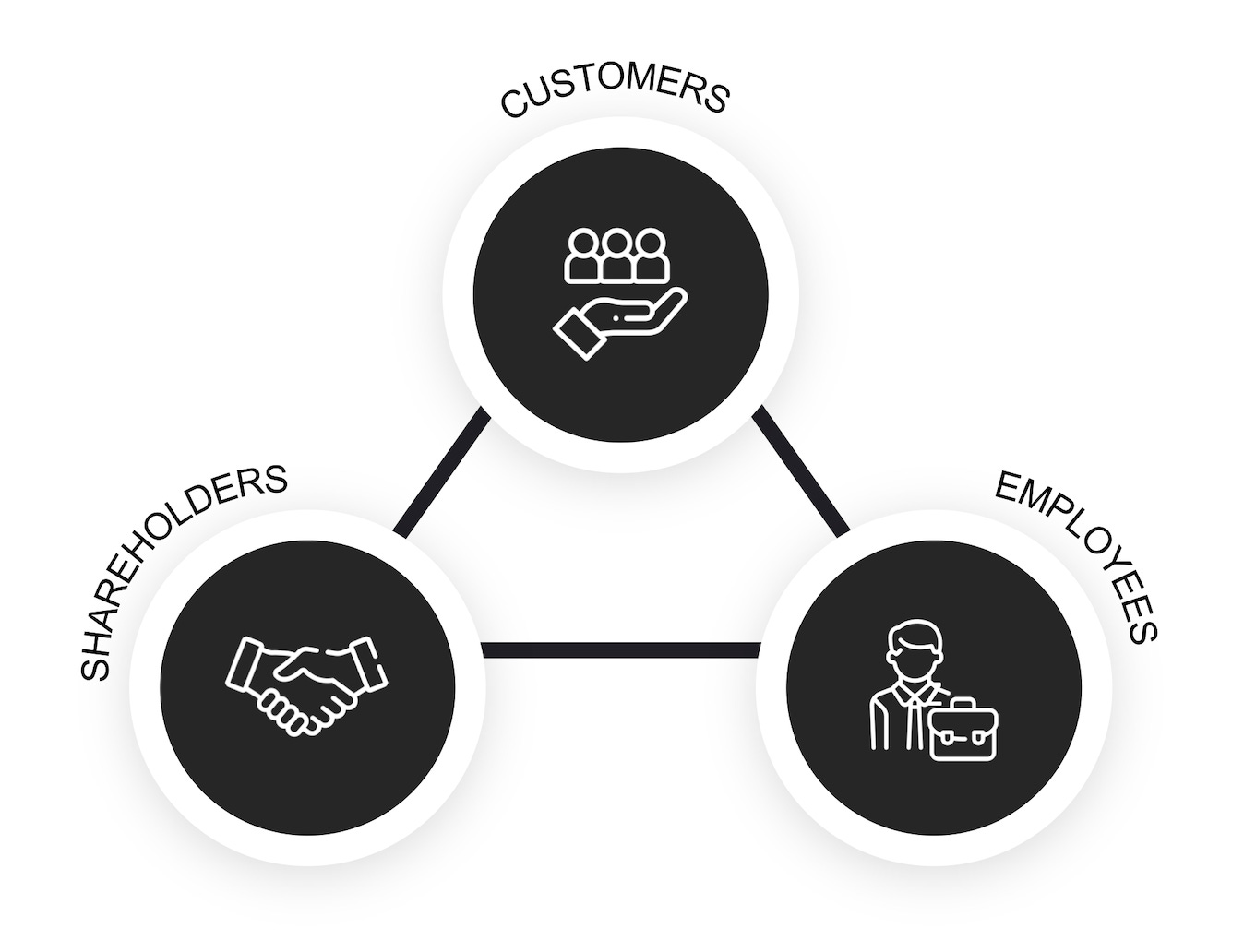
Employees
For-profits and nonprofits must both compete for talent in the labor market, offering a sufficient mix of pay, benefits, opportunity, growth, and rewarding work to bring on people capable of filling key roles.
Customers
For-profits sell goods and services to buyers.
Nonprofits solicit funds from donors. (Note that the recipient of the nonprofit’s programs is not the customer—the person voluntarily paying the nonprofit is.)
Shareholders
For-profits are expected to—at least eventually—deliver returns to the business’s investors, stockholders, or owners. These interests are typically represented by a board.
Nonprofits have similar controlling interests to answer to, usually in the form of its own board, who ultimately make decisions about how resources are allocated and whether they are fulfilling the mission they were created for.
The underlying mechanics of these organizations are quite similar. It’s primarily the tax status and the storytelling that differs.
Oh, and there’s another way for-profits and nonprofits are alike: They can both be subject to corruption. Here are just a few examples of nonprofits putting the lie to the idea that all nonprofits are ethical.
3. What Profit Signifies
As we’ve seen, nonprofits often get a halo of virtuousness based on the absence of profit.
In my view, this is a total misunderstanding of what profit is: a byproduct of value creation in a market.
When I go to Walmart and spend that $100, Walmart didn’t “make” $100. They created something that I felt was worth $100 of value. Walmart’s obligation to make that slim 2% margin and stay afloat means they created that value as efficiently as possible, using their resources as wisely as possible. Their profit isn’t a sign they ripped me off. It’s a sign that their activities created value in excess of the inputs.
Without this tool of profit, the nonprofit lacks urgency around efficient use of resources. They can always go out and raise more funds. Studies from organizations like Charity Navigator show that many nonprofits spend more on marketing and admin than their actual mission. Yet because they have the aura of virtue and aren’t subject to the need to create surplus value in a market, they escape the repercussions a business would face.
4. Charity Doesn’t Scale
Furthermore, the for-profit’s profits don’t just get siphoned into a shareholder’s personal bank account.
Those returns to shareholders give the business future access to capital. That happens lots of ways, from attracting new investors to growing share price to ability to reinvest earnings to growing ability to finance new debt.
That 2% net profit gives Walmart access to capital that lets the company scale. Walmart can erect new stores, buy more trucks, and build out better supply chains. It turns out that selling at scale also dramatically increases efficiency, so value-creation grows in tandem. This is why a nonprofit can’t compete with Walmart. The efficiency gained is significantly more than the 2% profit.
That kind of efficiency at scale is something a nonprofit will always struggle to recreate. They can endlessly go back to the well of donors and ask for more, but without a profit to demonstrate they have created value in the eyes of a consumer, it’s very hard to grow the way a business does. They lack the information that Walmart receives every time a person makes a purchase and trades their money for stuff.
5. The Emotions and Stigma around Money
A final point: I think our emotional relationship with the concept of money underlies our reaction to nonprofits and for-profits.
Money is a neutral means of value exchange. Yet bound up in it are all sorts of moral, psychological, and even religious assumptions drilled into us from a young age.
At the end of the day, I believe the healthiest view is to see money as a resource detached from any judgment about a person’s worth or intentions. We use money because it’s simply the easiest thing to exchange within a complex economy. But it’s no different, conceptually, from exchanging value in the form of apples or bags of wheat.
Taking on this mindset gets us away from assuming a big business is evil or exploitative because it makes money and that a charity is righteous because it makes none.
There are great businesses and bad businesses. There are great nonprofits and bad nonprofits. That’s closer to the reality of the world than the oversimplified narrative that one is good and the other is bad.
While nonprofits, of course, have their place in society, I believe it would do us all a great deal of good to require more of them, to hold them accountable to being efficient rather than just assume they will because of good intentions.
The other side of this coin is acknowledging that businesses, even a certain blue-branded big-box store, often do a similar amount or more for society than the charities we like to praise.