


A growing business is composed of many, many moving pieces. Businesses that beat the odds and become large enterprises have so many moving pieces that they become very difficult to lead. It’s why every enterprise CEO needs a strong model for leading holistically and strategically—and not getting sucked into endless operational details.
The bedrock of all the CEO training I do is such a holistic model. And I want to share it with you today.
This model may seem simple, and it is, but when you internalize it and use it as the starting point for your CEO leadership, everything changes. Making decisions doesn’t get easier per se, but you have a starting point for thinking through key tradeoffs. Goal setting for the company still requires discipline, but the model gives you a blueprint for getting started, steering you toward what’s most important. And you’ll never learn every detail of how the sausage is made inside the enterprise company you lead, but this model gives you, essentially, a curriculum for learning what’s most critical for the CEO to know.
What is this model? Well, it starts with a working definition of what a business is:
A business is a group of people who provide a product or service to a market for the benefit of customers, employees, and shareholders.1
If we pick apart this definition, we can identify three core functional groups within the business and three core constituencies the business serves. The three core functional groups are contained in the first part of the definition:
A business is a group of people who provide a product or service to a market . . .
These three internal groups are the Product or Service group (those who create the offerings of the company), the Marketing group (those who position the product or service within a market), and the Sales group (those who facilitate the exchange of value between the company and the market). They form the first Triangle of Tension the CEO must understand:
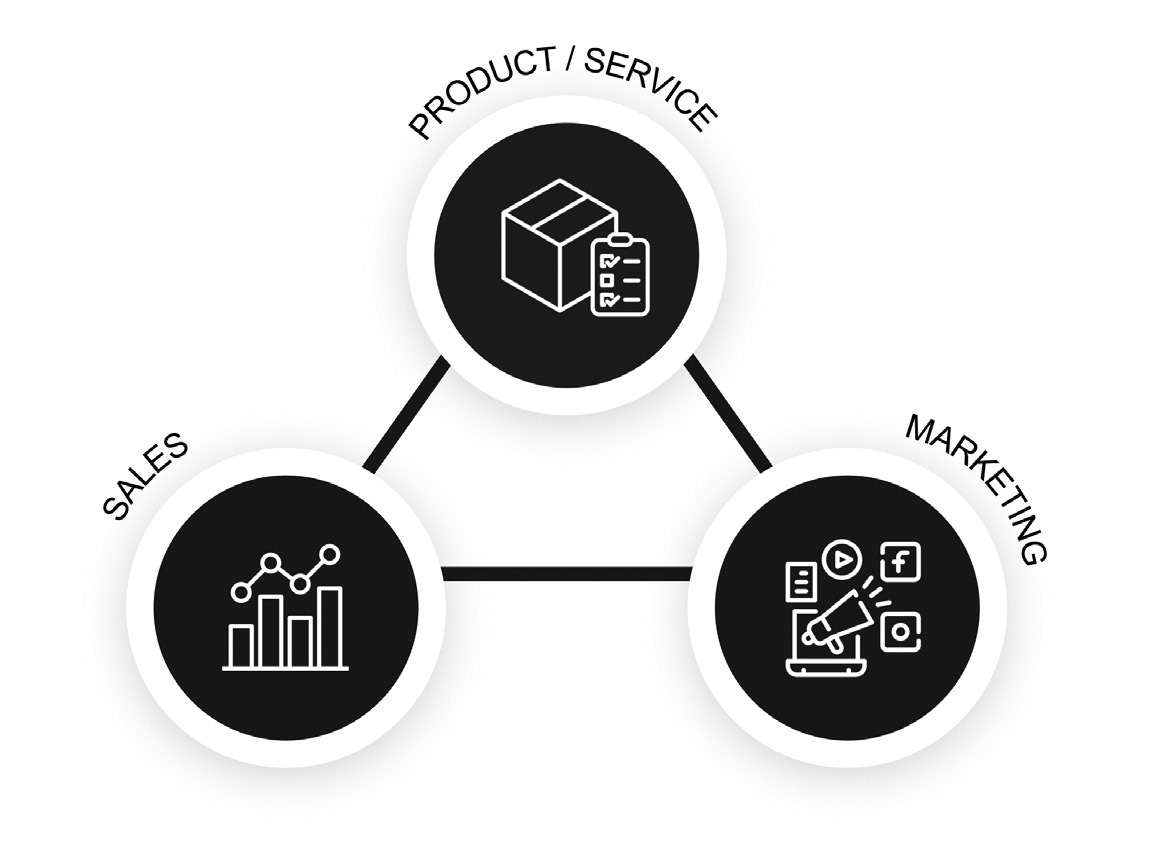
You are likely familiar with some of the tensions that arise from these three groups, as each one values fundamentally different things. Sales values closing deals. Marketing values maximizing the brand. And the Product/Service group values the quality of whatever is being delivered. As CEO, you sit outside these groups and are responsible for ensuring that all of these interests are properly represented, with no groups running roughshod over the others. Sales shouldn’t make promises on which the Product/Service group can’t deliver. The Product/Service group can’t make something they think is cool but that the market won’t buy. And so on.
The second Triangle of Tension is contained in the back half of our definition of a business:
. . . for the benefit of customers, employees, and shareholders.
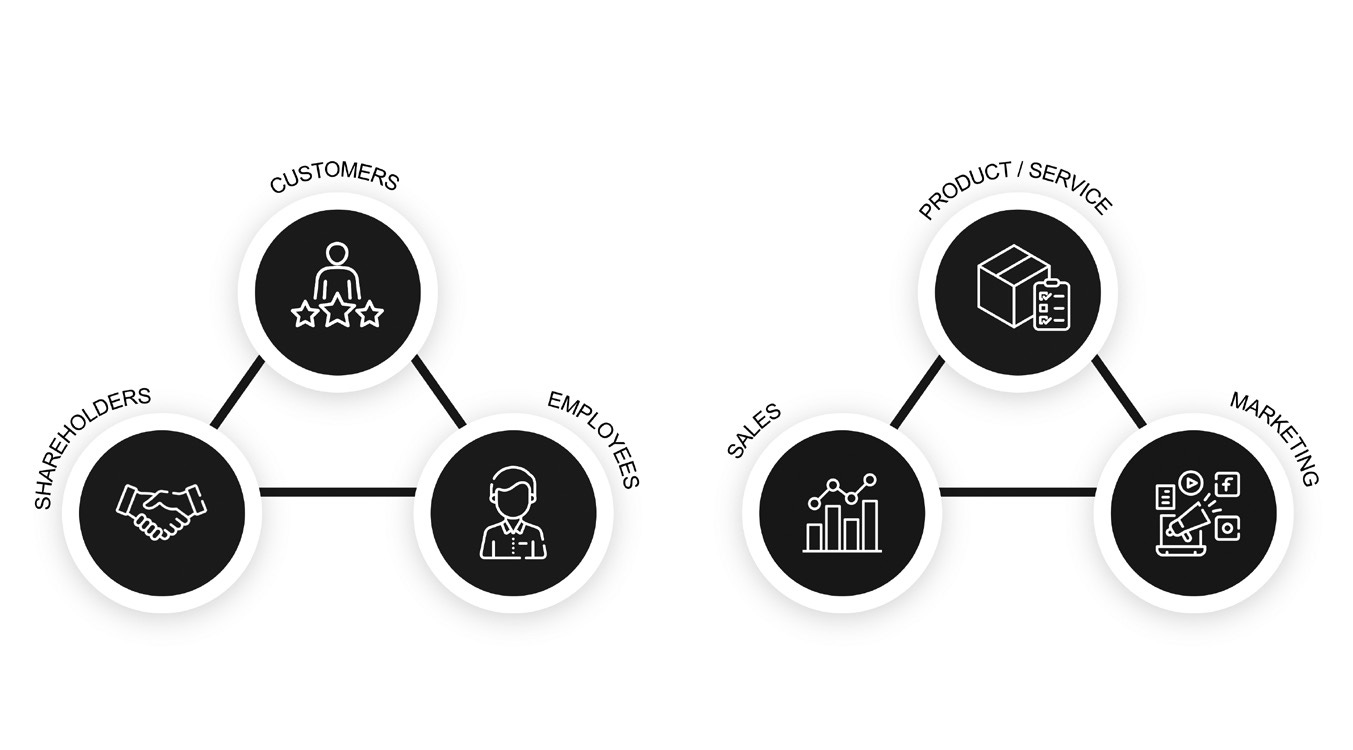
These are the core constituencies the business serves, and again they have interrelated but competing interests. Customers would like a high-quality product at the lowest price possible. Employees would like as much pay as possible. And shareholders, or the controlling interest, want maximum efficiency and the biggest return they can get. To be successful over the long term, a CEO must balance the needs of these groups to build a sustainable enterprise.

Taken together, the Triangles of Tension form a model for how the CEO should think about their entire company. It pinpoints the six fundamental areas you need to pay attention to as CEO:
OK, great, I can hear you saying. My business consists of six areas. What do I do with this? Let me tell you about a few of the ways I coach CEOs to apply the model.
The 6 Areas Inform Goal Setting
I’ve worked with many CEOs who would rather get a root canal than sit down and write clear goals for their companies. Others are more eager, but often this type begins listing dozens of tactical activities rather than real goals.
Both approaches are helped when you start goal setting with the six areas. With this model, the process is in fact simple. You just have to follow these principles:
A business at scale consists of six core areas.
Each area operates with the same goal every quarter.
Good goal setting consists of choosing the most relevant way to measure this goal every quarter.
We’ve talked about the six areas, but what is the goal they have each quarter? Here is how I define it:
Sales: Maximize perceived customer value
Marketing: Identify & engage qualified customers
Product/Service: Solve customer problems effectively & efficiently
Customers: Provide peak customer satisfaction with available resources
Employees: Maximize productivity of internal workforce
Shareholders: Maximize shareholder value
With this understanding going into the goal-setting process, you can then simply choose the best way to measure each area’s goal over the next 90 days. These become a set of six clear goals for your company to strive for. Here’s a cheat sheet for common ways to measure the core goal of each area:
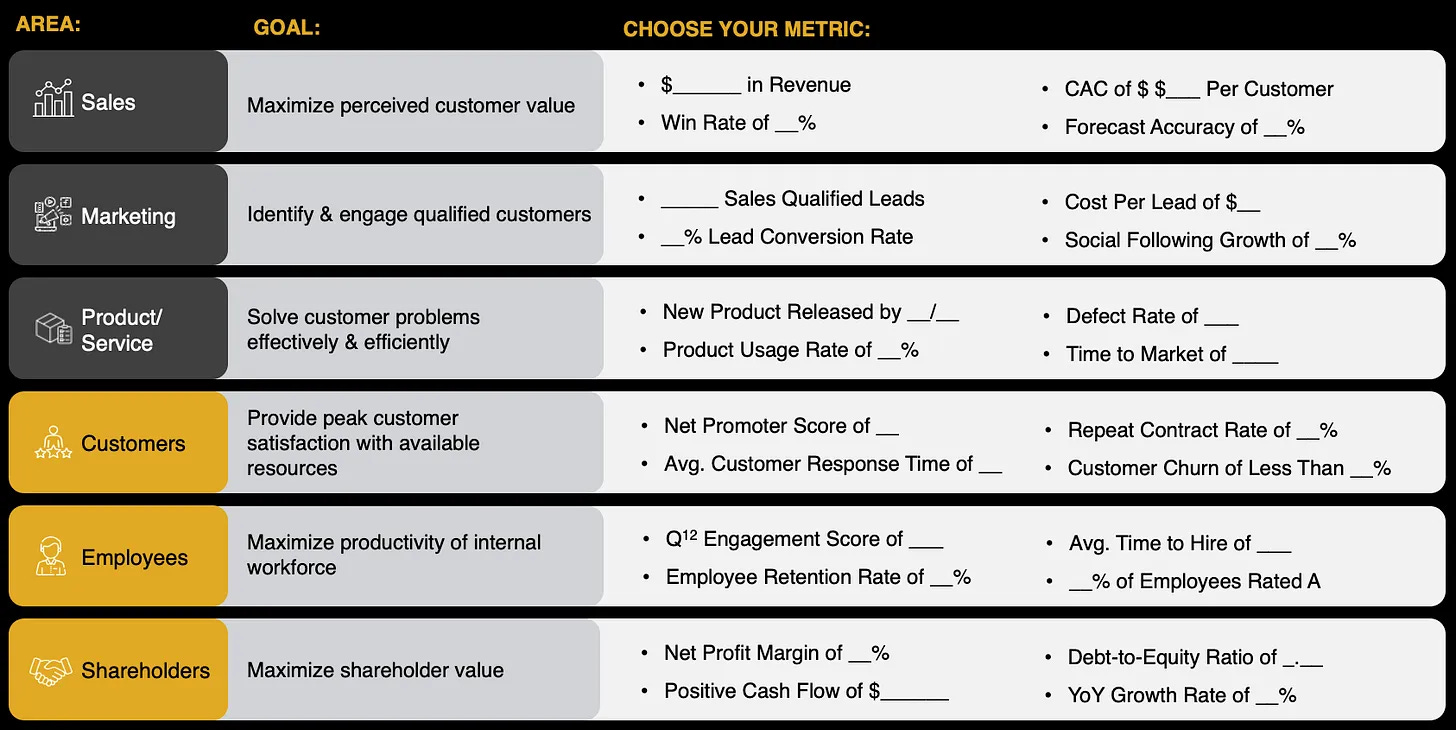
You may find other measurements that better fit your business right now. Regardless, this holistic mental picture of your business is an invaluable starting point for setting balanced, meaningful goals.
The 6 Areas Help You Make Decisions
As mentioned above, there will always be tension between the six areas. Each of them would like more resources than you’re allocating to the other. The business thrives when you find solutions that are at the middle of the two Triangles of Tension.
Say for example that a couple of board members (representing shareholders) have suggested outsourcing the customer support team to save on overhead. With this model in your head, you can think through it, weighing the effects on the other areas of the shareholder-employee-customer triangle. How would outsourcing affect the quality of support our customers expect? How would it affect the morale of remaining employees? Does it privilege shareholder interests at the expense of these two groups, or is it a reasonable tradeoff? Is there a compromise path that might balance their interests?
Again, the model isn’t a Magic 8 Ball—it won’t conjure up the perfect decision—but it will give you a consistent framework for making wise, balanced choices that keep the business from tipping over in favor of one stakeholder group.
The 6 Areas Define Your Organizational Chart
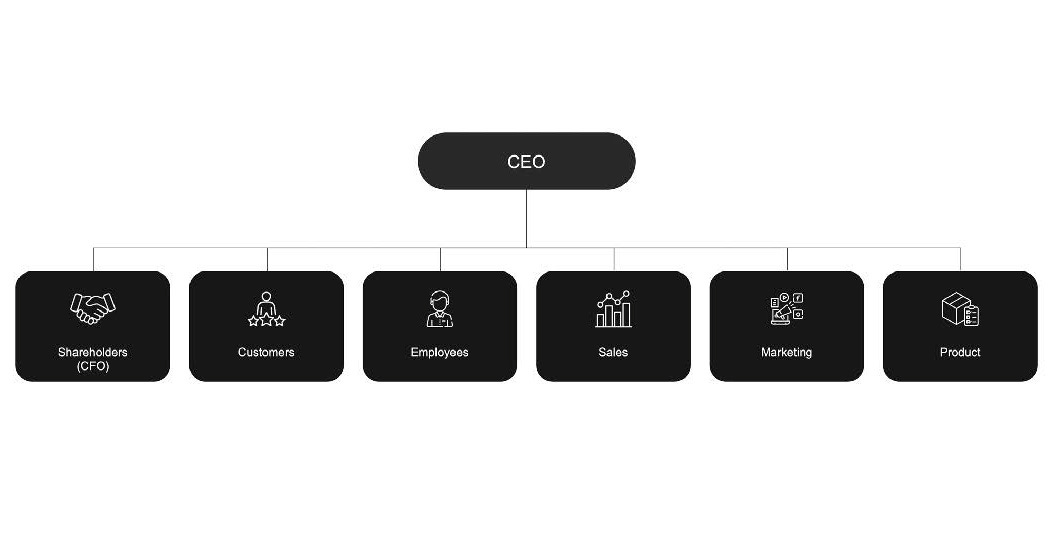
These areas of the business can also be viewed as a framework for a basic organizational chart, with one executive role representing each of the areas.
After an organization reaches a certain size, it will likely have an executive heading up Sales, Marketing, and Product/Service, as well as an executive representing shareholders (the CFO), the employees (a CHRO, Head of People, etc.), and customers (a customer service executive).
CEOs can flub this by not giving each of the areas a seat at the table. I’ve written here about three common ways this happens:
HR reporting to Finance or Operations
Marketing reporting to Sales
Customer Service reporting to Sales
Unless you have all six areas represented, though, the essence of the business structure isn’t reflected in the leadership team. Over time, this can skew the business away from that balance that is so imperative to maintain.
The customer service executive is probably the least common to have reporting to the CEO. Nevertheless, if the business is past the startup stage, I regard that as a fundamental mistake that creates an imbalance among the core constituencies. It is imperative that the person representing the voice of the customer have their own seat at the executive table, just like those representing the other five groups.
Bottom line: There’s power in a good mental model, and I’ve been using this one to excellent results with CEOs for close to a decade. It shines a light on the unseen, implicit relationships within your business, so you can align your leadership and decision making with reality.
Every time I’m in a conversation with a CEO who’s grappling with an organizational challenge, within a few minutes of discussion we can almost always boil it down to a core imbalance between the six areas.
If you’re a CEO and up against such a challenge, let’s test it out. Give Substack’s new DM feature a try, shoot me a message, and we’ll set up a time to talk.
“Shareholders” here refers to the controlling interests of a business. For a corporation, the controlling interest is shareholders. In other cases, the controlling interest might be a single owner or, in the case of a nonprofit, a board of trustees.
It’s fascinating to see how people set goals—so often, they’re not measurable or broken down into actionable steps, making it harder to achieve what they’re aiming for.