


Most software tells you what it is for the moment you open it.
PowerPoint makes presentations. Nobody has to explain that. You click around, you try a few things, and you figure out how to build a better deck. The purpose is built-in. We even call the software’s output the same thing as the application: PowerPoint.
Nearly every tool a company buys has a similarly well-defined purpose. A CRM tracks customers. Accounting software keeps the books. A spreadsheet does math. You never have to wonder what to do with the tool.
AI is different. Very different.
AI Was Not Designed for One Purpose
AI is not designed for one particular job. It is general-purpose intelligence. It can write, analyze, plan, summarize, argue, and advise on almost anything you put in front of it. It is like a person with a degree in everything.
That sounds like a gift, and it is. But it is also a problem. Once you open an AI tool, you usually get a blank box staring back at you. Many AI providers try to help by putting suggested prompts and workflows in front of you — but the fact remains that those suggestions represent a tiny sliver of its capability, chosen by someone who isn’t you.
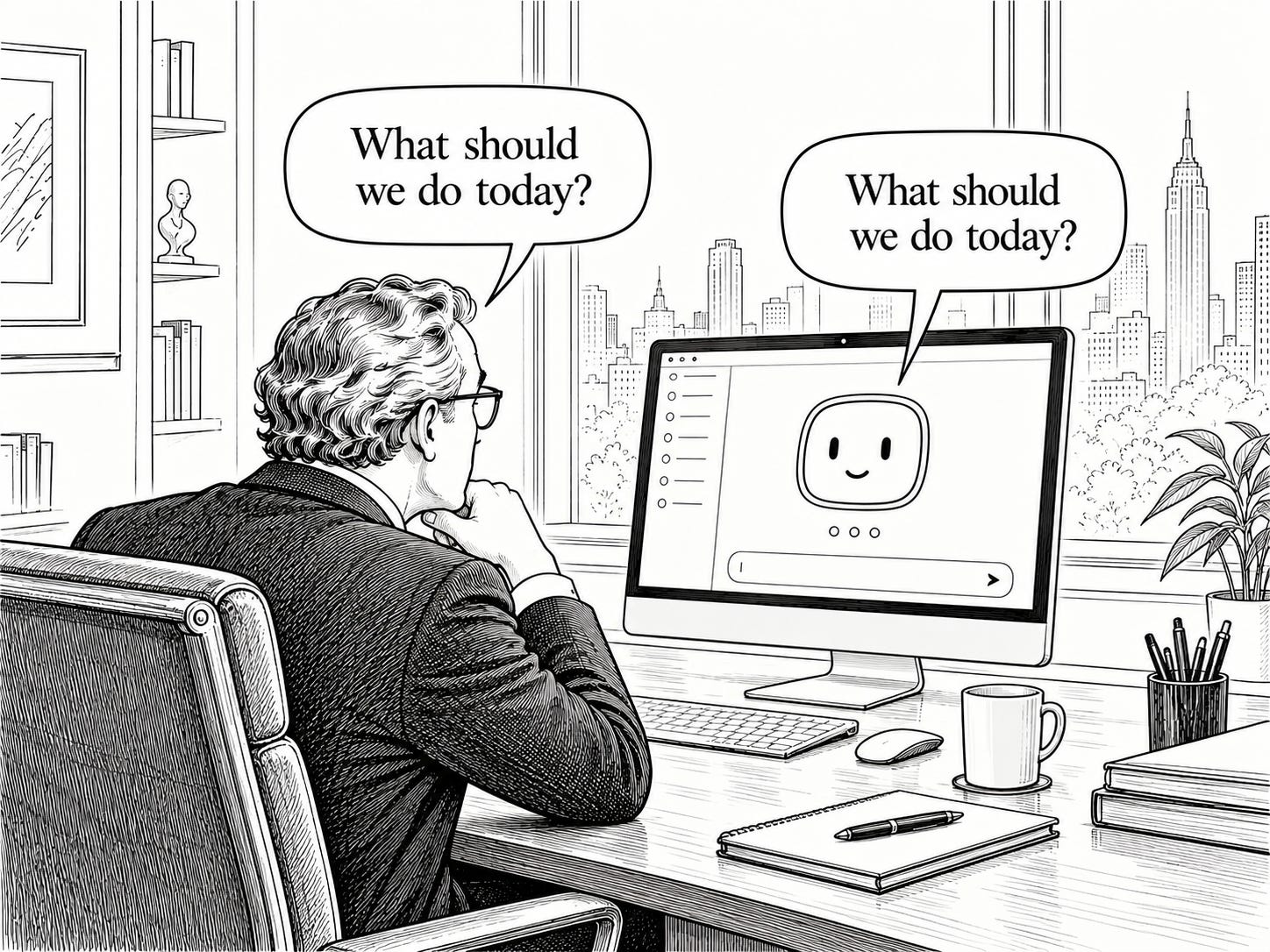
With AI, the ultimate generalist, it’s hard to know where to start. It can do anything, but what should it do for you?
It’s the Same Problem the CEO Has
I have written before that the CEO job is unique because nobody tells you what to do. Every other executive runs one function, using a scoreboard and a clear set of responsibilities. But the CEO runs the whole company with no instructions. Figuring out WHAT to do in the first place is usually the hardest part of the job.
If your executives’ jobs are like those specialized apps (PowerPoint, Salesforce, QuickBooks), yours is like the “everything” app: AI.
Now let’s put the two together: AI is a general tool with no assigned purpose. The CEO is a general role with no assigned function. Hand one to the other and you get the same question twice: What should I do?
A CEO who is unclear about how to spend their own time will be unclear about how to use AI. They will aim it at the small-scale tasks everyone else is using it for: drafting emails, summarizing documents, replacing Google. Useful, sure. But it’s not giving you an edge as CEO.
One Answer to Both Problems
If AI and the CEO role share the same inherent problem, they also share a solution: having a system for the CEO role.
A systematic approach to being CEO answers the “What should I do?” question with specificity. It tells you what the job is and how it differs from other executive roles. It points your attention where it needs to be and suggests what to do next. It shows you the shape of the job and the basic constituencies it serves.
When you have a mental model for those things, the AI question gets much smaller. “How can I use this broad, universal tool?” becomes “How can AI make me more effective in my CEO activities?”
The idea behind the Chief Executive Operating System — the framework I developed over my career — is to give CEOs that clarity. Once you have it, you have simultaneously given yourself a map for how to use AI effectively.
It’s a big topic, but no CEO has to tackle it alone.
My team and I are developing ways to help CEOs apply AI to the things that matter most: setting direction, building the right team, making decisions, and keeping the company on track.
If you are a CEO who feels you are only scratching the surface of what AI could do for you, reach out. I would be glad to talk through your situation and share some approaches I have seen work for other chief executives.

