


If you’re a CEO, I have several free tools available for your use:
Create or refine your 1-Page Strategic Plan with our custom AI agent.
Build your leadership User Manual.
Grab a complimentary CEO advisory session with me.

In the mid-2000s, I was in my first job as a professional CEO, and confronting all the challenges that entails.
My wife and I had cofounded NetQoS in 1999 and we were scaling up fast. Every time I blinked there were a dozen new employees walking around our halls. Keeping track of everything we were working on was becoming exponentially difficult.
Fortunately, we were using a rudimentary version of the goal-setting process I train CEOs on today:
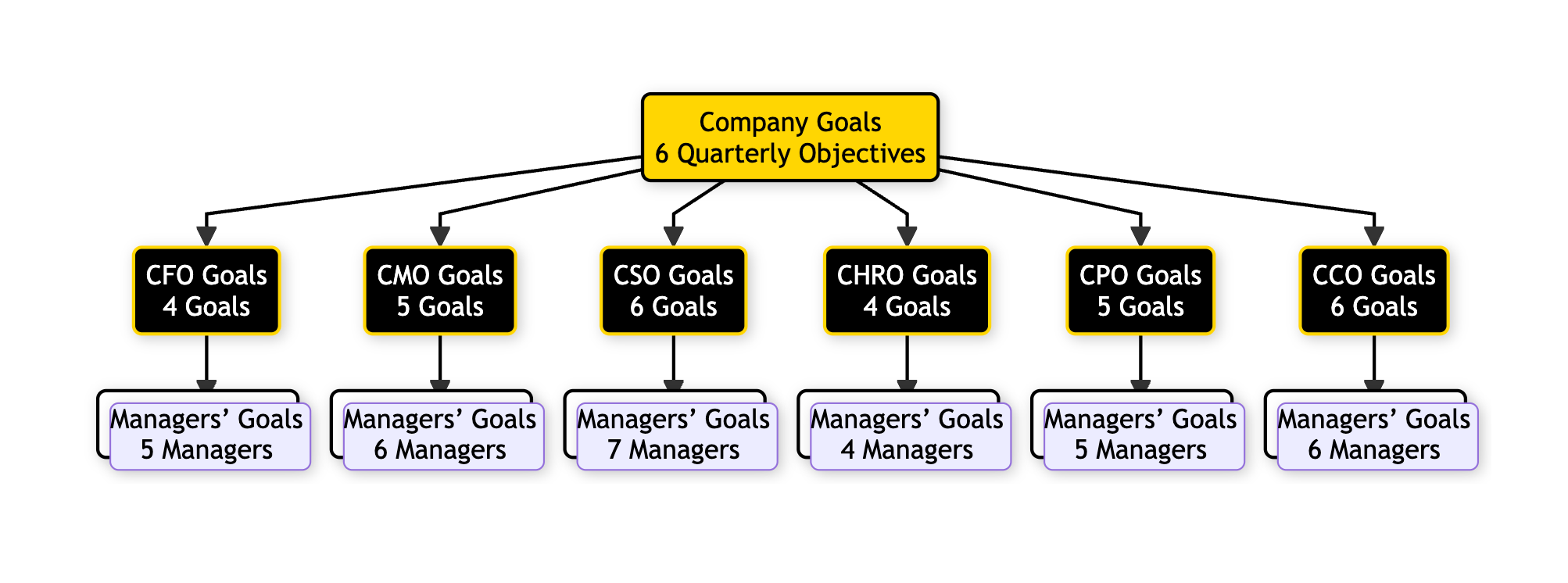
Set ~6 specific goals for the company each quarter (one for each area of the business).
Ask each executive to then set their own goals for the quarter.
Review these goals together in weekly 1on1s and team meetings.
But something was still getting lost. People would commit to goals at the start of the quarter, but then there would be inevitable drift toward stuff that felt more urgent in the moment than the priorities we set. Other times I’d be blindsided at the end of the quarter by a shortfall I thought I should’ve known about earlier.
Over the years, I worked with the team to build a basic interface for tracking our goals. Soon we had the backbone of an alignment system: a set of cascading goals that began with the top objectives of the company and branched into supporting goals for departments and employees.
This tool helped a lot. Years later, I asked one of my team members to add an email going out to everyone weekly, prompting them to give me their progress on each goal.
That’s when things got really interesting, as we started talking about what exactly should be in that update.
The Problem with Status Updates
The employee I asked to build this email update told me that I actually didn’t want a status update on the goals. He argued that a status update isn’t going to really tell me anything, because an employee could say they are 80 percent done on a project but have no idea how they are going to get the final 20 percent done.
What I really wanted, he said, was for each goal owner to predict the likelihood they are going to achieve the goal on time.
It hit me that he was absolutely right. I’d been sitting in team meetings for years and getting a lot of historical data that didn’t do much of anything. People talked about what had happened, not about what would. The only forecasting done in these meetings was done by sales, and that was the number we spent 95 percent of the meeting talking about.
This insight led to the implementation of the first of the two questions I still use to this day as part of the management system I train CEOs on.
Question 1: Likelihood
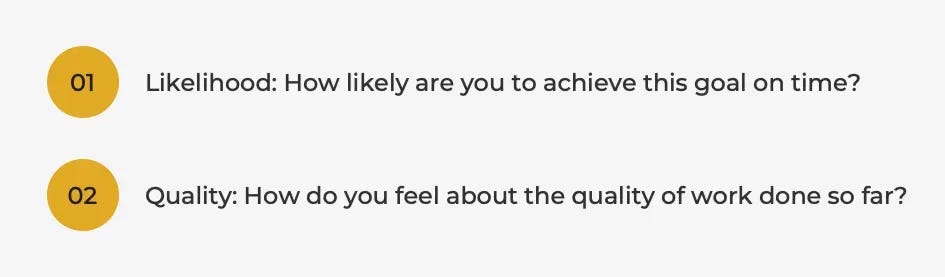
"How likely are you to achieve this goal on time?"
This became our first weekly question. Instead of asking for historical progress, we would ask each leader to predict their likelihood of success. This shifted our focus from what had happened to what would happen, giving us genuine forecasting intelligence from the people best positioned to make those predictions.
The question works because it captures nuanced understanding that percentage-complete metrics cannot. As I mentioned above, someone might be almost finished but facing obstacles that make completion unlikely. Another person might be only 30 percent complete but have a clear path forward with high confidence. The likelihood assessment reveals this distinction and allowed me to plan more confidently from the CEO seat.
Question 2: Quality
"How do you feel about the quality of the work done so far?"
The second question also came about in discussion with my employee, and it came from the fact that I would often walk around and ask people how they felt about their work. If they trusted me enough, that line of questioning would often surface interesting insights. A situation that looked good on paper might mask something that spelled trouble ahead, but only the employee themselves really knew about it.
This insight became our second weekly question. The Quality question captures the sustainability and integrity of progress, and sometimes this is subjective and qualitative rather than purely measurable (which is why the word feel is so important). Teams can technically meet their goals at low Quality, which creates problems that emerge later:
A sales team might hit their quarterly number but completely deplete their pipeline
A marketing team could deliver the required number of leads, but they're all low-quality prospects that waste the sales team's time
An engineering team might deliver a product on time that's held together with duct tape and will break the moment customers start using it heavily
The Quality question elegantly surfaces those trade-offs before they become problems.
Two Sides of the Same Coin
These questions work together as complementary assessments:
Likelihood tells you about trajectory and timing.
Quality tells you about sustainability and long-term impact.
Together, they provide a complete picture of goal health that traditional goal updates miss.
A goal with high Likelihood but low Quality might need timeline adjustments to avoid future problems. A goal with high Quality but declining Likelihood might need additional resources or obstacle removal. The combination gives you the intelligence to make informed interventions.
The Weekly Rhythm of Intelligence
The process we developed centers on these two questions asked consistently every week. Each executive answers both questions for each of their quarterly goals, rating responses on a five-point scale from red (Very Unlikely or Low Quality) to green (Very Likely or High Quality). This creates normalized data that reveals patterns across different functions.
In our weekly executive team meeting, I answer the same questions about our company-level quarterly goals with the entire leadership team present. This transparency helps everyone understand where we stand as an organization and which areas need collective focus.
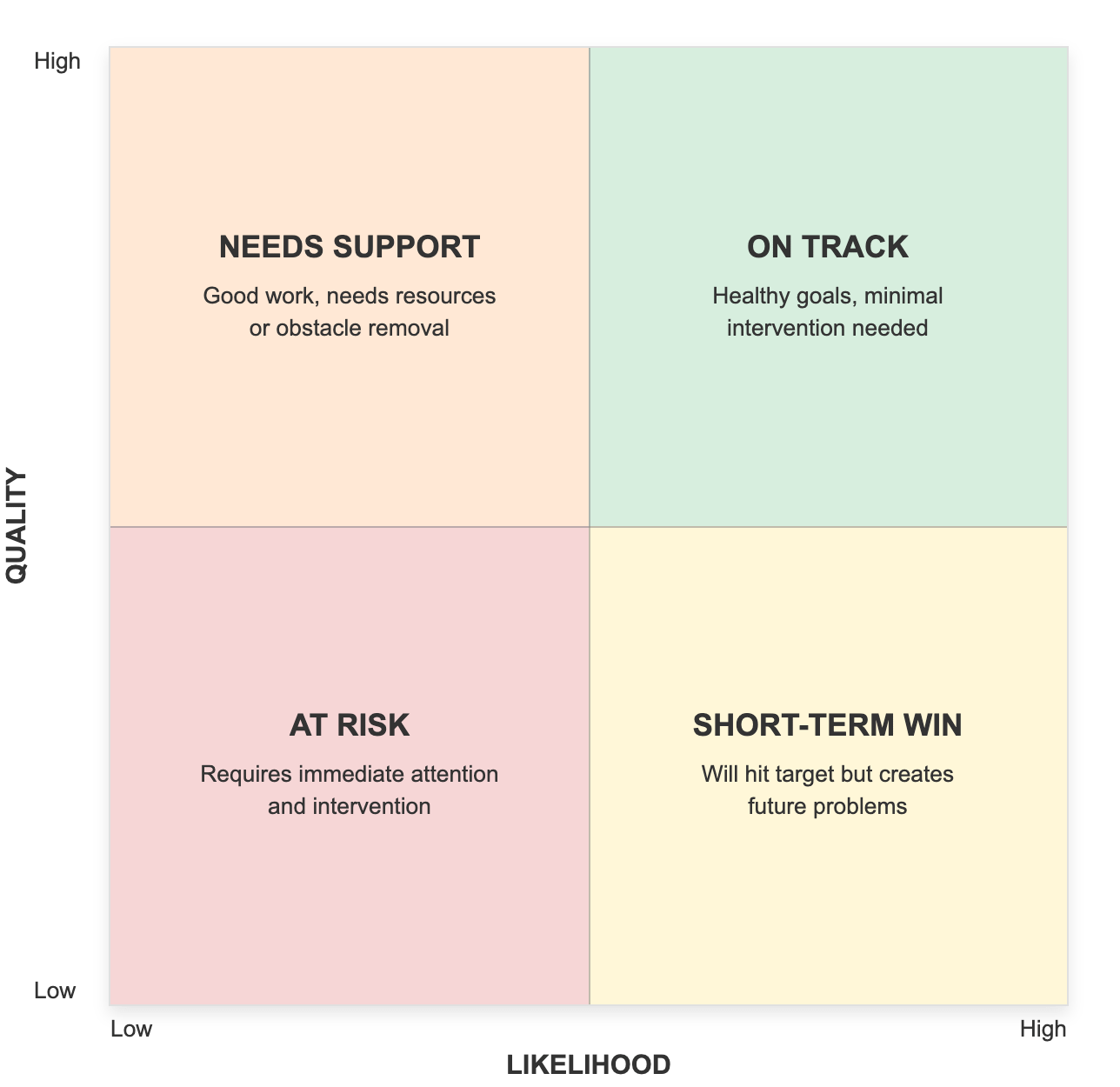
When aggregated into a simple matrix plotting Likelihood against Quality, the data becomes actionable. Goals in the upper right quadrant are healthy and require minimal intervention. Those trending toward the lower left need attention, and I can explore the underlying issues with the responsible leader.
It's About Metadata, Not Data
Here's what I realized: I don't need to understand the technical details of every software sprint, marketing campaign, or sales process. What I need is metadata, i.e., human intelligence layered on top of the raw data.
When my VP of Engineering tells me our new feature is 75% complete, that's data. When she tells me she's 75% complete but only 30% confident we'll hit our deadline because of unexpected API limitations, that's metadata. The second piece of information is far more valuable to me as a CEO because it’s my job to allocate resources to the priorities as needed, not solve the technical problem in a functional area.
Raw functional data requires domain expertise to interpret. Metadata gives the CEO actionable intelligence regardless of the technical complexity underneath.
Five Reasons These Questions Are Effective
1. They Encourage Forward-Looking Thinking
Instead of rehashing what happened last week, your team starts thinking predictively. This shift improves execution.
2. They Surface Hidden Trade-offs
Teams constantly make quality vs. speed decisions you never hear about. These questions bring those choices to light before they create problems.
3. They Create Normalized Intelligence
Whether it's engineering, sales, or marketing, you get standardized assessment across different functions. Five-point scales work consistently everywhere.
4. They Leverage Expertise You Don't Have
Your department heads see problems forming weeks before they show up in reports. These questions capture that early insight.
5. They Support Honest Communication
When people see you respond constructively to concerns, they become more willing to surface problems when you can still address them.
The Weekly Rhythm
Every Friday, each executive rates their quarterly goals on both dimensions. Every Monday, I do the same for company goals in front of the entire leadership team. This transparency shows everyone where we stand and what needs attention.
CEOs who consistently ask these questions typically report a fundamental shift in how they lead. Instead of being surprised by problems, they see them developing. Instead of postmortems, they have early interventions. Instead of hoping everything's on track, they have systematic intelligence that shows them exactly where to focus.
Having trained hundreds of CEOs on incorporating these questions into their management systems, I've seen this pattern repeatedly: leaders get the execution insight they need without requiring expertise in every functional area.
That's the value of good metadata. It’s human intelligence that makes raw data actionable.
One of the most simple yet impactful frameworks for managing at the executive level. Thank you, Joel! Love getting to continue learning from you and your training.