AI has become the air we all breathe. It’s ubiquitous. Or at least talk of it is.
Many executives are still checking their watches, waiting for the payoff to show up. Famously, a PwC survey of more than 4,400 CEOs found that 56% had seen no benefit whatsoever from their hundreds of billions of AI investments.
What’s the issue?
Executives’ use of AI is still weak
The gap could be due to the fact that leaders just aren’t using AI that much. For example, this month a National Bureau of Economic Research study of 6,000 executives found that:
While about two-thirds of execs reported using AI, usage averaged just 1.5 hours per week.
1 in 4 execs said they were not using AI at work at all
Nearly 90% reported no impact on employment or productivity over the last three years.
You cannot lead an AI transformation you are not personally experiencing.
The Credibility Problem

The crux of the issue is that you cannot lead an AI transformation you are not personally experiencing.
Most CEOs recognize AI will reshape their business. They commission AI strategies, fund innovation initiatives, hire Chief AI Officers. Their employees gripe at happy hour about initiatives requiring them to show they are using AI.
Meanwhile… the CEO’s workflow remains unchanged. They continue working exactly as they have for the past decade. Same Sunday night board prep. Same reactive calendar. Same deferred strategic work.
Your organization sees this. When you delegate AI adoption while avoiding personal adoption, you create a credibility gap that undermines transformation.
Companies Become AI-Enabled to the Degree Their CEO Does
Two decades of studying CEO performance has taught me that organizational capability rarely exceeds CEO capability.
Companies become data-driven when their CEO becomes data-driven. They become customer-obsessed when their CEO becomes customer-obsessed. They become strategically disciplined when their CEO becomes strategically disciplined.
The same holds for AI adoption.
Your company will integrate AI into workflows to roughly the same degree you integrate AI into your workflow. If AI is a peripheral tool you occasionally use, it will remain peripheral in your organization. If AI fundamentally transforms how you work, your organization has permission and direction to pursue similar transformation.
AI, Built for the CEO
Your next question is likely, "Well, how exactly can AI help me do my job as CEO?” The application isn’t as clear for, say, an accountant, a lawyer, or a software engineer.
It seems increasingly inevitable that every knowledge worker will have a personal AI agent: a system that knows their work, anticipates their needs, and handles the preparation and analysis that used to consume their days. For many workers, that day is already here.
Imagine with me for a moment that the CEO had a central AI hub, a suite of agents trained specifically on CEO workflows, built around the demands of this particular job.
The CEO is no different, except that the job is singular. There is no other role in an organization quite like it in terms of complexity, accountability, breadth of decisions, loneliness, and stakes. These are specific to the enterprise CEO. Which means a generic AI tool is not enough. The CEO needs AI built for the CEO.
Imagine with me for a moment that the CEO had a central AI hub, a suite of agents trained specifically on CEO workflows, built around the demands of this particular job. Not a general-purpose assistant adapted for general executives, but something purpose-built for the person running the enterprise. What would that look like?
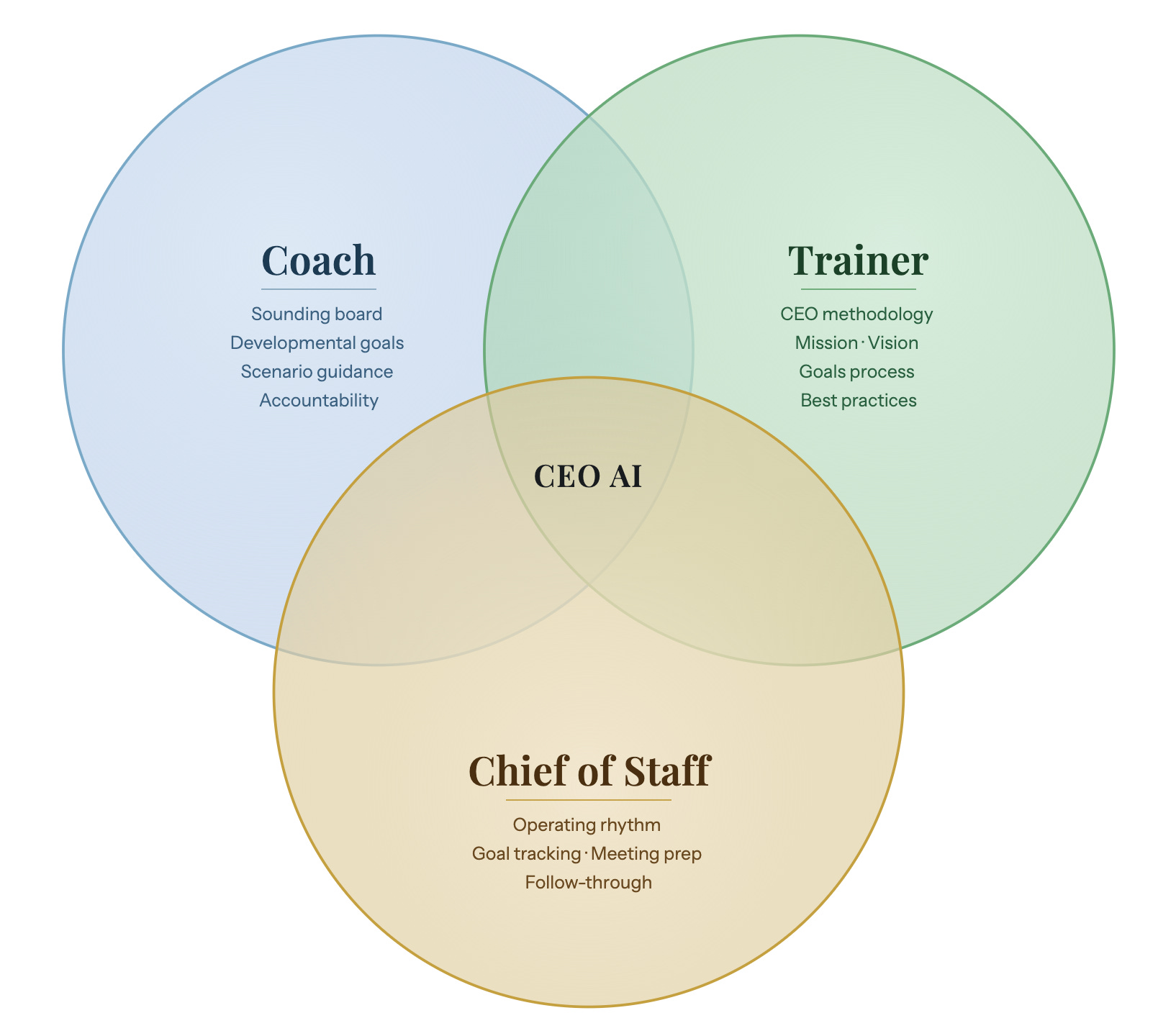
I believe a good AI solution for the CEO would have three core functions:
Coach – A confidential sounding board available whenever you need it. Facing a difficult conversation with an underperforming executive? Working through a strategic decision with no clear answer? Not sure how to handle a board dynamic? The coach function of your CEO AI helps you ask the right questions, pushes back where warranted, and holds you accountable to your own development goals, the kind of ongoing guidance that used to require an expensive outside advisor and a scheduled appointment.
Trainer – A complete methodology for the CEO role, available on demand. How do you build a mission and vision that actually guides decisions? How do you construct a strategic plan with real accountability? How do you run a goals process that keeps the organization aligned? Most CEOs piece this together over years of trial and error. The trainer function codifies the best practices, tools, and frameworks of the role so you can lead with clarity from Day 1 rather than learning the hard way.
Chief of Staff – The operating layer that keeps everything moving. Goals tracked, deadlines flagged, meeting prep assembled, follow-through monitored. The CEO role generates an enormous amount of organizational noise. A dedicated AI chief of staff cuts through it so you can keep the business on beat.
What CEO AI Looks Like in Practice
Let’s imagine the daily working life of a CEO who has such a tool.
It’s Monday morning in the first week of Q2, and you feel unusually confident walking into the quarter, because…
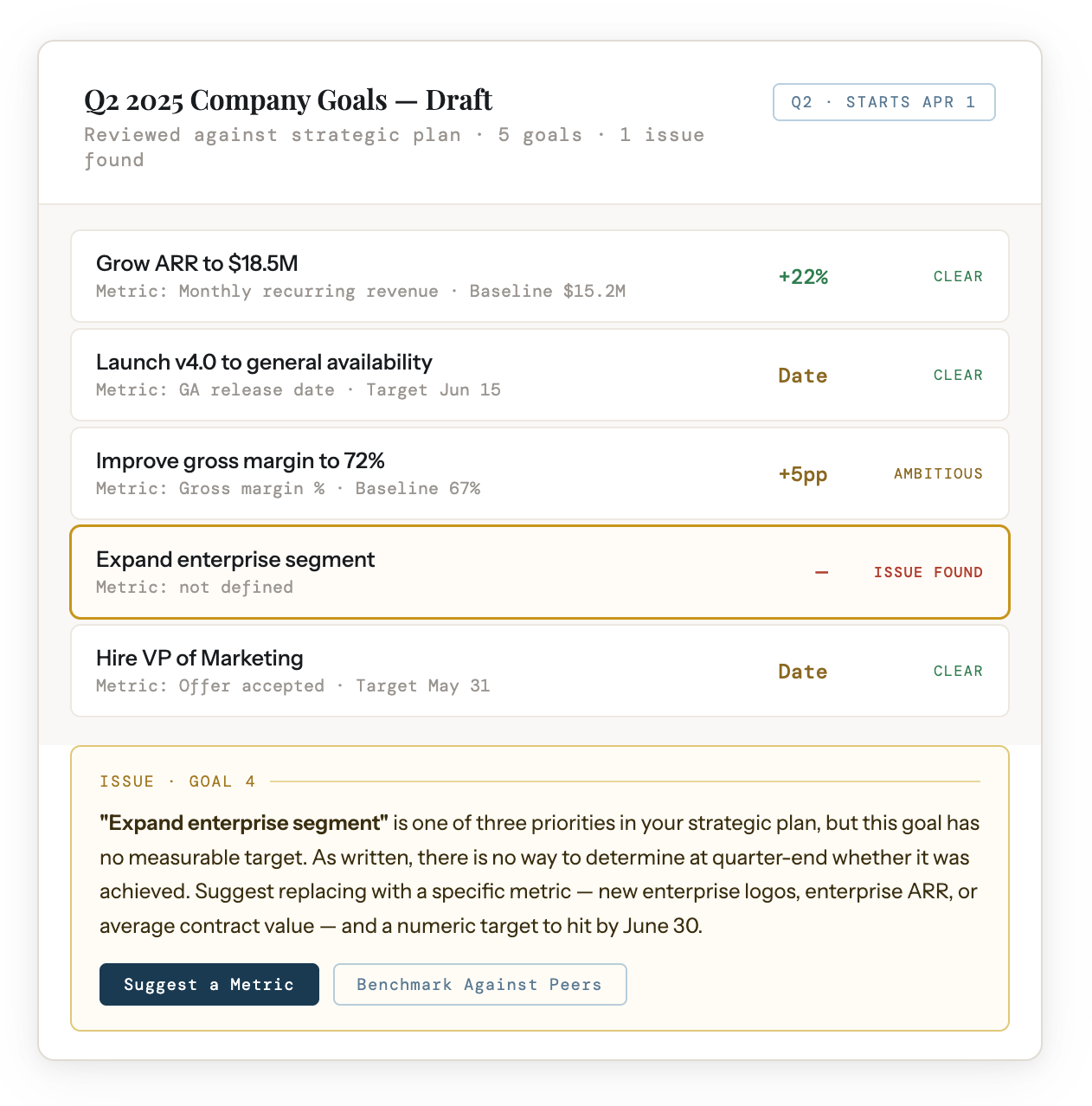
Two weeks ago, your agent flagged that goal-setting season was approaching and walked you through the process: drafting four to six company goals tied directly to your strategy, pressure-testing the metrics, benchmarking them against what similar companies track. It caught a gap — a key strategic priority with no goal attached to it. When the goals were set, it drafted the all-hands communication explaining what the company is focused on this quarter and why, so every team could align their own work to it. The quarter starts with clarity instead of confusion.