



In business, time is the silent deal-killer lurking in every negotiation, hire, or sale.
Yet most companies treat deadlines as suggestions and timelines as rough estimates. They allow milestones to drift and decisions to languish indefinitely.
In a word, they’re slow.
The problem often starts at the top. If the corporate team were a band, too many CEOs think they should be the lead singer strutting around at the front of the stage. But the great CEO is actually more like the drummer.
Much like a skilled drummer bent over the kit, the effective CEO keeps the rhythm and establishes the pace. They have a clear system that ensures milestones are hit on time (BOOM bap BOOM bap) and they keep the tempo up.
Sadly, a lot of corporate bands are trying to play with a drummer-CEO who's just plain sluggish. It's like listening to an experimental band where you want to yell, "Can I just get a BEAT!?"
These slow CEOs don't realize that every moment of hesitation compounds the risk of losing what matters most—whether that's top talent, a crucial deal, or a market opportunity.
Here are five ways that slowness manifests, and how you can up the b.p.m. of your CEO drumming.
1. Hiring: Top Talent Has a 10-Day Shelf Life
The best candidates stay on the market for roughly ten days. After that, they're gone. That research backs up what every recruiter knows: Exceptional people get snapped up fast.
Nevertheless, most companies treat hiring like a deliberative process. They schedule multiple rounds of interviews, send offers through legal review, and wonder why candidates disappear. I know of many companies that lose star candidates because offer letters sit with legal or HR for weeks. Those candidates are more likely to accept a same-day offer from a competitor.
The oft-cited “Hire slow, fire fast” dictum means being deliberate about who you want and moving decisively once you’ve decided. Even then, I think the better mantra is “Hire A-level talent as soon as it’s available.” Top talent won’t wait for companies that can’t make up their minds.
2. Mergers & Acquisitions: Time Kills Deals
Mergers and acquisitions fare no better. Over 70-75% of them fail, with delays being a big part of that equation.
There’s a reason “Time kills deals” is a truism in the M&A world.

For every high-profile deal that fails (e.g., Xerox-HP and Yahoo-Microsoft), there are countless others that don’t get written up exhaustively in the press. Unwarranted delays are very often the culprit. Passing time inflates the risks: market conditions shift, valuations fluctuate, someone gets cold feet.
Every deal needs momentum. When a transaction stalls, it’s usually best to push it forward or walk away.
3. Sales: The 5-Minute Rule Multiplies Conversions
Time kills deals with your customers, too. Their interest has a half-life measured in minutes and hours, not days. MIT research shows that jumping on sales opportunities immediately is vital:
The odds of contacting a lead if called in 5 minutes versus 30 minutes drop 100 times.
The odds of qualifying a lead if called in 5 minutes versus 30 minutes drop 21 times.
A business whose sales team takes a week to finalize a proposal is likely to lose out to a competitor who gets the paperwork out the same day. Speed signals competence and priority.
Long approval chains, complex contract reviews, and multi-signature requirements all give buyers time to reconsider or find alternatives.
4. Product Development: First-to-Market Advantage Compounds
Being first to market creates compounding advantages that become difficult to overcome. Early entrants establish customer relationships, refine their offerings, and build brand recognition while competitors remain in development.
Tesla didn't build the first electric car, but they were first to market with a premium EV. That speed advantage provided years to establish market position before traditional automakers responded.
5. Decision-Making: Velocity Creates Organizational Momentum
At a more basic level, fast decision-making creates momentum and increases your chances of winning. Rather than be a broken stoplight, the CEO has to keep up an energizing tempo with their own decisions, which sets the pace for the decisions others in the organization make.
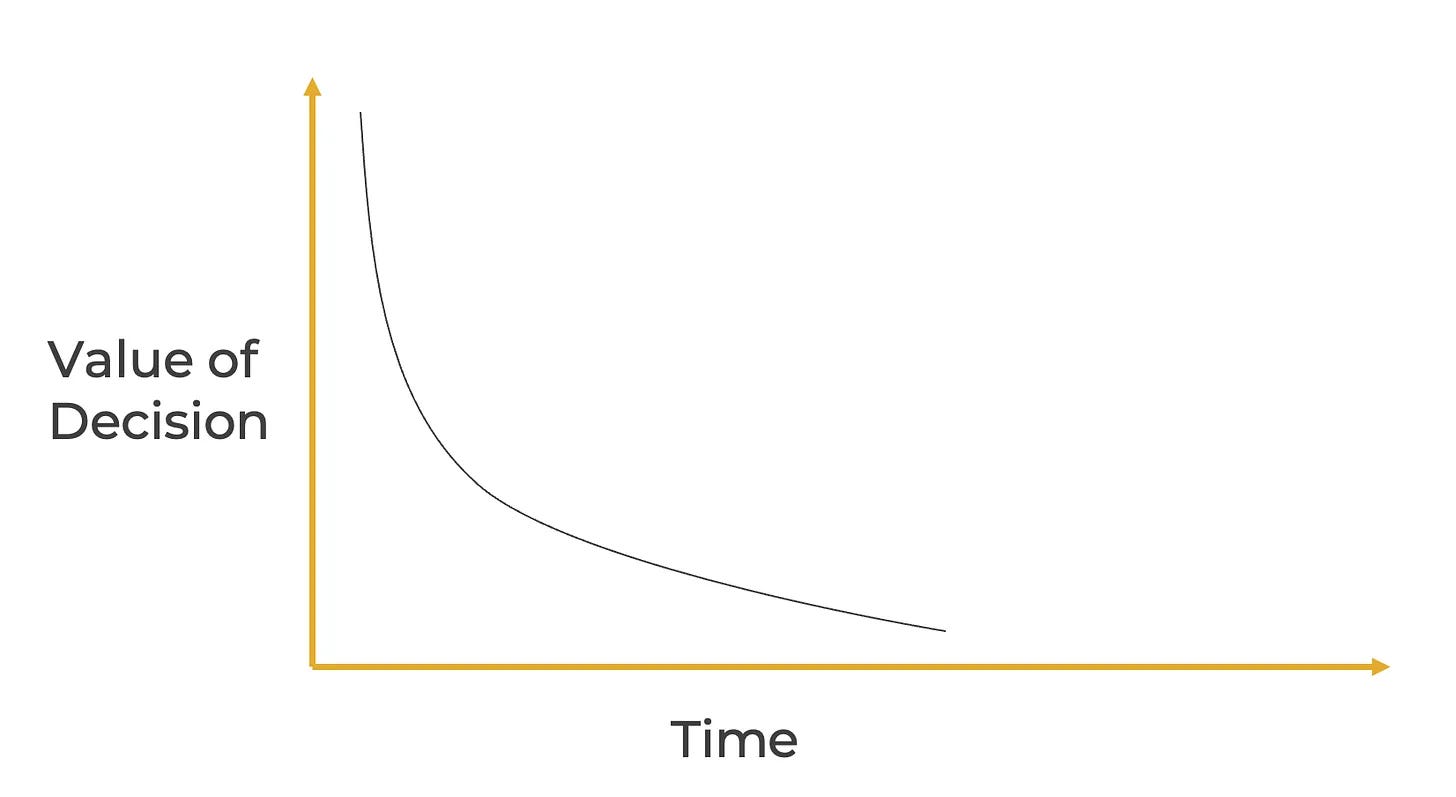
As the CEO drummer, if you take weeks to approve budgets, your managers will take weeks to approve smaller expenditures. When you respond to emails slowly, your team will respond slowly to customers. The standards you establish for meeting deadlines and accountability become the organizational heartbeat.
Like everything in the CEO role, this requires balance. I’m not telling you to recklessly rush major decisions that truly need deliberation, but in truth the CEO only makes a few of those each year.
These days I more commonly see companies prioritizing process over speed and letting opportunities slip through their fingers thanks to lack of swiftness.
The ways to speed up your tempo are abundant:
Streamline processes. Eliminate unnecessary approval steps.
Empower decision-makers at every level with clear authority limits.
Set clear, realistic deadlines and stick to them consistently.
Use weekly Likelihood and Quality assessments to keep projects honest about progress
Celebrate speed and course-correct quickly when momentum stalls.
The passing of time kills off possibilities. In most situations, act fast… or watch opportunities vanish.
Let's Revive Your Slow Startup

Startups thrive on speed. The best of them move fast, adapt quickly, and outmaneuver big incumbents burdened with bureaucracy.
Love encouraging Systems not Sales.
Sales tends to orient leadership to leads, calls, and closing business, but that's usually a hard-approach process that isn't systematic and isn't scalable. Speed needs systems, play books, and clarity, so that everyone ELSE can do their best more efficiently. You can't lead if you have to manage.
Isn’t that the paradox? Slowness kills your business, but speed kills you.