



In my college days, I was a pretty good tennis doubles player.
In my final match, my partner and I took down the nation’s top-ranked team, who were then undefeated.
But I never had much interest in playing professional tennis. At the time, John McEnroe was the undisputed king of doubles tennis. The running joke was:
Q: Who’s the best doubles team in the world?
A: John McEnroe and anybody else.
If McEnroe had called me up and said, “Joel, I want you to be my partner,” I’d have said yes in a heartbeat.
Could I have kept up with him? Probably not.
Could he have carried me to the world’s top spot? Doubtful.
But the chance to play alongside a legend would’ve been irresistible. It’s a rare opportunity to be challenged and achieve something extraordinary.
This same dynamic applies when a professional CEO is invited to lead a company alongside a brilliant, high-profile founder/owner who remains deeply involved.
I thought of this while reading about Linda Yaccarino’s departure as CEO of X this week. When the news broke, there were lots of comments about the difficulty of her role and how it’s nearly impossible to lead when tethered to a polarizing figure like Musk. This often happens when a professional CEO steps into a company with a dominant founder: they’re dismissed as the COO at best or an executive assistant at worst.
I don’t see it that way at all. And if someone offered me the chance to be CEO of X, I’d say yes faster than I would’ve agreed to partner with McEnroe.
Having that asset as CEO is like having McEnroe as your doubles partner. It’s the chance of a lifetime, and it doesn’t mean you’re any less of a real CEO. A good CEO should be able to figure out how to work with an outsized and influential founder/owner figure, and how to leverage their talent for the good of the business.
When Eric Schmidt took the helm at Google in 2001, founders Larry Page and Sergey Brin remained central figures, shaping the company’s direction. Schmidt’s role was to provide structure, strategy, and discipline, enabling Google to grow from an upstart search engine into a tech titan.
The same applies at X. Musk’s influence should be regarded as an asset, not a shackle. A CEO who sees it as a burden misunderstands the role. A CEO’s job isn’t to outshine the founder but to run the company effectively and leverage every asset, including the founder’s strengths.
The CEO’s Role vs. the Founder’s
The CEO’s job is distinct from the founder’s. Founders are often product visionaries or torchbearers of the brand. CEOs, by contrast, are stewards of the organization’s holistic success, responsible for aligning vision with execution.
Does this affect any of the five core CEO responsibilities I talk about in my books? For example, what about the very first responsibility, “Owning the Vision”?
Well, owning the vision doesn’t mean you created it. It means you take stewardship of the vision and take responsibility for its transmission to the team and its integration into every relevant area of operations, from goal setting to decision making to recruiting. That was the situation I was in with my wife Cathy at NetQoS. She was the one who created the vision of the business. But as CEO I had to take stewardship of the vision and explain it to the team because she wasn't going to do that herself as as the founder.
A CEO working with a founder like Musk must embrace their vision (say, making X the ultimate platform for free expression) and make it actionable.
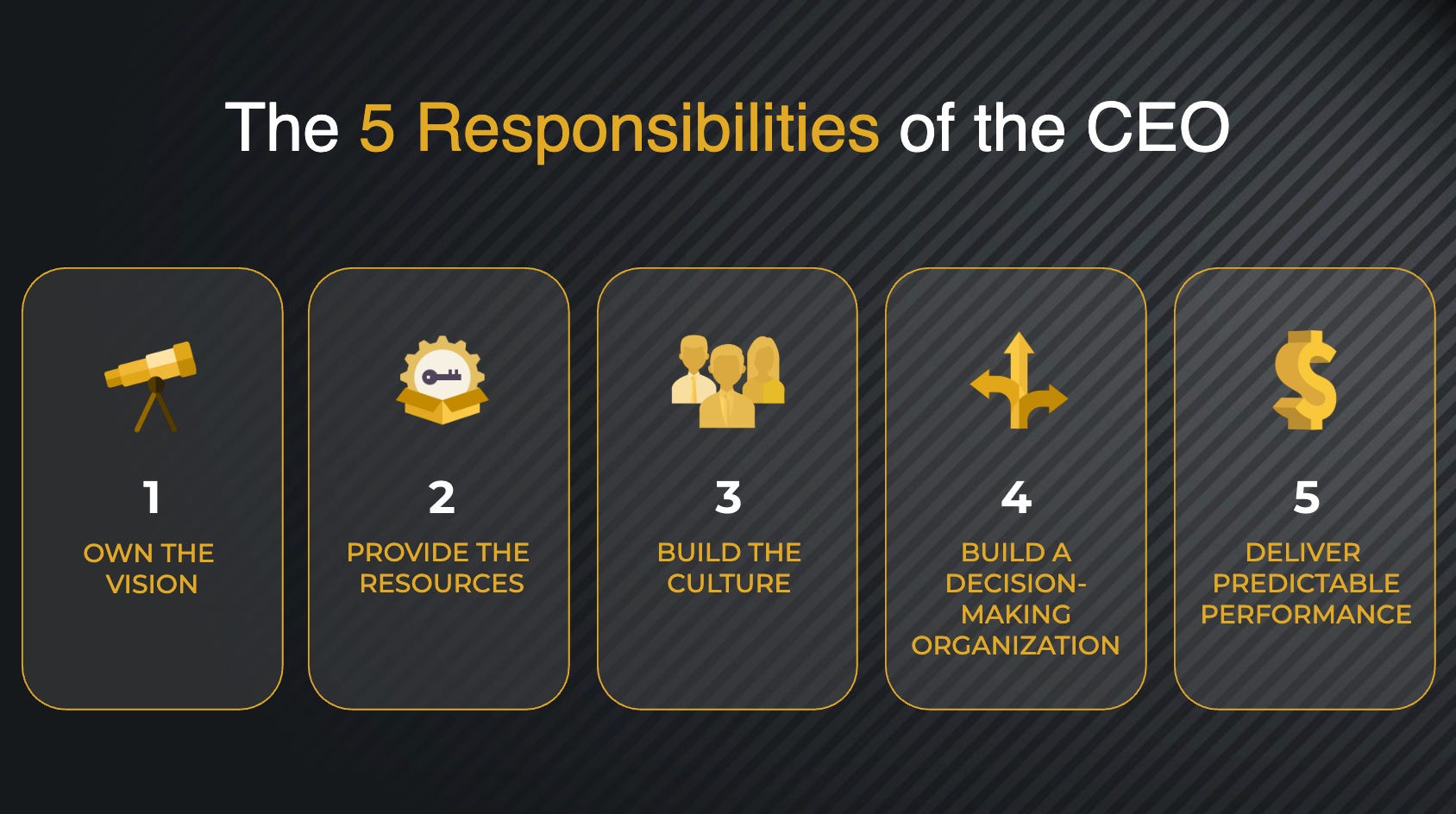
The other four responsibilities still remain with the CEO who works with a dominant founder/owner:
Providing Resources: CEOs secure the talent, capital, and tools to succeed. The founder’s reputation might be a huge boon in hiring and fundraising, or it might complicate those activities. The CEO’s job is to manage these effects and capitalize on the positives.
Building the Culture: A founder’s personality often shapes company culture, but the CEO refines and sustains that culture. At X, for example, Musk’s intensity sets the tone, but the CEO needs to channel that energy into a culture that retains talent and drives results.
Building a Decision-Making Organization: Founders may weigh in on high-level choices, but CEOs own the day-to-day decisions that keep the company moving. This requires navigating the founder’s input while maintaining authority over operations and ensuring the right people are making the right decisions at the right level.
Delivering Performance: Ultimately, CEOs are judged by results. A founder’s involvement doesn’t absolve the CEO of accountability; it raises the bar. Delivering growth, profitability, or impact alongside a figure like Musk is a chance to shine.
If John McEnroe had called me to be his doubles partner, I wouldn't have hesitated because proximity to greatness makes you better. The same principle applies to CEOs who have the opportunity to work with brilliant founders, even when that brilliance comes packaged with downsides.