



EOS (the Entrepreneurial Operating System) is a fantastic playbook. In an ecosystem glutted with advice for business owners, EOS gives founders a structured way to gain traction. Instead of running the company out of their head, they get a cadence and tools that turn vision into execution. This kind of framework is an appreciating asset in the world of LLMs:

But as a framework, EOS also has its limits.
It begins to creak as the company scales past 50 or so employees. But it really starts to break down when the leader is no longer the owner of the business. The fundamental issue is this: EOS is designed for owner-operators (what they call Integrators), not for CEOs with a board and shareholders. These two jobs share a superficial resemblance, but in reality? It’s apples and oranges.
You can see the distinction most clearly in private equity. Say a PE firm buys a founder-led company. The founder is at the same desk, but the job is now a very different one. There are now outside shareholders and a board with real authority. This transition is such a struggle that 65% of PE firms reported CEO turnover during the holding period, with a good chunk of those being unplanned.
Owner-operator → EOS
Board-accountable CEO → ???
Two different jobs
The gulf between owner-operator and board-accountable CEO is wide enough that a good framework needs to account for it.
For one, EOS assumes a single decision maker at the top (the Integrator), while the board-accountable CEO faces a more complex reality. In addition to accountability to the board, they also must build out an executive team and delegate authority and decisions down to them properly.
Here is how I would sketch out the biggest differences between the EOS-style owner-operator and the CEO of a company of 50+ employees:
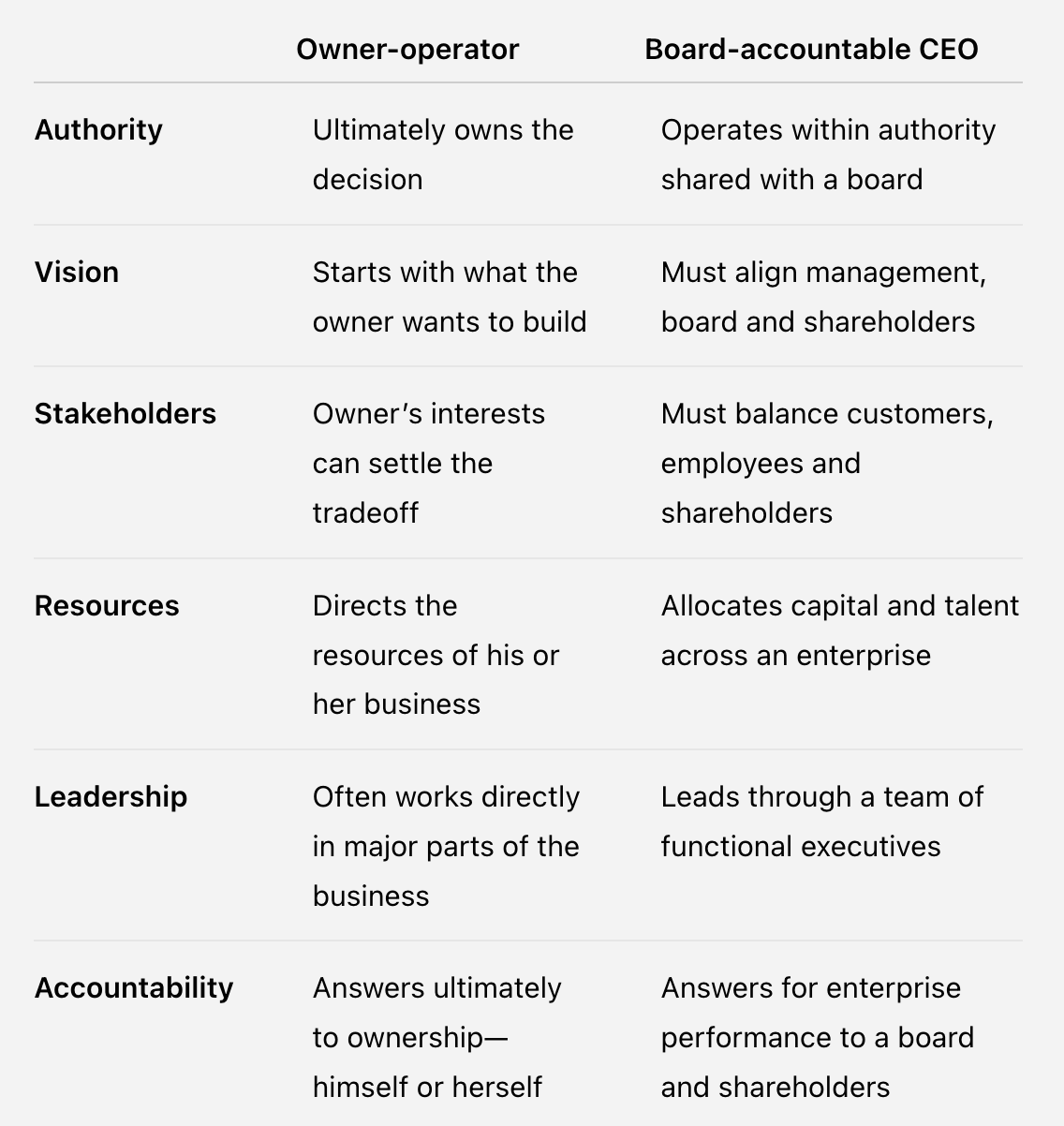
EOS Worldwide itself notes that EOS “was not created for companies with investors and boards of directors.” It says the system can work in that environment, but requires customization. As great as EOS is, I think its strengths lie in helping owner-operators run an entrepreneurial company, while board-accountable CEOs need a system of their own.
An operating system for the chief executive
The Chief Executive Operating System is my take on that system. It is designed from the ground up to put a structure around the CEO who must run a company that has shareholders and a board. It is built for those particular challenges that characterize the CEO job once the company is past 50–100 employees. Those challenges are remarkably persistent all the way up to thousands of employees.
Bottom line:
EOS is an operating system for the owner-operator.
The Chief Executive Operating System is built for the CEO with a board, shareholders, and full executive team.
If you are a CEO with a board, a board member, or a PE firm responsible for portfolio-company leadership, the practical question is: Does the CEO have an operating system built for their real job?
If not, there are a few places to start.
Grab a copy of my book The Chief Executive Operating System for a full presentation of the framework.
Come to my CEO Masterclass this November.
Sign up for ChatCEO to see how we are putting the system into practice with AI.
Email me if you’d like to talk about training or implementation. I would genuinely love to have my inbox flooded with CEOs looking for help.