


The CEO job comes with pressure, isolation, and more than a few sleepless nights. I’ve been there. Which is why I want to give CEOs an always-on portal to practical support. A CEO coach and chief of staff rolled into one. Something that knows all the parts of your business discussed below, but is totally private to you. That’s ChatCEO. Check it out here and let me know if you would like my team to set up your instance.
Before we get to today’s article, a bit of positivity:
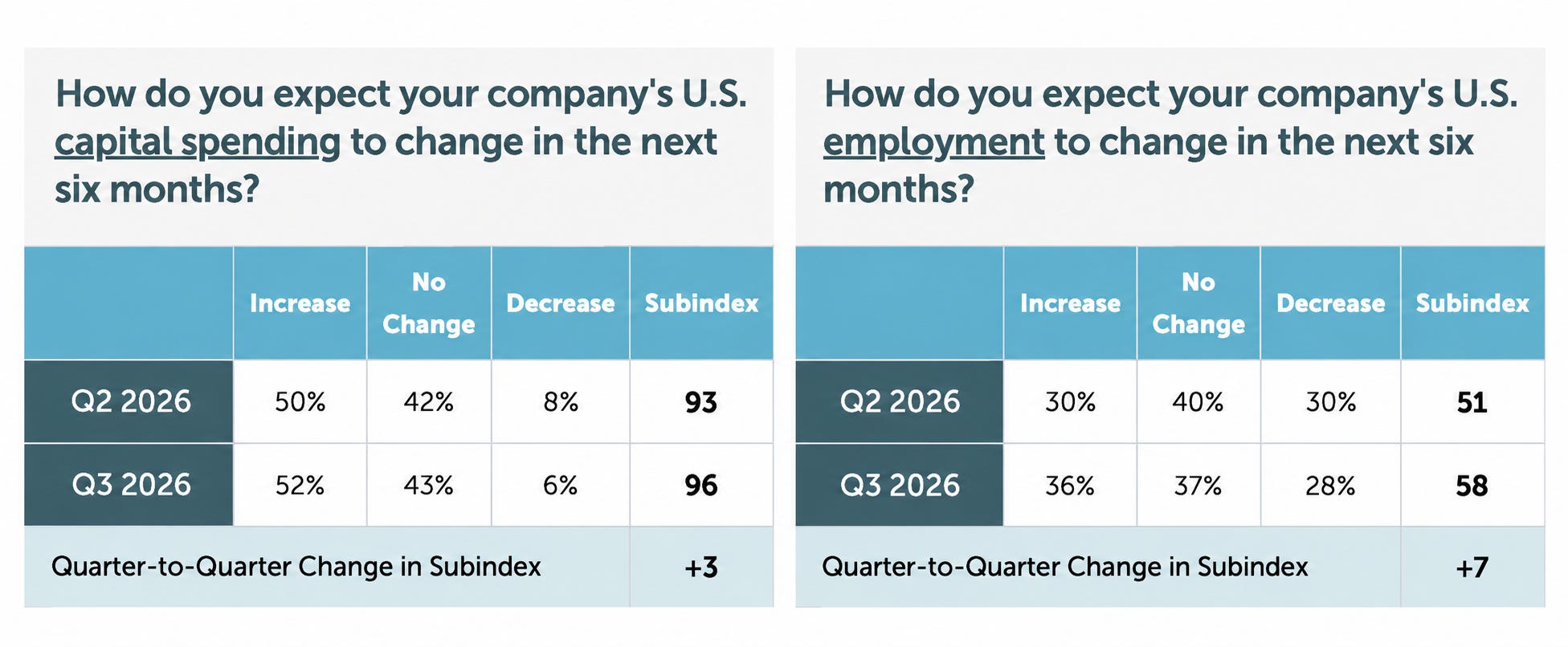
CEOs showed more appetite to invest and hire in Q3 2026.
In the Business Roundtable’s latest CEO Economic Outlook survey, the index ticked in the right direction:
52% of CEOs expected to increase capital spending over the next six months, up from 50% last quarter.
CEOs’ hiring intentions strengthened more sharply: 36% planned to add employees, up from 30%.
The combination suggests that confidence is broadening. It may not be a hiring boom, but executives see reason to expand both capacity and headcount, an encouraging signal for economic growth. And for the economy, it means a firmer foundation—should those plans become action.
AI’s Real Value Is Upstream
Every CEO I talk to has an AI initiative underway.
But once you probe into what has actually changed, the answers get thin. Where has AI improved the bottom line? Where has it created significant value for customers or employees?
The usual explanations for disappointing AI returns focus on the technology: wrong tools, inadequate training, immature capabilities. But I think many CEOs are looking for the payoff in the wrong place.
Most companies are applying AI downstream, helping employees perform individual tasks more efficiently. There is certainly value in drafting emails faster, summarizing meetings, and automating routine work. But the much bigger opportunity is upstream, in the CEO’s strategic work: setting direction, allocating resources, making decisions, and keeping the organization focused on its goals.
It’s the difference between doing more stuff, and doing more of the right stuff.
This is where I believe AI has the potential to create enormous leverage. Properly deployed, it can dramatically extend the CEO’s reach and influence throughout the organization. It can sharpen the CEO’s decision making, improve resource allocation, and build strategic alignment, up, down and across the organization. It can also give the CEO greater visibility into how the company is performing and where intervention is needed.
But to do that upstream stuff well, AI needs a clear understanding of how the company operates. And in many companies, those things aren't nearly as clear or well documented as they should be.
Only 16% of CEOs have strong confidence in measuring AI ROI and have real-time visibility into AI costs and returns. —EY
If you point AI at a company with a clear strategy, defined roles, measurable goals, and disciplined management rhythms, it can make that company faster and sharper.
But if you point it at a company where priorities live in the CEO’s head, accountability is fuzzy, and decisions get remade every week, it will produce more disorder at greater speed and with more confidence.
That is why I believe one of the most important things a CEO can do to prepare for AI is something I have been advocating for decades: make the implicit explicit.
Writing the Unwritten
One of the central ideas I’ve taught CEOs for years is the importance of making the implicit explicit.
A surprising amount of what determines how a company operates is never formally articulated. The CEO may have a clear idea of where the company is headed, how it will win against competitors, and which priorities take precedence over others. But how much of that understanding has actually been put into words, much less written down?
Often, the people who have worked closely with the CEO for years have learned these things through experience. They know what the CEO means, even when the CEO has not been particularly clear. Everyone else has to figure it out.
I call this leadership by ESP. The CEO communicates something broad, people try to infer the intended meaning, and the organization moves forward based on a collection of educated guesses.

This has never been a good way to manage people. And now there is another reason to fix it.
AI can absorb vast amounts of information, reason through problems, and increasingly figure out how to accomplish complex tasks without detailed instructions. But it needs to understand the company it is working for.
Interestingly, as AI becomes more capable, we need to spend less time telling it how to accomplish things. Ethan Mollick makes this point in a recent article about the “Bitter Lesson”: increasingly, AI can figure out how to organize and execute work on its own.
That should sound familiar to anyone who has managed talented executives. The better your people are, the less you need to dictate their methods. But you still need to give them clear objectives, appropriate authority, and enough context to make good decisions.
The same management discipline that allows people to work effectively with greater autonomy is now essential to getting the most out of AI.
Five Things Your AI Needs to Know About Your Company
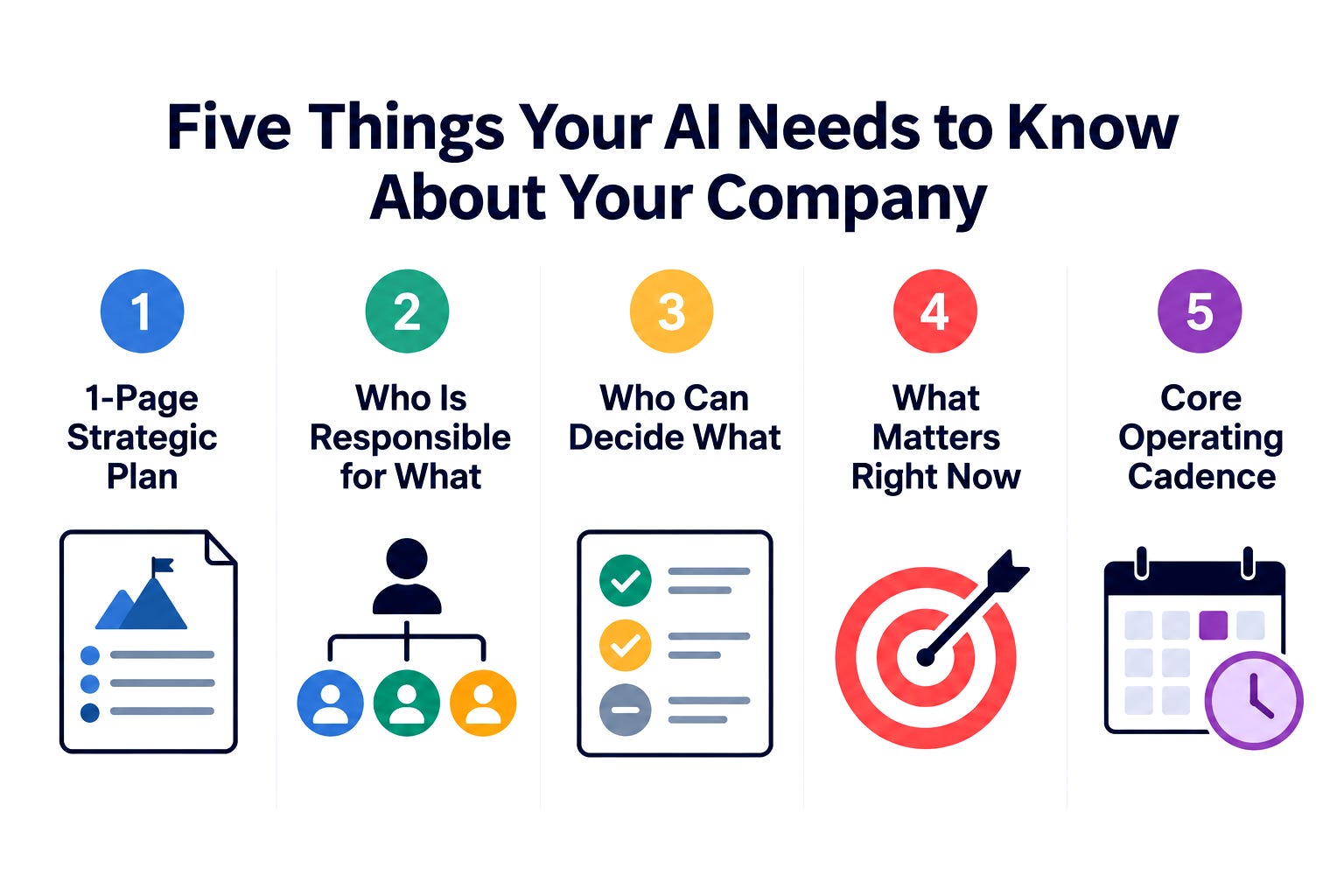
An effective AI system for CEOs needs a sound, differentiated framework for the CEO role (the reason we built ChatCEO around the Chief Executive Operating System), but it also needs an understanding of the company itself. Here are five things I would want any such system to know.1
1. Where you are going
Every company should have a clear, concise strategic plan that articulates its mission, vision, differentiating values, and long-term objectives.
I’ve always advocated getting this onto one page. The discipline of doing so forces the CEO to make choices and gives everyone in the organization a common understanding of where the company is headed.
It also provides essential context for AI.
Suppose you ask AI to evaluate a new market opportunity. Without knowing your strategy, it can assess the market, analyze competitors, and recommend ways to enter. But it has no basis for judging whether that opportunity is right for your company.
With a clear strategic plan, AI can evaluate opportunities against the direction you have established, identify potential conflicts with existing priorities, and help you make decisions that reinforce your competitive position.
2. Who is responsible for what
In my CEO methodology, I describe the structure of a mature company through what I call the Two Triangles.
The first consists of the three core business functions: product, marketing, and sales. The second represents the three constituencies a company must create value for: employees, customers, and shareholders.
Together, these six areas define the essential work of the business. Each needs a clear executive owner, with the CEO occupying the shareholder seat and managing the balance of resources and value creation across all six.
This structure is important context for AI because it establishes who is responsible for which outcomes and how the pieces fit together.
Think of AI as adding new intelligence and capacity to each executive’s area. An AI working with your head of product needs to understand the product strategy and current development priorities. One working with your head of sales needs to understand your sales objectives and how the company competes for customers.
And AI supporting the CEO needs to understand the entire picture, including how decisions in one area affect the others.
Without that understanding, AI may be very effective at optimizing individual activities while doing little to improve the performance of the company as a whole.
3. Who can decide what
Clear ownership is a starting point. The next question is what authority each executive actually has.
I recommend that every executive have an Executive Performance Profile that defines their responsibilities, their authority, and the metrics by which their performance will be judged.
Consider a decision about changing prices. AI can analyze customer data, competitive positioning, and the financial implications of a proposed change. But who has the authority to make that decision? Under what circumstances should the issue be escalated to the CEO? What other parts of the business need to be involved?
These are questions that a well-organized company should already have answered.
Making those answers available to AI allows it to operate within the company’s established management structure, direct recommendations to the appropriate people, and recognize when a decision requires additional input or approval.
4. What matters right now
Your strategic plan establishes where you’re going. Your quarterly goals establish what you’re trying to accomplish next.
Every executive should have a small number of measurable goals, typically three to five, that reflect their contribution to the company’s larger objectives.
These goals give AI something concrete to work toward.
For example, suppose the head of customer success has a quarterly goal to reduce onboarding time while maintaining customer satisfaction. AI can help analyze the existing process, identify opportunities for improvement, and evaluate the results of changes.
Compare that with simply asking the department to find ways to use AI. You will probably get plenty of ideas and experiments, but it will be difficult to know whether any of them are making a meaningful difference.
When AI understands the goals that matter to the business, you can put its capabilities to work directly against those goals.
5. How you keep the company on track
Finally, AI needs to understand how the company manages its ongoing work.
A well-run company has established rhythms for executive meetings, one-on-ones, quarterly planning, performance reviews, and the other recurring activities that keep the organization aligned and accountable.
These routines generate valuable information about the state of the business: current priorities, progress against goals, unresolved problems, decisions made, and commitments that need follow-up.
Imagine an AI system preparing for your weekly executive meeting. With access to the right information, it can identify which goals are at risk, which decisions need attention, and which commitments from previous meetings remain outstanding.
It can also help executives prepare for their one-on-ones, track important decisions, and surface issues before they become serious problems.
The underlying information needs to be captured and kept current. But once it is, AI can become a valuable participant in the ongoing process of keeping the company on track.
Management Discipline for the AI Era
None of these five things should be new to an experienced CEO. They are fundamental elements of running a good company, and I’ve spent much of my career helping CEOs put them in place.
For years, I’ve argued that CEOs need to get this information out of their heads, put it on paper, and communicate it throughout the organization. When people understand the company’s direction, their responsibilities, and the expectations placed on them, they can work more independently and make better decisions.
AI makes that same discipline even more valuable. The information that helps your executives run their departments effectively can now serve as the foundation for an entirely new source of intelligence and productive capacity.
So before investing in another AI initiative, consider a simple question: If a capable new executive joined your company tomorrow, could you hand them a set of documents that clearly explained your strategy, organizational responsibilities, decision rights, current goals, and operating rhythms?
If those documents do not exist, creating them may be the most valuable thing you can do to prepare your company for AI.
Need a hand pulling it all together?
Our 90-day Quick Start draws on our team’s decades of experience with the CEO role to help you put these five fundamentals (and more) in place, document them clearly, and load them into a private AI system built around our proven CEO methodology.
The result is a stronger management foundation and an AI system that understands your company and can help you run it more effectively.
Learn more at xpertloop.ai/operators.
Securely, of course. Another thing I have noticed is a subset of CEOs who are surprisingly nonchalant about feeding critical company data into public-facing AI tools without understanding how that data is handled. The relevant questions include whether inputs are retained, used for model training, or accessible to third parties.