



A long time ago, there was a predictable path to a CEO job at a big corporation.
⮕ Start by distinguishing yourself at a large company. Earn a reputation as a great salesperson, a great marketer, a great operations person, etc.
⮕ Get promoted into middle management, where you show your leadership promise, your loyalty to the firm, your ability to handle organizational politics.
⮕ Catch the eye of executives and start to be groomed (let’s retire that word for this context) prepared for an executive role. You may get put on rotational assignments to diversify your skill set. Maybe you even do a stint in a foreign market, running a sub-unit of the business.
⮕ Secure that C-suite role. CFO or COO, for example, puts you where you want to be.
⮕ Finally you’re in the right spot once the big kahuna announces his/her retirement. When the board starts looking for the successor, there you are, with a resume showing decades of proven service to the firm.
This idealized path is, of course, a relic.
Today, CEO roles are increasingly likely to go to outsiders (or private equity appointees). And when internal succession does happen, it’s often rushed or reactive.
In the recent article “There's a CEO Succession Crisis Brewing” from Business Insider, executive search pro Shawn Cole of Cowen Partners warns about a “collapse of the leadership pipeline” in modern organizations.
The article reveals how companies face a perfect storm when it comes to CEO succession planning. The primary factors that currently make the process difficult are:
Middle management ranks (where many CEOs have traditionally been nurtured) are being slashed, as at Amazon. This leaves boards without a natural starting point for a CEO search. As much as I dislike bureaucracy, strong, efficient middle management has a role in organizations, one of which is building up a leadership pipeline. See:
“The middle-management, VP-level successors are just gutted right now.”
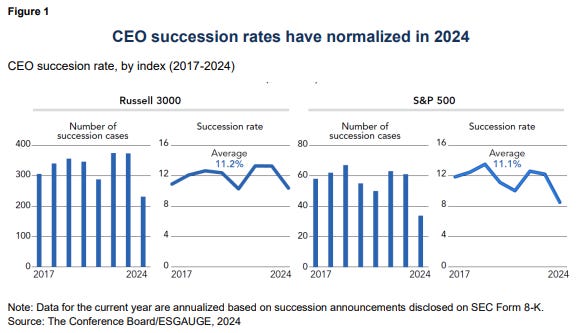
—Shawn ColeTotal CEO turnover is inching back up. The immediate post-pandemic years saw CEO turnover shoot up, partially because firms tended to hold on to CEOs longer than intended during the disruption of 2020–2021. Last year saw CEO successions drop a bit (see figure below), but 2025 is slated to be back up to 14.8% turnover among the S&P 500, per The Conference Board and ESGAUGE. That’s the highest we’ve seen since 2001. The average yearly since then has been 11.3%.
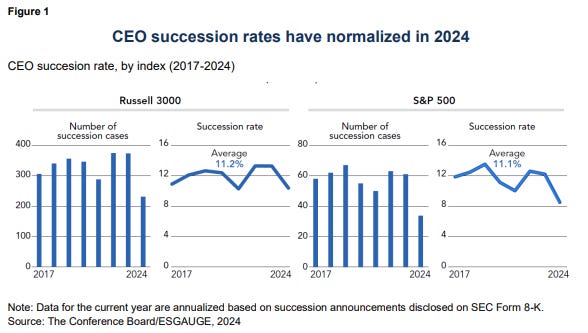
Turnover slowed in 2024 but is inching back up for 2025… Employees move around a lot. Though job-hopping isn’t as prevalent as it once was, people tend to move to new roles every few years, which also makes long-term succession planning difficult. As the BI article notes, boards may be turned off by a CEO candidate with tons of short stints on their resume, even though this is the paradigm for many leaders of the rising generations. Boards may need to recalibrate what a stable resume actually signals.

These aren’t just theoretical issues. As a Financial Times article points out, almost HALF of CEO successions fail after a year and a half:
No company wants to deal with the ramifications of disaster successions such as Microsoft's in 2013 — when Steve Ballmer abruptly announced his departure — or Howard Schultz's repeated return to the helm of Starbucks. One often-cited study shows 40 percent of CEO transitions end in failure within 18 months. Tenure in the post is also declining.
So what now?
Well, boards can’t count on the old model. The days of patiently preparing one or two internal candidates over decades are gone. But treating CEO selection like a last-minute Hail Mary won’t cut it either.
The better move is to get proactive about identifying leadership talent early and giving them a reason to stick around.
That starts with taking CEO development seriously.
Not just generic “leadership training,” but focused preparation for the top job. It’s one of the few roles in a company that still comes with no manual, no structured training path, and almost no honest feedback. Most executives are left to learn by osmosis and guesswork.
Great internal candidates are still one of the best sources of CEO talent, and we shouldn’t assume that ambition alone will keep them in place. They need to see a path forward. One way to do this is to expose them to the unique demands of the CEO role.
Here’s what that can look like:
Don’t just promote. Prepare. Identify your most promising executives now, not later. Look beyond functional success and assess whether they can handle what the CEO role actually requires: system-level thinking, capital allocation, cultural stewardship, communication under pressure, etc. Most of these aren’t intuitive skills, but they’re teachable if you’re intentional.
Make CEO-specific training part of your retention strategy. Some firms have institutionalized CEO development by giving rising leaders broad operational exposure, mentorship from senior executives, and structured succession paths, as seen at companies like P&G, Cintas, and across Blackstone’s portfolio. They may not be able to count on having decades to do it, but this type of tangible preparation is still worth the effort. When you invest in training that gives talented leaders a system for understanding the CEO role (like the aforementioned programs or my CEO Masterclass), it signals long-term trust. It also gives rising leaders a reason to stay. Organizations that do this well keep their bench stronger for longer. Let your high-potentials in the pipeline know that you think they could be “CEO material” in the future while being careful not to make promises you can’t keep.

Watch a good FT on CEO turnover and succession: