


Welcome back to Managing the Future.
If you’re new, welcome. On this Substack I look at topics of interest to CEOs and boards, which increasingly intersects with AI.
To any currently serving CEOs:
Please reach out if you’re experiencing any of the common struggles of the job. Pressure. Isolation. Feeling like you’re turning the ship’s wheel… but the ship just isn’t turning. I would love to hear what is on your mind and see how I can help.
For most of human history, we have treated mathematical ability as one of the clearest signals of intelligence.
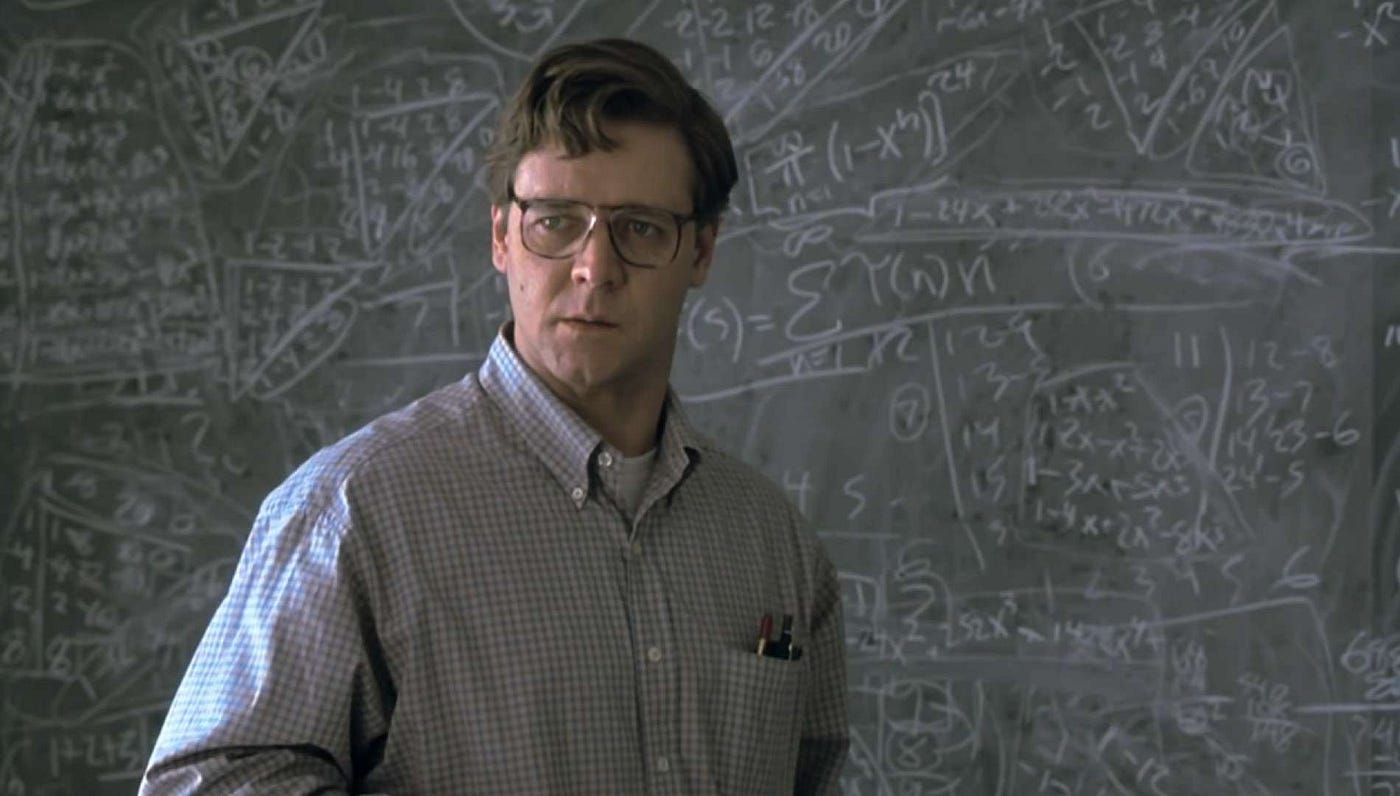
Picture a brilliant person at work. What do you see? Probably a chalkboard filled with arcane, scribbled math equations. Something like in A Beautiful Mind or Good Will Hunting.
These people who can manipulate complex equations, construct proofs, recognize abstract patterns, and reason logically through difficult problems are obviously doing something most people could not do. The great mathematicians were therefore regarded as some of the smartest people in society.
Today, that image may be due for an update. Math is still hard, but now everyone has access to tools that can do astoundingly complex mathematics work for us.
In 2025, a version of Google’s Gemini solved five of six problems at the International Mathematical Olympiad, earning a gold-medal-level score. While that achievement doesn’t make mathematicians obsolete, it does make me wonder whether the ability to reason through difficult abstractions will remain our most persuasive proxy for intelligence.
Jensen Huang recently made waves with comments along these lines on The Ezra Klein Show.
“Basic math is being forgotten. Does it matter?”
When the question was put back to him by Klein, he said:
“Yeah. I don’t think it does.”
The Economics of Intelligence
Lots of people disagreed with Huang, but he raises a pertinent question about what happens when abilities we once considered rare become abundant.
Technology has done this before. Calculators reduced the value of doing long calculations by hand. Spreadsheets reduced the value of constructing financial models manually. Search engines reduced the value of simply remembering large amounts of information.
AI is now moving higher up the intellectual stack. It is making sophisticated analysis cheaper and more widely available.
What we regard as intelligence is partly a function of scarcity. Mathematical ability has historically carried such prestige because it is difficult and relatively rare among humans. If machines can perform more of that work better than we can, the skill may become less useful as a proxy for who is smartest.
Try ChatCEO, the first AI built for the chief executive officer.

What CEOs Already Know
The business world offers a useful preview of what that shift might look like.
A good CEO is not supposed to be the best analyst, salesperson, marketer, engineer, or accountant in the company. In fact, one of the CEO’s most important skills is recognizing people who know more than he does and putting their expertise to use.
Nor should the CEO personally analyze every piece of data coming out of the business. That is the job of the executives responsible for those areas. The CEO has a different job: to synthesize information across functions, balance competing interests, see the whole system, set direction, and make decisions.
In other words, the CEO’s intelligence has always depended less on personally producing every answer than on knowing what to do with the answers other people produce. AI pushes more of us in that direction.
The hardest questions a CEO faces are rarely mathematical:
Should we enter this market?
Should we fire an executive who has been with us for ten years?
Should we abandon a product in which we have invested millions of dollars?
How do we persuade the organization to follow a new strategy?
How do we get six capable executives with different interests and personalities to agree on a course of action?
AI can already help enormously with the analytical side of these questions. It can examine the market, model scenarios, identify risks, challenge assumptions, and propose alternatives.
But none of those activities settles the question. Someone still has to decide which considerations matter most, reconcile conflicting information, understand the people involved, and act under uncertainty.
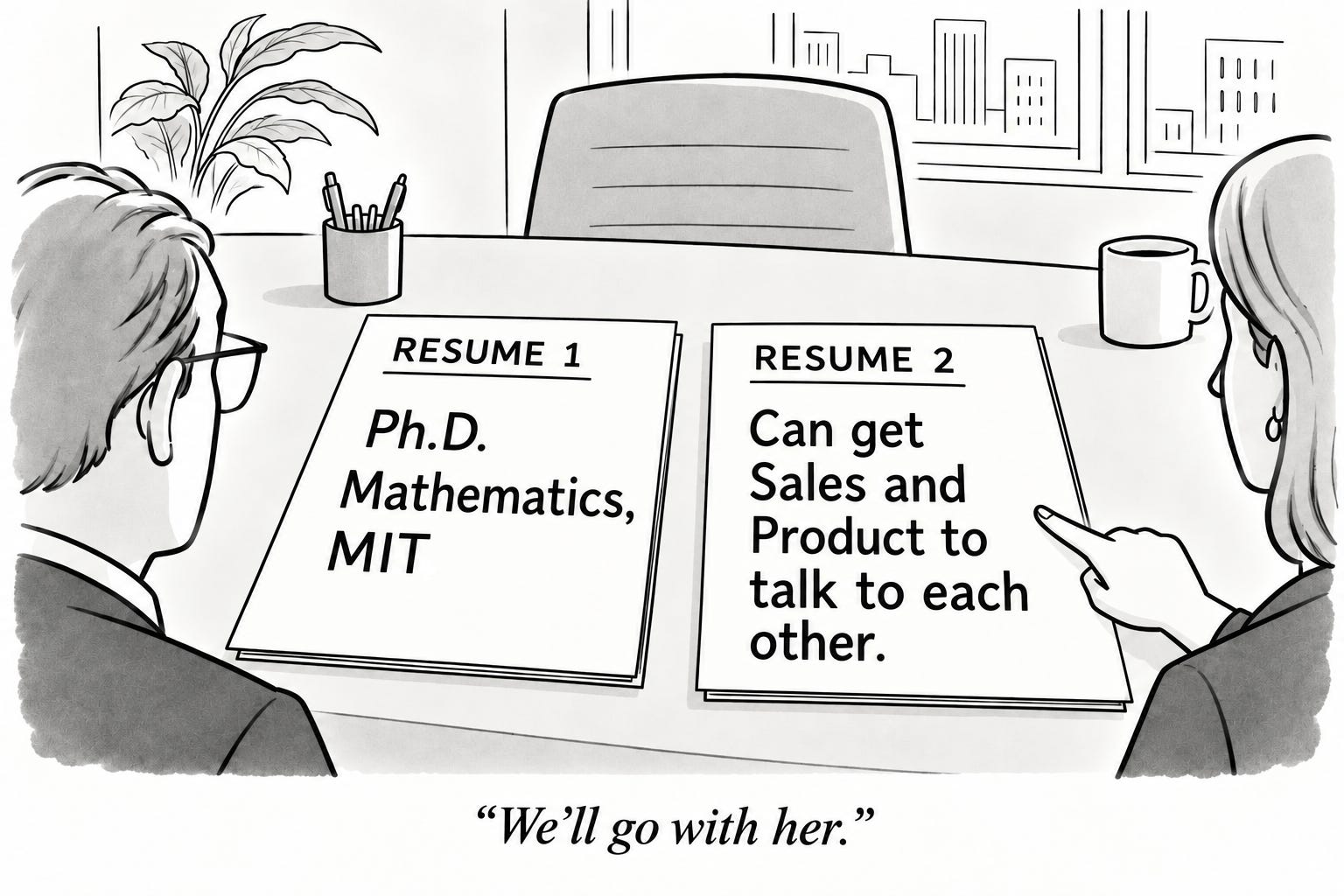
That should also change how leaders think about talent. If analytical horsepower becomes abundant, the scarce forms of intelligence inside an organization may increasingly be the ability to frame the right problem, exercise judgment, connect ideas across domains, recognize good work, understand people, and turn knowledge into action.
Those are the capabilities CEOs should be looking for and developing.
What the Question Is Now
The same logic may eventually affect how we think about education and even national competitiveness. We still need people who understand mathematics. But the strategic advantage may shift as extraordinary mathematical capability becomes available almost everywhere.
The question has traditionally been:
Who can do the math?
Increasingly, it may become:
Who can use the machines that do the math to accomplish something important?
That is a much bigger change than simply giving people a better calculator.
The scarce capability will increasingly be not producing the technically correct answer, but applying judgment to it: What question should we be asking? Which answers matter? How does this fit with what we know from other domains? What tradeoffs are we willing to make? How will human beings respond?
The people who can do that kind of work well may be the savants of the coming era.