
How CEOs Fail the Disruption Test
An old tale has fresh resonance for today

Everyone knows the story of Kodak because it’s so damn ironic.
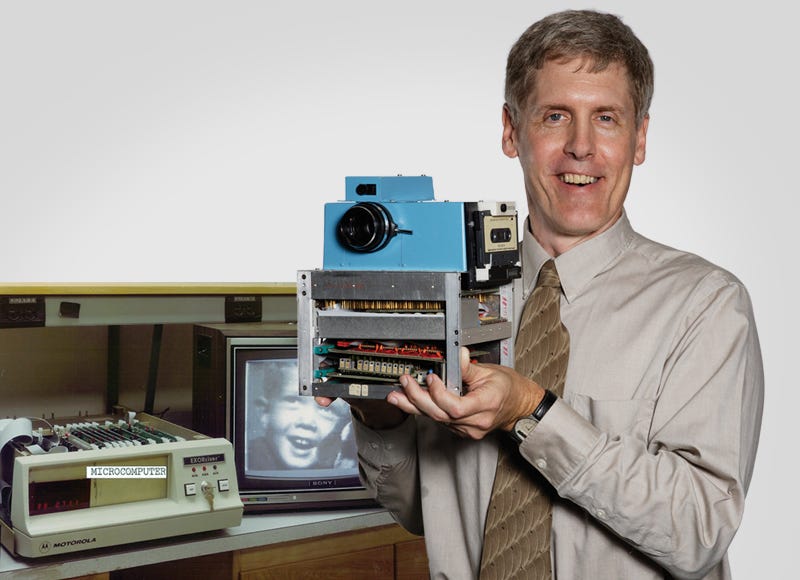
It was one of Kodak’s own employees who invented and pitched the first digital camera to leadership, in 1975. The inventor, Steve Sasson, was told by higher-ups, “That’s cute… but don’t tell anyone.”
Kodak failed to move on the technology because it didn’t want to rock the boat of its own thriving business. Of course, as the tech progressed, Kodak eventually wised up. It launched a digital camera line and even bought the online photo-sharing service Ofoto in 2001.
Alas… too little too late.
Kodak had tried to innovate around the edges of a business model that needed a total overhaul.
In this article, rather than retell this favorite corporate campfire tale in the usual way, I want to reexamine what happened in Kodak in light of a simple theory that I have come to articulate like this:
Companies survive or fail based on whether they can deliver consistent value to three groups simultaneously:
• customers
• employees
• shareholders.
The Triangle of Tension

I constantly use this framework in my work with CEOs. Anytime a CEO or company is struggling, it’s usually because they have over- or under-emphasized one of the three groups (customers, employee, or shareholders) that form a triangle at the center of their business.
As a result, the triangle goes wonky, with one group having won the constant battle for resources and attention. No business can succeed for long that way.
And this battle between groups is constant: Shareholders want more profits, customers want low prices for products they love, and employees want stability and good pay. The CEO’s job is to manage this triangle of tension vigilantly, making wise, continuous tradeoffs between the groups.
I was thinking about how Kodak failed to manage these three groups, and it struck me that delivering value to them is even tougher than usual during a major disruption.
As digital cameras and smartphones hit Kodak’s market like one asteroid after another, the company’s fundamental value proposition to customers, to employees, and to shareholders had to change, fast. Unfortunately, Kodak couldn’t manage it.
Managing the tension between the three groups is hard enough in stable times (“What are those?” I hear you asking.) In times of massive disruption, the CEO must manage the tensions between the groups even as they redefine the value each group gets. That’s the test Kodak ultimately failed.
Let’s look at how that played out with each group, starting with shareholders.
The Kodak Shareholder: “Profits, please.”
In a large, established company, shareholder expectations feel like the ultimate pressure. The shareholders want consistent profits, each and every quarter. In a company like 1990s Kodak, the shareholders were not speculators but institutional investors and retirees who owned the stock for its earnings, its dividends, and its predictable cash flows. And Kodak’s film business was extraordinarily profitable. At its peak, margins ran north of 60% on film. Every dollar diverted from that cash engine into an unproven digital business was a dollar taken from shareholder returns.
The disruption around digital photography meant that Kodak’s shareholders could no longer expect those profits in perpetuity. If the company was to survive, it would need to shift its priority away from profitability and toward growth in the new market.
That would require Kodak’s shareholders to accept the kind of value the investors in a startup are usually after: growth now, even if it means losses, in the hope of big profitability later. Venture capitalists and founders expect to lose money in the early days. They plan for it. Their entire financial model is built around spending aggressively to capture a new market, with profits arriving later if the bet pays off. The value delivered to the shareholder corner of the triangle is oriented around growth, not yield.
Kodak was doing exactly what its shareholders wanted it to do, extracting maximum value from the film business. But that very success made the transition to digital harder. It required a CEO willing to tell shareholders something they did not want to hear, and to make the case for long-term value creation over short-term yield.
The Friedman doctrine (the idea that shareholder returns are the overriding obligation of management) is seductive in stable times, but a trap in times of disruption.
The Kodak Customer: “We like the current product, thanks.”
Let’s move to the next point on Kodak’s triangle of tension: its customers. For the better part of a century, Kodak’s consumers, photo labs, and retail partners loved film. They understood it and relied on it. They weren’t asking for digital. When Kodak conducted market research in the 1980s, its customers consistently said they valued print photographs, the tangible artifact you could hold in your hand and put in an album.
The customers who would eventually want digital cameras were, for the most part, not yet Kodak’s customers. They were younger, more tech-savvy, and had different expectations about what a photograph was for. Serving this future customer meant, in practical terms, deprioritizing the expressed preferences of the current one.
This is the insight at the heart of Clayton Christensen’s “innovator’s dilemma”: your best customers are the worst source of strategic guidance during a period of technological disruption. They will tell you, with absolute sincerity, to keep doing what you are already doing. They will reward you for incremental improvements and punish you for radical departures.
The CEO must have the vision and conviction to redefine what value means for this corner of the triangle, understanding that the long-term health of the customer relationship depends on changes the current customer will resist. Kodak focused on delivering a dying version of value to its customers while faster movers got in on the ground floor of the technology that would soon take over the world. By not redefining customer value quickly enough, Kodak lost.
The Kodak Employee: “Let’s keep things the way they are.”
The third corner of the triangle is the most viscerally human and, in some ways, the most difficult for the CEO to manage on a personal level.
Kodak at its peak employed over 145,000 people, the vast majority of whom worked in businesses tied to film: manufacturing, chemical processing, distribution, retail partnerships. They were real people in Rochester, New York, whose mortgages and retirement plans depended on the continued health of the film business.
Asking these employees to support a digital transition felt a lot like asking them to work toward their own obsolescence (a way some of your employees feel about your AI initiatives right now). A digital Kodak would not need chemical engineers, film coating specialists, or the massive manufacturing infrastructure that employed thousands. Even with generous retraining programs, the math would likely mean different people.
The film division at Kodak, which generated the revenue and employed the most people, had enormous organizational power. The digital division was small, unproven, and a net drain on resources. In any internal resource allocation battle, the film division would always win. Those employees wanted to keep their jobs, and the organization’s incentive structure told them to protect the profitable core.
Here the triangle model offers a difficult, nuanced truth. A CEO’s obligation to employees is not to preserve any particular set of jobs indefinitely. It is to build and maintain an organization where people derive genuine value from the opportunity the employer provides. That may require painful changes. It could be retraining and reskilling, or it could be changing the composition of the workforce. A CEO who tries to placate the most entrenched voices in the employee base, or who cannot make hard employment choices that allow the business to survive, is not providing sustained value to the employee corner of the triangle. As Kodak demonstrated, the result of that kind of accommodation is that those employees end up without jobs anyway, because the business fails.
The Core Problem
Kodak’s leadership saw the digital future coming, but it could not rethink how it delivered value to the three core groups it served.
A startup has the advantage of building its triangle from scratch. A legacy enterprise, suddenly forced to become startup-like, will usually fail. It needs to reconfigure a triangle that already has mass, momentum, and internal constituencies fighting to preserve it.
This pattern recurs with depressing regularity. Xerox. Nokia. Blockbuster. In each case, the company’s leaders were caught between the legitimate, competing demands of three groups whose interests had become irreconcilable under the existing model.
What Can a CEO Do?
What does not work in these situation is making incremental moves that protect the current triangle while reassuring each group that their interests are safe.
The better path is to be explicit and deliberate about what the disruption actually requires of each of the three groups. This is as much a communication problem as a decision-making problem.
Shareholders need to understand why returns will compress during a period of reinvention, and why that compression is the right trade for long-term value.
Current customers need to understand why the product they love is evolving in directions they did not ask for. New customers need to see the value quickly.
Employees need to understand why the skills and structures that built the company may not be the ones that sustain it.
None of those conversations are comfortable, but if you don’t have them, you’re not managing the triangle… the triangle is managing you.


