



Would the people in your company think of you as a “moral” leader?
This may seem like a grandiose idea. Isn’t it always the leaders who work the hardest to portray themselves as “moral” who end up turning out to be anything but?
I sympathize with that view. But when moral leadership shows up in concrete actions observed by your organization rather than as mere words and posturing, it actually is important. It has measurable effects.
This morning, I read the 2025 State of Moral Leadership in Business report from the HOW Institute for Society. I found it commendable that HOW gauges moral leadership by how often employees reported seeing leaders display very specific actions. One could argue about which actions constitute moral leadership, but HOW picked ones that few would disagree with. They include:
Upholding ethical standards when it is difficult
Rigorously seeking the truth in nuanced situations
Seeing the humanity in other people, including understanding their hopes and aspirations
Demonstrating humility, including by admitting mistakes
Acting with courage by stating uncomfortable truths
How often would you guess people see their CEO exhibiting such behaviors? According the report, not very often...
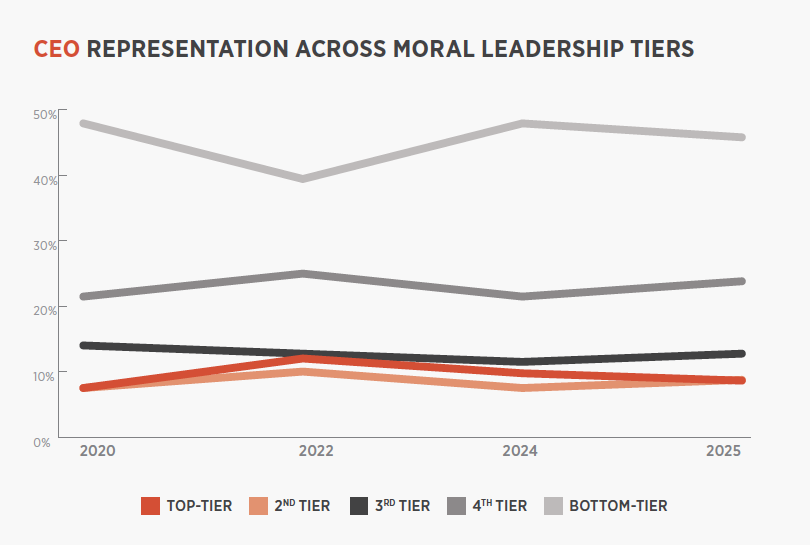
That top gray line is the bottom tier of moral leadership, which means that employees witnessed these CEOs exhibiting moral leadership behaviors none of the time. As in not at all. That’s almost half of all CEOs in the sample.
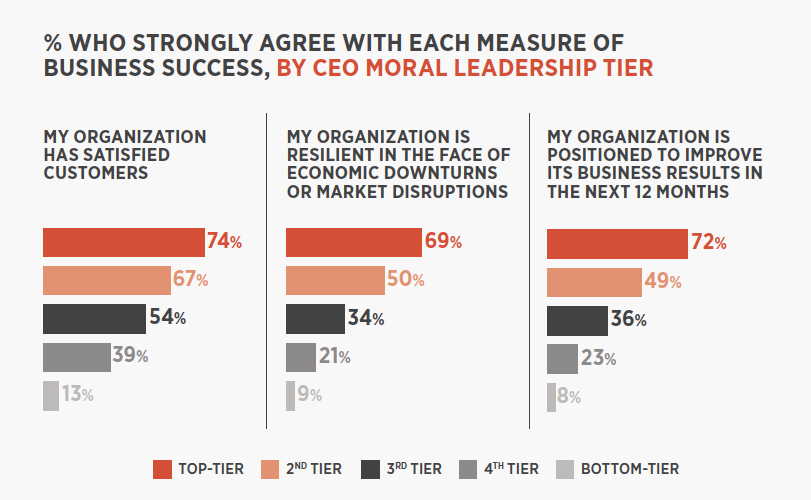
This isn’t merely an academic distinction. HOW breaks down how organizations fare based on the CEO’s moral leadership tier. See below, where companies with top-tier CEOs report happier customers, more resilience, and a more optimistic business outlook:
What I found even more interesting were the correlations between moral CEOs and positive organizational dynamics you might not think of as connected to morality.
For example, organizations with moral CEOs tend to have:
Less bureaucracy
Less micromanagement
Better cross-department dialogue (i.e., fewer silos)
Why would an upstanding, ethical CEO be associated with these things? That’s probably a question for another day, but I do find it suggestive. It’s worth thinking about the fact that leaders who aren’t humble, transparent, courageous, etc. seem more likely to foster cultures where employees are less free to achieve outcomes on their own.
What does this mean for you as CEO? Two things to keep in mind:
One, moral leadership is the presence of positive behaviors, not just the absence of bad behaviors. I think HOW’s methodology is right to show that CEOs drive positive outcomes though proactively demonstrating their ethical standards. That could be admitting you got something wrong, explaining why and how you made a hard decision, recognizing a difficult tradeoff the organization is making, or recognizing the unique strengths and personalities of your team instead of treating them all the same. Those are things that stick with people. It’s very different from priding yourself on NOT being unethical, on NOT yelling at people, on NOT being unfair. Those things are standard expectations. You don’t get credit for them.
The second point is related: leadership is in the eye of the beholder. People have to see you doing the right things. You could, in the privacy of your own mind, have all the uplifting and magnanimous and ethical thoughts in the world—but people need to see the proof for it to matter. Much of this comes down to being communicative and transparent. Why did you make that decision? How are you thinking about employees’ and customers’ well-being, in addition to that of shareholders? Why did the company miss that goal, and what’s going to be done about it?
I like the idea of regarding morality not as an elusive metaphysical dynamic of a leader but as the actions that employees see the leader taking in the course of running the company. Those are the proof points we can, and should, work on each day.