



When we say that a person is “good at business,” what do we mean?
Maybe someone is good at business because they know how to sell. Sales certainly matter. But plenty of companies have generated impressive sales while destroying themselves in the process. If every dollar of revenue costs you two dollars to produce, more sales may just get you to bankruptcy faster.
A related answer is that being good at business means making a lot of money. That doesn’t quite work either. A company can generate enormous profits for a period and then lose them just as quickly. The opposite is true too: Some of the most successful companies in history (like Amazon and Uber) spent years losing money while they built something extremely valuable. We are seeing versions of the same phenomenon today as companies spend extraordinary amounts of money building the infrastructure for AI.
Another thing that springs to mind when we think of a typical “good businessperson” is risk. Maybe being good at business means high risk tolerance paired with good judgment. Entrepreneurs certainly need those skills. But a professional gambler also needs to understand risk and reward. That does not make gambling and business the same discipline.
So what are we actually trying to get good at?
The Purpose of Business
I begin every CEO Masterclass I teach with a fill-in-the-blank exercise:
LAW IS TO JUSTICE AS MEDICINE IS TO HEALTH, AS BUSINESS IS TO ________.
The answer is value.
The formulation comes from business scholars Thomas Donaldson and James P. Walsh, and I think it gets to something fundamental. I call it the Zeroth Law of Business:
THE PURPOSE OF A BUSINESS
IS TO CREATE AND EXCHANGE VALUE.
That gives us a much better definition of what it means to be good at business. To be good at business is to become exceptionally good at creating and exchanging value.
The harder question is: value for whom?
Value for Whom?
For much of modern business history, the easiest answer has been the shareholder.
Milton Friedman gave the most famous articulation of this idea when he argued that the social responsibility of business is to increase its profits. Versions of that principle became deeply embedded in corporate thinking. If shareholders own the company, then the CEO’s job must ultimately be to maximize the value delivered to them.
There is an appealing simplicity to that idea. Money is measurable. Share price is measurable. Profit is measurable. You can put them on a spreadsheet and determine whether they went up or down.
But businesses do not create value for shareholders in isolation. Every business, from a lemonade stand to a global enterprise, creates value for exactly three primary groups:
Customers exchange money for products and services.
Employees exchange their time, talent, and energy for compensation and much else besides.
Shareholders, the owners, exchange their capital and their appetite for risk in return for a claim on the value the business creates.
In the lemonade stand, one ten-year-old may play multiple roles at once: she does the work, owns the enterprise, and may even consume some of the product herself. As businesses grow, those roles separate, and the interesting problems begin.
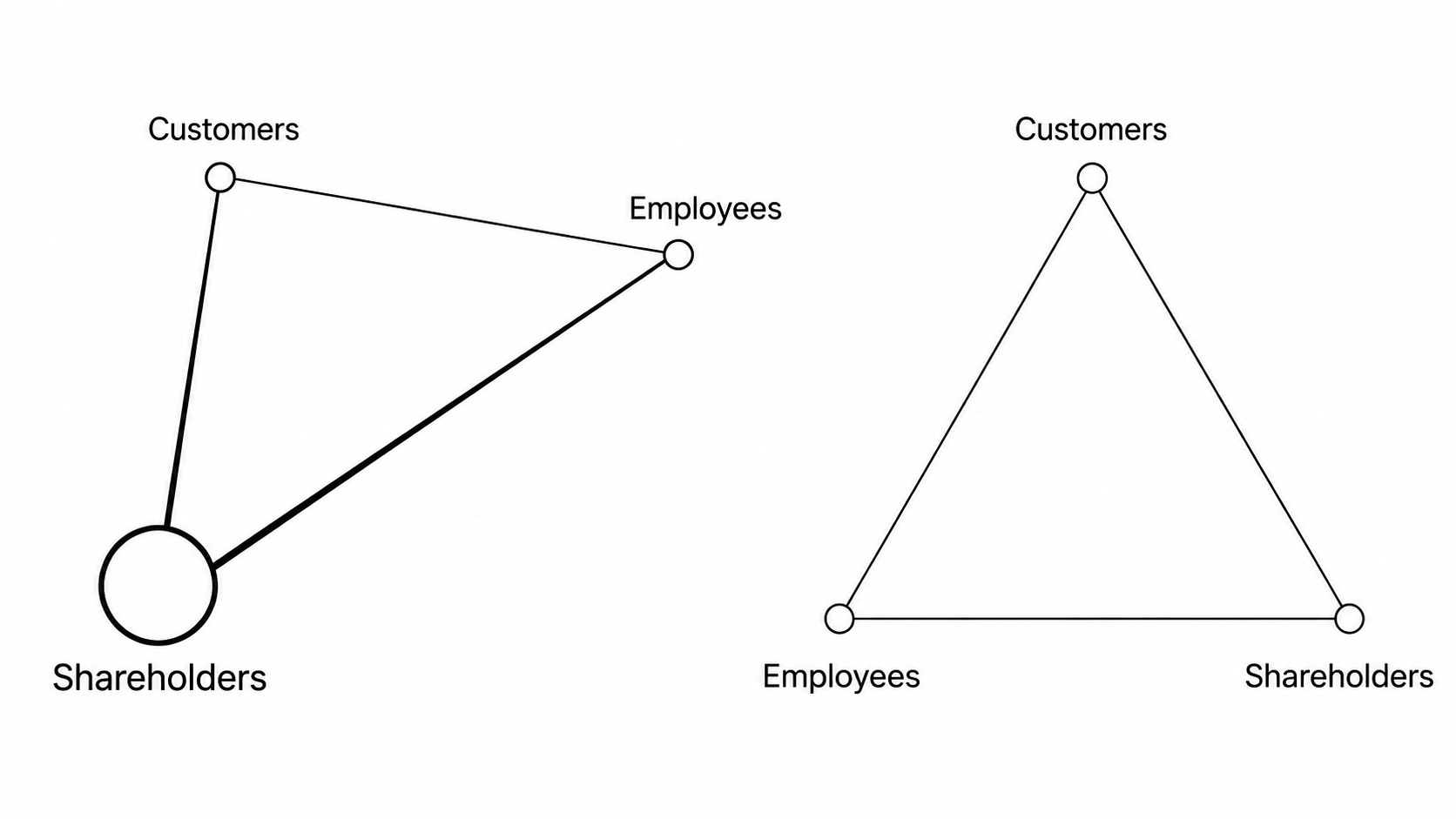
The Three-Way Exchange
The mistake is to assume that these three groups are fighting over a fixed pool of value.
If you believe that, business becomes a constant exercise in choosing winners and losers. Raise prices to benefit shareholders. Suppress wages to protect margins. Increase compensation and accept lower profits. Spend more on the customer experience and disappoint investors.
Sometimes there really are tradeoffs. CEOs make them every day. But the best businesses do something more interesting: They find ways to increase the total amount of value being created.
A better product can make customers happier while increasing demand and improving shareholder returns. Better tools can make employees more productive while making their jobs easier. A stronger culture can improve retention, customer service, and profitability simultaneously.
That is the real art of business: providing value to each constituency without simply taking it away from another.
You might think of it as value arbitrage. The business is constantly searching for opportunities where one action creates disproportionate benefits across the system. The best decisions do not merely redistribute value. They create more of it.
What Good Businesspeople Actually Do
This changes how I think about someone who is “good at business.”
It is not necessarily the person who can sell anything. It is not the person who squeezes the highest quarterly margin out of an organization. It is not even the person who makes the boldest bets.
A great businessperson understands the system of exchanges that makes an enterprise possible. They recognize where value is being created, where it is being destroyed, and where an apparent conflict between customers, employees, and shareholders can be turned into a mutually beneficial exchange.
Revenue, profit, growth, and shareholder return still matter. They are essential signals. But they are not the purpose itself. The purpose is value. The better you become at creating more of it for all three groups, the better you are at business.