


Happy Monday. Hope you had a safe and happy Halloween. Before we get to today’s article, I have an interview to share with you, including a very flattering thumbnail image 😂. Many thanks to Sunny for chatting with me about AI, CEOs, and leadership.
If you’re a CEO and want to give yourself the best chance of success in a notoriously difficult, high-pressure role, visit us at ChatCEO.co. We’d love to set you up with your own AI-powered operating system.
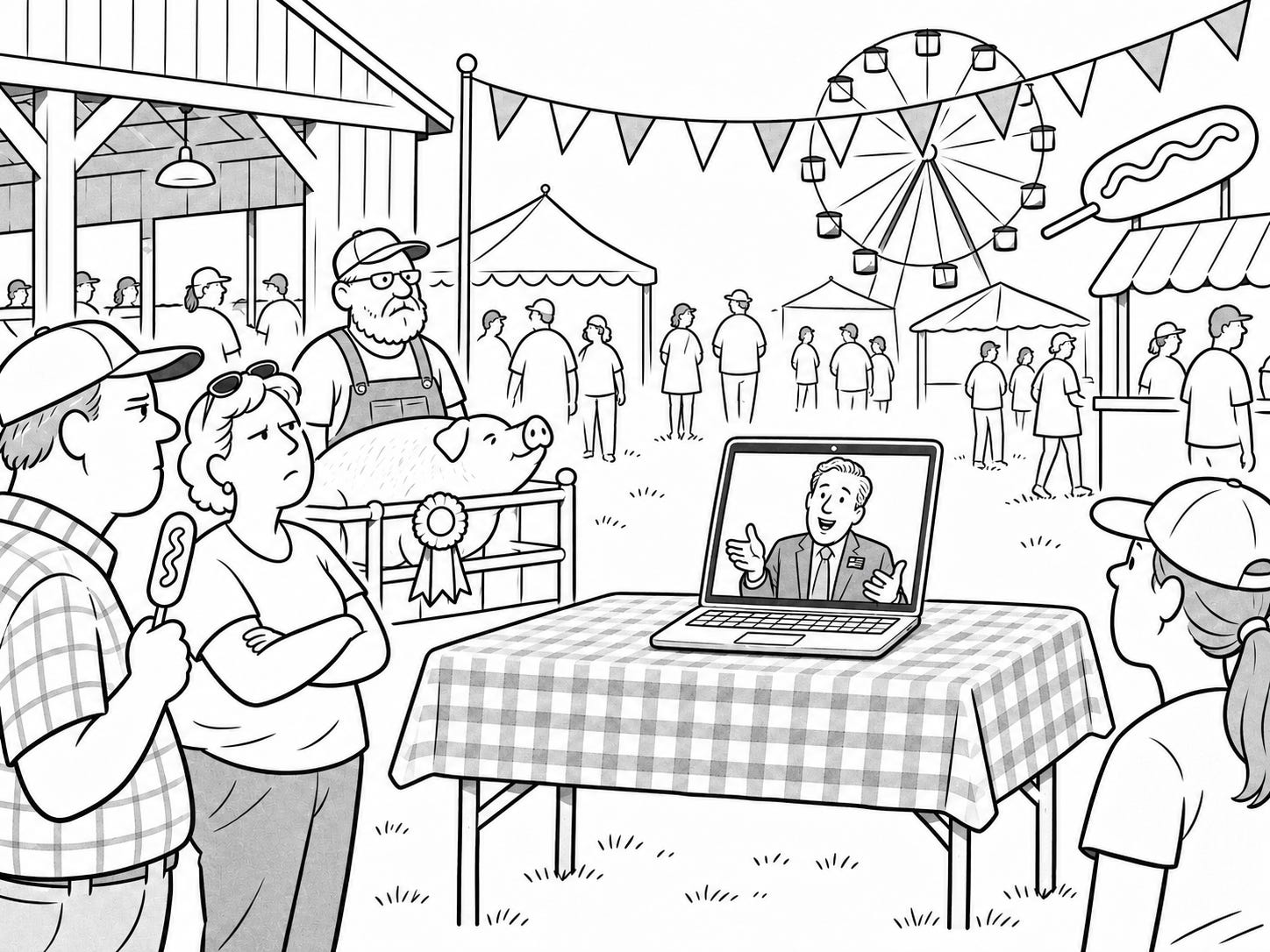
Thank goodness the end is in sight. Soon the political ads will end and we can go back to the normal lineup of erectile dysfunction and weight loss pills. There is, however, one part of the election process that is interesting for CEOs. Most candidates spend months doing something that makes no sense on a spreadsheet: They fly across the country to stand in high school gyms, county fairgrounds and diner booths, speaking to a few hundred people at a time. A single video call could reach more voters in one evening than a week of rallies, at a fraction of the cost and with none of the jet lag.
No serious campaign takes that route consistently. Candidates still work the rope line, still eat the pork chop on a stick at the Iowa State Fair, still care about the size of the crowd. Politicians understand something many executives forgot during the remote-work years: a rally is not an informational event. Nobody leaves the event knowing more policy than they could have read on the website. They leave having seen the candidate in person, and having decided whether to believe them.
CEOs face the same problem every day. Many have drawn the wrong conclusion from the ease and ubiquity of video, thinking of it as more efficient. It is not, and it is also very bad at the one thing a CEO most needs to do: persuade people to change.
For CEOs navigating an increasingly remote workplace, I think there are five principles worth keeping in mind.
1. Communication is the CEO’s ultimate skill. It is best done in person.
I have long believed that communication is the most fundamental skill a CEO can develop. It is the skill on which nearly everything else in the job depends.
Think about it. The CEO doesn’t manufacture the product, fulfill the orders or perform most of the activities that create value for the company. The CEO’s job is to align people around a strategy, balance competing priorities, anticipate problems, motivate employees and make sure everyone is moving in the same direction. Nearly all of that is accomplished through communication.
Other executives have the advantage of speaking to audiences with similar backgrounds and responsibilities. The CFO talks to finance people. The head of sales talks to salespeople. The CEO has to reach everyone, from the executive team to the newest employee, across every function, personality type and level of experience.
Consider a company town hall. Some employees want to understand the logic of the strategy. Others want to know how it affects their jobs, whether the numbers add up, or whether this latest initiative will last longer than the last one. A CEO has to reach all of them, often in the same conversation.
That is difficult enough in person. Over video, it becomes considerably harder. When I’m speaking to a room, I can usually tell when I’ve lost someone. I can see the skeptical expressions and notice when people exchange glances, or whatever the signals are — and then I can adjust my message accordingly. Maybe I need to slow down, offer an example or address a concern before moving on. That feedback is an essential part of communication. (It’s why we always do CEO Masterclasses in person.)
On Zoom, half the cameras may be off and the rest of the audience is reduced to thumbnails. The people with the strongest objections may be the least likely to speak up. You can finish a presentation believing you’ve made your point without realizing how many people remain unconvinced.
I’ve written before about Leadership by ESP, the CEO who assumes the organization knows what he is thinking because it is so clear in his own head. Remote communication makes that failure even easier. A CEO who can’t see the audience can’t see the confusion either.

2. It’s really difficult to build trust over a screen.
One of the CEO’s biggest challenges is getting people to do things differently. A new strategy, a reorganization, a different approach to serving customers or managing performance: none of these succeed unless people change their behavior.
Yet people are naturally resistant to change, particularly when the current approach is familiar and seems to be working. You can make a perfectly logical case for doing something differently and still struggle to get anyone to do it.
That’s where trust comes in. Employees have to believe that you understand the business, that you’re being straight with them and that the changes you’re asking them to make are worth the effort. Building that trust is much harder when most of your interactions take place on a screen.

There was a management doctrine that became popular decades ago called Management by Walking (or Wandering) Around. The idea, associated with Hewlett-Packard and later popularized by Tom Peters, was simple: managers should spend time among their employees, observing the work, listening, asking questions and making themselves accessible.
I think we could use a revival of that philosophy.
The ability to interact with people spontaneously has been one of the casualties of remote work. You don’t have to schedule a conversation when you run into someone in the hallway or sit down next to them at lunch. Employees get to know their leaders through these interactions, and leaders learn things about their organizations that would never surface in a formal meeting.
The argument becomes even stronger in the age of AI. It is increasingly easy to produce a polished memo, a convincing presentation or a personalized message to any employee in the organization. Those tools can be enormously useful, but they don’t establish the personal credibility that comes from showing up, answering difficult questions and spending time with people. A CEO who flies to a branch office to discuss a difficult change is communicating something before saying a word: these employees and their concerns are important enough to warrant the trip.
3. The office is more than a place to work.
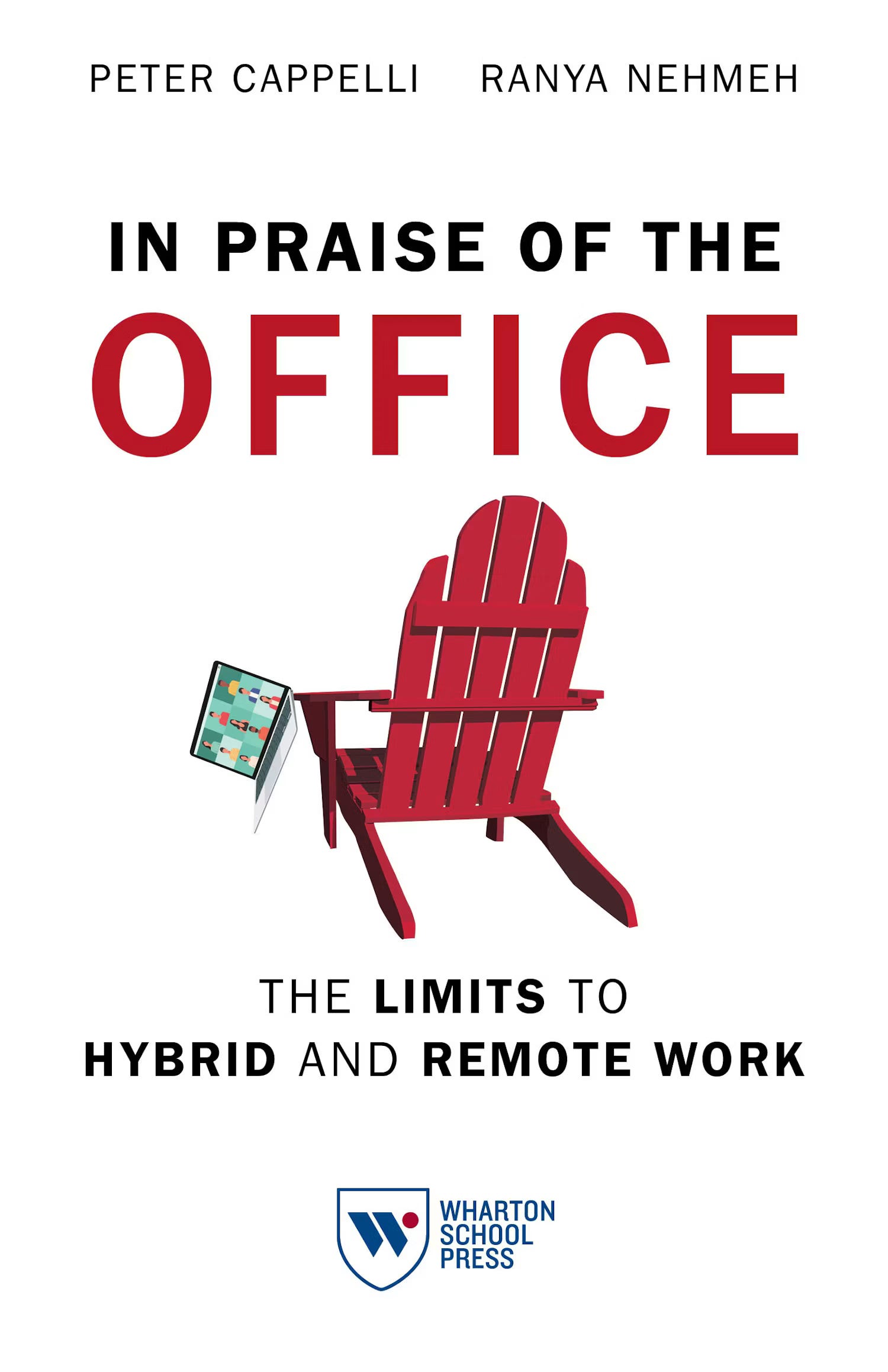
It’s easy to dismiss concerns about remote work as old-school executives complaining that employees aren’t showing up at the office. But there’s real research behind those concerns. In their 2025 book on remote and hybrid work, In Praise of the Office, Wharton professor Peter Cappelli and Ranya Nehmeh make the case that while people can be highly productive working independently from home, collaboration, innovation and relationship-building often suffer when people are apart.
That doesn’t surprise me. The CEO’s job is almost entirely composed of those relational activities. Aligning people, resolving conflicts, building trust, motivating teams and communicating a vision are not things you accomplish by sitting alone at your desk. And even if individual employees are getting plenty done at home, that doesn’t necessarily mean the organization is working as effectively as it could.
But CEOs need to be careful about how they approach this. There’s a real danger that advocating for more time in the office comes across as wanting to monitor employees because you don’t trust them to work without supervision. That’s not the argument I’m making. There are many ways to organize a workforce, and I’m not opposed to hybrid arrangements that are thoughtfully designed, consistently applied and fair to employees.
The research also points to a significant divide in how employers and employees view remote work. Employers tend to believe it hurts performance, while employees tend to believe it helps. CEOs need to recognize that difference rather than simply dismissing one side. If you believe more time together is important for your organization, you need to explain why, and your own behavior is a good place to start.
4. A CEO who wants employees to show up must be willing to show up first.
One of the observations Cappelli and Nehmeh make is that return-to-office policies frequently fail when managers responsible for enforcing them aren’t committed to returning themselves. That shouldn’t surprise anyone.
A CEO who mandates three office days a week while working remotely from a home two states away has undermined the policy before it begins. The same is true when members of the executive team enjoy special arrangements unavailable to the rest of the organization.
I’ve been exploring this issue in a business novel I’m writing about a first-time CEO. The protagonist, Jack Green, inherits a marketing executive who runs his department remotely from Denver under an arrangement with the previous CEO. Jack ultimately requires him to relocate to the company’s headquarters in Austin. The issue isn’t geography so much as accountability. Jack can’t establish new expectations for the organization while allowing his own leadership team to operate under a different set of rules.
A return to the office, like any significant organizational change, requires a clear business rationale and a willingness to hear objections. But the CEO’s own behavior will always communicate more than the policy itself.
5. Use the screen to inform and presence to persuade.
None of this means that CEOs should give up video meetings or insist that every interaction take place in person. A weekly operating review, a routine status update or a quick decision with the executive team may be handled perfectly well over Zoom.
The distinction I would make is between communication intended primarily to exchange information and communication intended to change people’s minds or behavior.
If you’re reviewing quarterly results, a video call may be fine. If you’re announcing a major strategic shift, explaining an acquisition, reorganizing the company or asking employees to make significant sacrifices, I believe you should be in the room whenever possible.
And make time for the conversations that follow. The most important part of a political rally may well be the rope line after the speech, when voters have a chance to interact personally with the candidate. Similarly, the most revealing part of a company town hall may be the twenty minutes afterward, when employees approach the CEO with questions they weren’t comfortable asking in front of everyone else.
The same principle should influence how CEOs spend their time in the office. If your company operates on a hybrid schedule, make sure you’re there when the largest number of employees are present. Walk around. Eat lunch with people. Allow yourself to be interrupted. Some of the most valuable conversations you’ll have won’t appear on your calendar.
Politicians keep holding rallies because, election after election, they find that people are more likely to follow someone they have met and decided to trust. Employees are no different.
This week, think about the most important change your company needs to make in the next year. How many of the people responsible for carrying it out have heard you explain it in person, and had an opportunity to look you in the eye and tell you what they’re really worried about?