



Between election and inauguration, the US president-elect must build what amounts to the biggest, fastest startup in existence.
In these 75 or so days, there are around 4,000 roles to fill in the executive branch, quickly, and about 1,200 require Senate confirmation. It is these people who will, at least in theory, execute the president’s agenda in service of the American people.
Though it will be his second term, Trump faces a challenge much like a first-term president—one, because his terms are nonconsecutive, and two, because few of his previous staffers and cabinet members are likely to return for a sequel.
Needless to say, a presidential transition is not like a startup in the typical sense. Let’s look at some of the ways it resembles and differs from a CEO building a team in the world of business.
Sheer Scale
A founder scaling a startup hopes to be doing lots of hiring, but it’s nothing like filling 4,000 high-pressure roles in a few months. You’ve got to get your cabinet and senior advisers in place, the president’s equivalent of a C-suite, plus all the agency heads, ambassadors, and White House staffers who will shape the administration. “Each appointment is a little drama of its own,” said William Rogers, Secretary of State in the Nixon Administration. Not to mention that the president-elect is hiring people who influence matters of war and peace, life and death on a global scale.
The volume of hiring is so daunting that the Presidential Transitions Improvement Act of 2015 mandates that candidates begin working on their transition in May of election year. As John Dickerson explains in The Hardest Job in the World, candidates in the past often worried about appearances of “measuring the drapes” in the Oval Office before the election; this stipulation of the 2015 act was intended to give them cover for doing the necessary preparation for the transitional period.
“Each appointment is a little drama of its own.” —William Rogers, former Secretary of State
Because “personnel is policy,” it’s critical that a president-elect’s transition team—essentially his/her HR department—work on gathering and vetting the right kinds of names many months before a vote is counted.
Which leads me to the next big difference:
Heavy-Duty Vetting
As a company owner or CEO, it’s generally, “You pick them, they get hired.” Barring something really beyond the pale, the board and investors trust the CEO to make these calls.
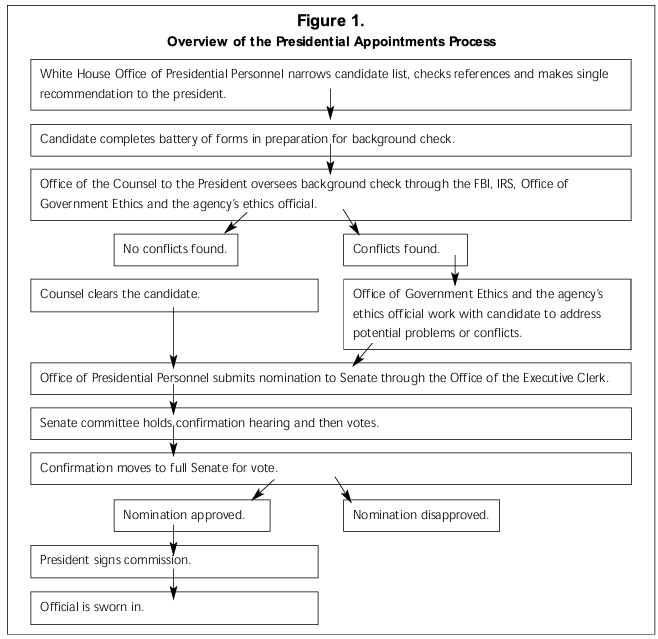
As incoming president, it’s more like, “You pick them, then you see if they pass multiple background checks and if a 52/48 Senate will clear them.”
As CEO I didn’t have to worry about the FBI being involved in my recruiting. I didn’t have to worry about pissing off a Senator from Ohio. I didn’t have to worry about what missed alimony payment or horrible tweet would come out of the woodwork and tank my CMO’s ability to do the job.
For the president-elect, all of those things must be considered before you even think about appointing someone.
It’s a 4-Year Gig
Four years isn’t that long, and it limits people’s ability to get things done. Obviously, many people will be hungry to take on powerful roles in the executive branch, but the short cap on the job is a limiting factor. The second term is hardly guaranteed. And in the case of the team Trump is now building, there’s no hope of another four years.
You Step into a Flowing River
As a CEO/founder, you have the luxury of setting the agenda, casting your vision, thinking about who the right people are to execute it. As president-elect, you’re jumping into a situation in flux, where pressing issues are already in play. On your first day, you might get briefed on bubbling threats in Iran and then get hit with a terrible jobs report. And you’re due for a press conference in an hour. The game has begun, and your time to think about finalizing your team is very limited.
Once They’re In, They’re Hard to Fire
It’s never a fun thing to have to replace a member of the C-suite, but sometimes it’s necessary. That kind of departure causes ripples within the company, but it probably won’t end up on CNN.
Firing a cabinet member is a huge deal. Not only will it be analyzed to death by media and commentators, but now you have to find someone else to fill the role. And how many of those four years are left? You could put in an interim, but will anyone respect them?
Loyalty Isn’t Assumed
Remember that 2018 op-ed in the New York Times where a then-anonymous Trump staffer admitted he was part of a “resistance” movement within the executive branch? That’s the kind of thing presidents have to worry about as they put together a team. There is an element of loyalty and discretion that comes into play that’s unlike anything in business. Most CEOs don’t really worry about leaks to the press or which executive is looking for an opportunity to undermine them. These are very real concerns for a president.
In government as in business, a leader’s success is about getting the right people on the bus. President Trump has a great deal of work ahead of him, and it starts with building out his new team.