
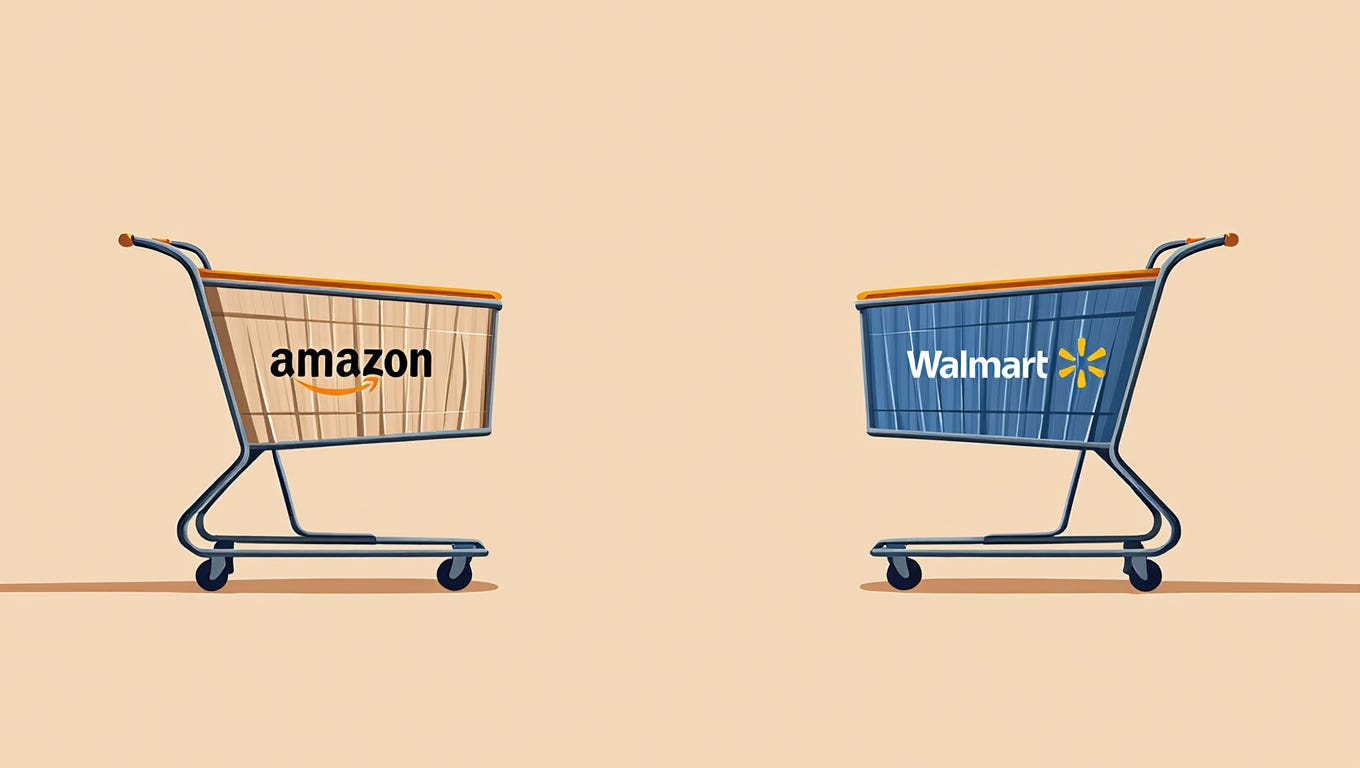
The surprising winner of Amazon vs. Walmart
Amazon just overtook Walmart on the Fortune 500. Who really won? You.
For the first time in more than a decade, Walmart is no longer the largest company in America.
With Amazon’s report of $716.9 billion in revenue for 2025, it edges past Walmart’s $713.2 billion. This is pretty significant because it means Amazon is poised to take the #1 spot on the Fortune 500 this year.
That ends a historic run for Walmart. The big-box retailer has been firmly ensconced at the top of the Fortune list for 21 of the past 24 years (briefly unseated only by ExxonMobil in years when oil prices spiked).
The average American might read that news and think, “Well, how nice for them.” But what interests me most about Amazon vs. Walmart is the fact that the average American is actually the biggest beneficiary of their battle.
Economists have a term for how this works: consumer surplus. This refers to the difference between (a) what consumers are willing to pay for a good or service and (b) what they actually pay. When two dominant firms wage war over the same customers, they compete on price, quality, convenience and other factors, and the surplus flows to buyers.
The Walmart-Amazon rivalry is maybe the most powerful modern illustration of this principle. Every dollar that one company has invested in faster delivery, lower prices, or better technology has forced the other to match or exceed it.
Cui bono? Who benefits? The cynical among us might say it’s the shareholders of the companies. Certainly the shareholders do demand value – but the most under-discussed beneficiary of this arms race is the consumer standing at the checkout counter or tapping “Buy Now” on a phone screen.
The Austrian economist Joseph Schumpeter called this process “creative destruction,” meaning the relentless cycle by which new innovations displace old ways of doing business, and in doing so, generate enormous new value. What makes the Walmart-Amazon story especially compelling is that it shows creative destruction working not between an upstart and a dinosaur but between two adaptive giants. Economists who study contestable markets would recognize the pattern.
Even before Amazon overtook Walmart in revenue, the mere threat of its growth was enough to discipline Walmart’s behavior and push it toward reinvention. That competitive pressure expanded the total value available to consumers. This is the crucial distinction between zero-sum thinking, where one firm’s gain is another’s loss, and the positive-sum reality of vigorous competition, where the total pie grows.
To understand how much value this rivalry has created, it helps to trace its arc in three phases.
The first phase belongs entirely to Walmart. In the 1980s and 1990s, Walmart transformed American retail by obsessing over supply chain efficiency and scale economics. It drove down the cost of everyday goods with a ferocity that competitors like Sears, Kmart, J.C. Penney could not match. The result was a massive transfer of value to consumers, particularly lower- and middle-income families who benefited most from Walmart’s everyday low prices. Academic research has estimated that Walmart Supercenters priced groceries approximately 15 to 25 percent lower than traditional supermarkets, generating significant consumer gains, with spillover effects that compel competing stores to reduce their own prices in response to Walmart’s entry into a market. Put simply: For decades, Walmart was the single most powerful deflationary force in American consumer goods.
The second phase began when Amazon emerged as an existential threat. Amazon’s e-commerce model exposed vulnerabilities that Walmart’s physical footprint could not easily address. These include the ones we’re all familiar with today: infinite selection, transparent pricing, customer reviews, and ever-faster home delivery. With the introduction of Amazon Prime, the company redefined consumer expectations around speed and frictionless purchasing. Suddenly, the competitive field expanded far beyond low prices to include these other factors. Loyal Walmart shoppers now had a compelling reason to shift their spending. The result was that Walmart had to wake up, fast.
Starting in 2014, under then-CEO Doug McMillon, Walmart launched one of the most ambitious corporate reinventions in recent history. The company overhauled its e-commerce capabilities, invested billions in technology and logistics, and undertook a cultural transformation that embraced experimentation - a radical shift for a company built on operational discipline and standardization. The results have been remarkable. Walmart’s online business grew 27 percent in its most recent quarter, and it now handily beats Amazon in the crucial arena of grocery delivery, using its unmatched network of physical stores as fulfillment hubs. Walmart’s revenue and market capitalization are at all-time highs. The company that many observers had written off as a relic of the pre-digital era is now one of the most technologically sophisticated retailers on the planet. Walmart lost, but it also won.
And the biggest winners of all are consumers. They now enjoy the best of both worlds: Walmart’s competitive pricing and physical presence and/or Amazon’s digital speed, selection, and convenience. It’s all at their fingertips.
The third and current phase of the Amazon/Walmart rivalry extends well beyond traditional retail and will continue apace. Under Amazon CEO Andy Jassy, who built the enormously profitable AWS cloud business, Amazon is pushing into AI, streaming, healthcare, and media services. Under new Walmart CEO John Furner (who earned his innovation credentials running Sam’s Club as a de facto technology incubator) Walmart is matching Amazon’s ambition move for move. Both companies are deploying artificial intelligence to personalize shopping, optimize pricing, and streamline logistics. Both are expanding their media and advertising businesses. Both are exploring new frontiers that will bring competitive pressure to industries that have historically seen far less rivalry.
The spillover effects are already visible across the entire retail landscape. Whether it’s Target or Costco or regional grocery chains, sellers are having to go digital, deliver quickly, and keep their prices as low as possible. The rising tide of Walmart-Amazon competition has lifted consumer expectations everywhere.
There is, of course, a counterargument. Critics worry that a market dominated by two titanic players doesn’t constitute genuine competition at all, and that concentration at the top risks depressing wages and ultimately reducing choice. These concerns deserve serious consideration. But to me, the evidence from this particular rivalry points in a different direction. Walmart and Amazon compete so aggressively precisely because neither can afford complacency. Walmart learned that lesson the hard way when it nearly lost its relevance in the e-commerce era. Amazon learned it when Walmart proved that physical retail, far from being obsolete, could be reinvented as a competitive advantage in last-mile delivery.
The Walmart-Amazon story is a powerful reminder that intense, sustained competition is the most reliable engine of consumer welfare. It is more adaptive than regulation, more responsive than subsidy, and more innovative than central planning.
The next chapter of this rivalry, playing out in AI services we have not yet imagined, promises to deliver even more.


