


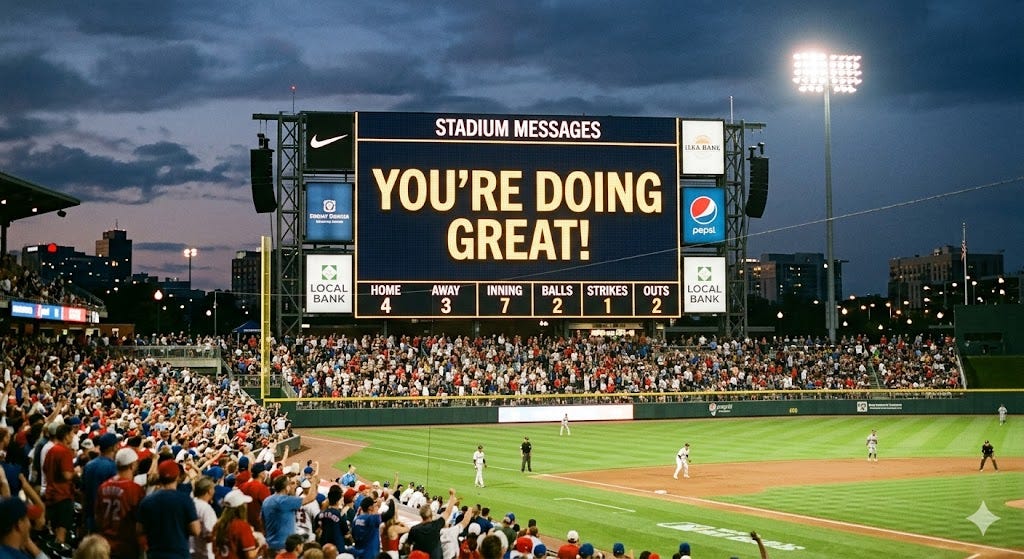
Suppose you took the worst team in the NFL and dropped them into a college football schedule. We’re talking the team that went 3 and 14 and whose fans have already turned their attention to next year’s draft. What would happen?
They would go undefeated. It would be a blowout every Saturday. The quarterback would now look like a Heisman candidate and the mood in the locker room would suddenly be electric. Guys who spent the NFL season doubting themselves would be strutting around like champions.
But in this scenario, the team is exactly as mediocre as it was in October when they were getting embarrassed on national television. Not a single player got better, and not one scheme improved. The only thing that changed was the competition.
Now ask yourself: Is this happening at my company?
In my experience, one of the most pervasive CEO failings is getting comfortable with a management team that LOOKS like it’s winning, but only because it’s playing easy games — and believing a scoreboard that lies.
When a company finds a hot niche or rides a market growing 20 or 30 percent a year, everything feels good. Revenue is up and deals are closing. The goals set at the corporate level might be comfortably sandbagged, and ignored when they go south. The CEO looks around the room and thinks, “Hey, maybe we’re doing all right around here!” And maybe they are. But maybe they’ve just put an NFL team on a college schedule and confused the easy wins for true excellence.
Mediocre management teams can survive this way for years. The market is doing the heavy lifting, but the wins get attributed to the people. Nobody questions the VP of Sales when the pipeline is overflowing. Nobody scrutinizes the operations team when pure demand masks all inefficiencies. Success has a thousand fathers, and a rising market is the most generous father of all.
A downturn in external circumstances can instantly change all that. Suddenly your crackerjack team is paralyzed, unable to execute. Fingers get pointed. You realize that the team you thought was performing at A-level was in fact coasting.
Now consider the opposite. Take a disciplined, well-coached college team and put them on an NFL schedule. The expectation is that they get overwhelmed… but instead they hold their own. They don’t win every game, but they advance because their discipline and rigor are real.
That’s what a genuinely strong management team looks like when the market gets hard. You can see the difference between people who were riding conditions and people who were actually good.
Some CEOs are unwilling or unable to evaluate the management team honestly when everything is going well, which is the only time you have the luxury to do it right. But it’s imperative to have a higher standard than the scoreboard, which will lie to you if you let it. CEOs must ask questions like:
Are we building thoughtful processes or just improvising?
Do we set meaningful goals and hold ourselves to those commitments?
Do our decisions consistently align with our mission, vision, and values?
Are we recruiting and developing great employees across the organization, or are we just extracting output?
My advice is to foster genuine excellence in yourself and your management team even in the good times. That way, when things get volatile (and it certainly seems like we’re heading into more volatile times than ever), your strong fundamentals will keep the team winning.
Nice read. This is one of the best illustrations of why behavioral standards matter more than scoreboards, and why the good times are actually the most dangerous time for a leadership team.
When the market is doing the heavy lifting, it masks everything. Unclear decision-making looks like strategy. Weak coaching looks like strong culture. Nobody questions the process when results are coming in, and that’s exactly when the gaps compound quietly in the background.
The diagnostic questions at the end are the right ones. I’d add one more: are your leaders developing the people around them, or just extracting output? That distinction doesn’t show up on a revenue dashboard. It shows up eighteen months later when the market shifts and the bench you thought you were building was never actually there.
The best leaders set a higher standard than the scoreboard, even when the scoreboard is lying in their favor.
Nice read. This is one of the best illustrations of why behavioral standards matter more than scoreboards, and why the good times are actually the most dangerous time for a leadership team.
When the market is doing the heavy lifting, it masks everything. Unclear decision-making looks like strategy. Weak coaching looks like strong culture. Nobody questions the process when results are coming in, and that’s exactly when the gaps compound quietly in the background.
The diagnostic questions at the end are the right ones. I’d add one more: are your leaders developing the people around them, or just extracting output? That distinction doesn’t show up on a revenue dashboard. It shows up eighteen months later when the market shifts and the bench you thought you were building was never actually there.
The best leaders set a higher standard than the scoreboard, even when the scoreboard is lying in their favor.