


Welcome back to Managing the Future. It’s the first Monday in October, and the holidays are already bearing down on us.
For CEOs, the next couple of months have a way of evaporating.
Now is an ideal moment to tame the chaos, get a real operating system in place, and make sure you enter the holidays with a plan for 2027 instead of coming back in January to figure one out.
That’s what we built ChatCEO to help with: giving the CEO a system, along with an AI that understands the company well enough to make that system useful. Today’s article gets into why those two things matter.
I encourage you to sign up for your own ChatCEO here and we will get you all set up!

The Internet changed how leaders get advice. Previously a cottage industry, business guidance grew into an industrial complex.
Founders became thought leaders. Companies became case studies. Academics became gurus. CEOs, previously starved for help, had blog posts, podcasts, Amazon bestsellers, and LinkedIn manifestos galore.
But all that content was a mess, and much of it contradicted itself.
Take a simple question every CEO runs into quick: How much should you listen to your customers?
The Internet has a clear answer. Listen to your customers. It is close to gospel. Put yourself in the customer’s shoes, build what they ask for, let their feedback drive the roadmap. “Customer obsession” is Amazon’s first Leadership Principle, and (the implication is) it should probably be yours too. You will find this advice everywhere, repeated with total confidence, usually attributed to someone successful.
The Internet also has a different clear answer. Customers don’t know what they want until you show them. This one comes with its own patron saints, legends like Henry Ford and his apocryphal “faster horse” quote, or Steve Jobs, who famously refused to run focus groups.
So what is the right answer? Both arguments have produced successful companies. But both cannot be true at the same time. And yet both are endlessly cited.
Synthesis is now cheap
For years, the CEO’s problem was sorting through all of this contradictory advice. Not anymore. Today, AI has given us the next evolution: effortless synthesis.
I just now asked ChatGPT how the CEO of a midsize company should think about customers. Here is a condensed version of what it told me:
Customers are an essential source of truth, but not a substitute for judgment. Listen literally to their experience and non-literally to their proposed solutions. Stay close enough to customers that reality can surprise you. Look for patterns rather than votes. Pay attention to what customers do as well as what they say. Know which customers you are hearing from. Use customer listening to improve strategic judgment rather than outsource it.
The CEO should listen at a level above Product, Sales, and Customer Success, asking how the customer’s world is changing, why customers really choose the company, and where the business may be becoming less relevant.
The goal is customer-led understanding without customer-led strategy.
Good job, ChatGPT. That is a good answer. It is well-balanced and difficult to object to.
And that is the problem.
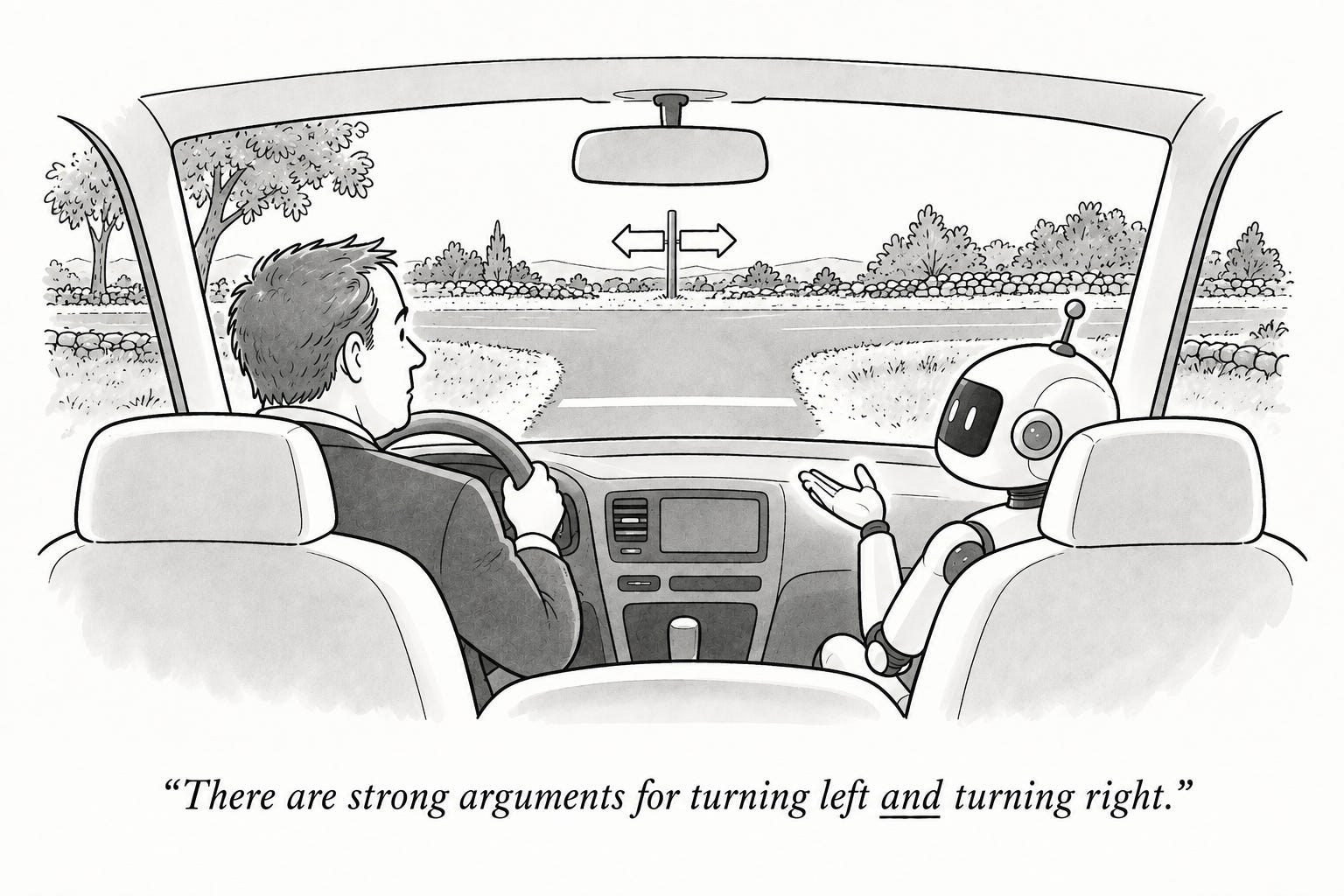
The Internet gave us a thousand contradictory answers. AI can now read all thousand, reconcile the contradictions, sand off the sharp edges, and hand us a polished synthesis. It is masterful at caveats. Give it two opposing views and it can find the respectable middle between them almost instantly.
Listen to customers, but do not listen too much.
Trust your vision, but remain open to evidence.
Move fast, but be thoughtful.
Empower your people, but maintain accountability.
Eventually, much of the existing business advice converges on the same conclusion:
It depends.
Of course it depends! The whole reason the CEO exists is because they look at “It depends” and say “We’re doing this, and here’s why.” It is a painful responsibility, but good CEOs do it every day. If that’s the job, a bot giving you hyper-nuanced both-sides maxims is not too helpful.
Taking the average of opposing advice does not produce a good decision. In fact, taking averages is a pretty reliable way to keep a company average.
Tell me what I want to hear
There is another problem with generic AI advice: It mirrors the person asking.
Based on how you position your query, it may lean toward one side of its synthesis. If I’m anxious about customer churn and turn to my LLM for help, it is likely to extrapolate from my wording that I need to listen more closely to customers. But if I come to it with my conviction that the company has discovered a new category, it will dutifully explain why visionary companies cannot let customers design the future for them.
It can make either case persuasively because both cases are well represented in the material on which it learned. However, what is it really doing here? It’s telling me what it thinks I want to hear.
If AI is simply reflecting your framing back at you, more fluently and with better bullet points, you have confirmation bias on steroids.
How to make your AI CEO-grade
That is not a reason for CEOs to avoid AI. Quite the opposite. The most capable CEOs I know are finding ways to make AI part of how they think.
But they are giving it two things generic AI does not have.
The first requirement is a system for the CEO job.
A customer decision is never only a customer decision. The CEO operates at the intersection of three constituencies: customers, employees, and shareholders. Pushing hard toward one corner of that triangle means the force moves through the other two.
Suppose customers are demanding extensive customization. Looking only at the customer, saying yes may seem obvious. But that decision may increase product complexity, require additional people, reduce margins, slow the roadmap, or make the company less attractive to the broader market.
Those consequences must inform the CEO’s decision. A functional executive can reasonably advocate for one corner of the problem. Sales wants the deal. Product wants architectural coherence. Customer Success wants retention. Finance wants margin.
But the CEO has to see the whole triangle move.
That is why a system matters. It gives the AI—and the CEO—a framework for asking what a decision does to the entire business rather than generating a sophisticated answer to whichever part of the problem happened to appear in the prompt.
The second requirement is operating context.
CEOs should not casually pour proprietary company information into public AI models. But when AI can securely understand the company’s strategy, market, goals, economics, organization, and current situation, something important changes.
Now it can move beyond “it depends.”
It can begin asking: What does it depend on?
Let’s return to the customer question.
An established company improving a mature product in a known market may need to listen extremely closely to customers. Those customers understand the shortcomings of the product because they live with them every day. Their behavior may expose where the company is losing relevance or where a competitor is beginning to win.
A company creating a genuinely new product faces a different problem. Customers can usually describe their frustrations better than they can imagine a product category that does not yet exist. Following their requested solutions too literally may pull the company back toward the familiar thing it is trying to replace.
The nature of the product matters. The maturity of the market matters. The company’s financial position matters. Its strategy matters. Its competitive position matters.
These are the inputs required to make the decision. That is the opportunity AI creates for the CEO. Once it understands your operating context, it can take meta-rules from its system and show you how they apply.
The bottom line
The Internet gave executives more advice than they could ever read.
Generic AI can summarize all of it.
The real prize is an AI that knows enough about the CEO’s job and the company in front of it to know which advice matters now.