


I recently came across this tweet from Marko Jukic at Bismarck Analysis:
It's unbelievable how many dynamic companies broke their streaks of engineer-CEOs for the first time in the 2000s, installing their first MBA/finance CEOs, who then promptly made fundamental strategic errors that nixed the company's future, that are now becoming obvious.
Is it true? Did companies like Intel, Boeing, IBM, and Sony lose their way by hiring CEOs who were more focused on finances than on the product itself?
While you may not 100% cosign Jukic’s analysis, I do think there is a core truth here: to be successful as a CEO, you must have a baseline knowledge of—and some degree of genuine interest in—your company’s product.
The classic engineer-turned-CEO has this implicitly, in a way a “money guy” (or gal) CEO hired to run the business might not. If the finance/MBA-type CEO hasn’t internalized how the product is made and sold, and isn’t curious about it, that disconnect eventually shows up in the bottom line. This type of CEO might:
Not grasp at a deep level the value customers gain from the product, or have a vision for what customers need in the future
Overlook critical technological advances and/or shifts in customer behavior
Root decision making in a bias for short-term profit rather than a long-term vision of the company’s success
Fail to build credibility with employees, particularly on the technical side
Fail to attract people who are passionate about the company’s offerings (because they sense that the CEO isn’t invested him- or herself)
There are plenty of solid businesses I would struggle to lead because I have limited passion for the product. I don’t think I would be a great CEO of a jewelry company, for example. For whatever mysterious reason, that category doesn’t get me fired up. But network performance management software, which sounds even more dry and boring to most people? That does genuinely interest me. Really. Thus, as CEO of network performance company NetQoS, I understood the product we made, how we sold it, and why it mattered to our customers.
Obviously, no CEO should be running the product department themselves. Successful CEOs rapidly transition from the specialist they were in their previous roles to the generalist required in the chief executive role. But with that in mind, an authentic enthusiasm for the product, paired with basic knowledge of how it’s built and delivered, is one of the best assets a CEO can have.
The Rundown
Don't Worry, Be Happy
Small business optimism gets a marginal boost—but it's still down overall.
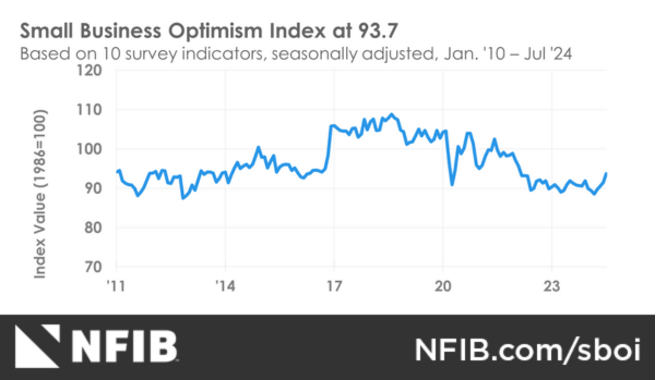
The NFIB Small Business Optimism Index rose to 93.7 in July, marking its highest level since February 2022. However, the index remains below the 50-year average of 98 for the 31st consecutive month and significantly lower than the all-time high of 108.8 set in August 2018. (As you can see in the first graph below, the optimism trend line is still down from 2017/2018.) Inflation continues to be a major concern, with 25% of small business owners identifying it as their most significant challenge, up four percentage points from June.
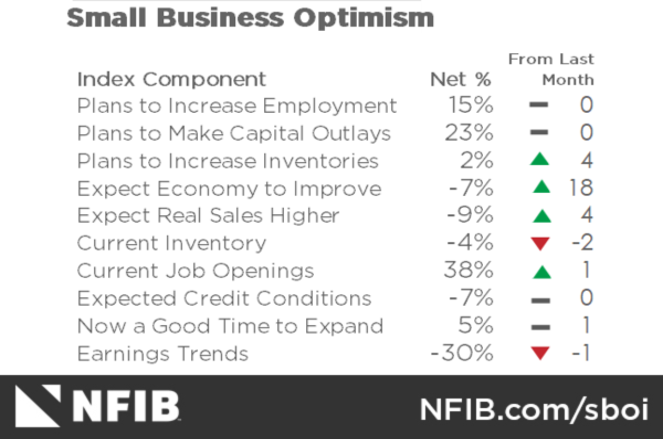
Despite this, the outlook for real sales in the remainder of 2024 has slightly improved, with a four-point increase, though it remains net negative at 9% (seasonally adjusted). Inventory investment plans and capital spending have also seen modest growth, with 2% of business owners planning to expand inventory and 54% reporting capital investments in the last six months.
Job vacancies remain a challenge for 38% of surveyed business owners, particularly in the construction, transportation, and retail sectors. Additionally, 19% of owners cited labor quality as a growing concern. Sales performance has been underwhelming, with a net negative 16% of owners reporting higher sales in the previous quarter, and 67% of businesses either cutting or freezing compensation for the rest of the year.
Abracadabra
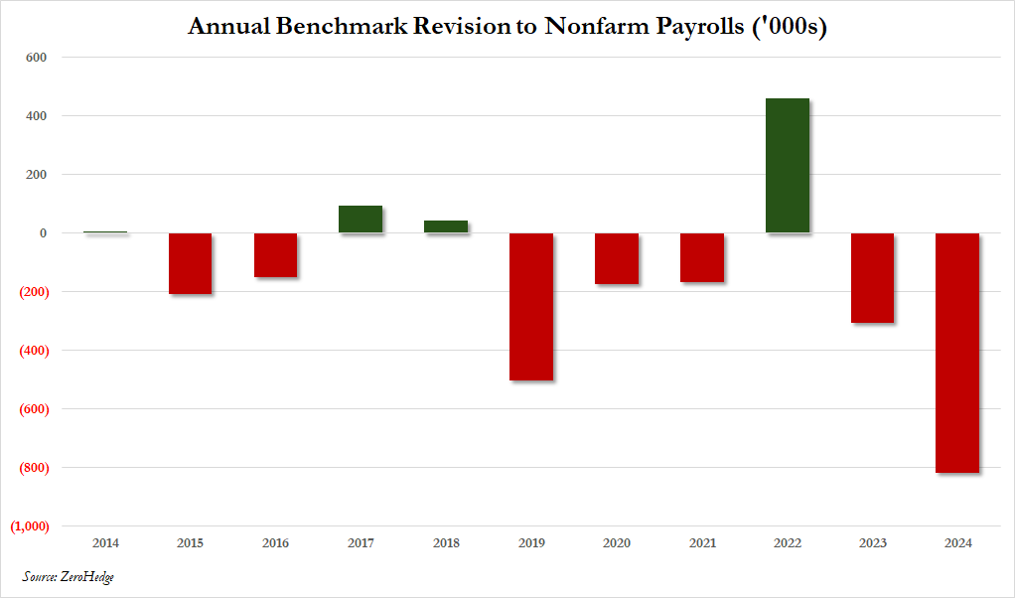
Almost a million U.S. jobs go poof in a recent revision.
A recent revision in job numbers reveals that the U.S. economy added 818,000 fewer jobs between April 2023 and March 2024 than initially reported. The updated figures show that 2.1 million jobs were created during this period, a significant reduction from the earlier estimate of 2.9 million. This nearly 30% downward revision suggests a softer labor market than previously thought, which could prompt the Federal Reserve to consider more aggressive interest rate cuts. The unemployment rate has risen to 4.3%, up from 3.4% in the spring of 2023. It certainly seems to me that more people are looking for jobs right now than we've seen in a while, and it's taking them longer to find them.
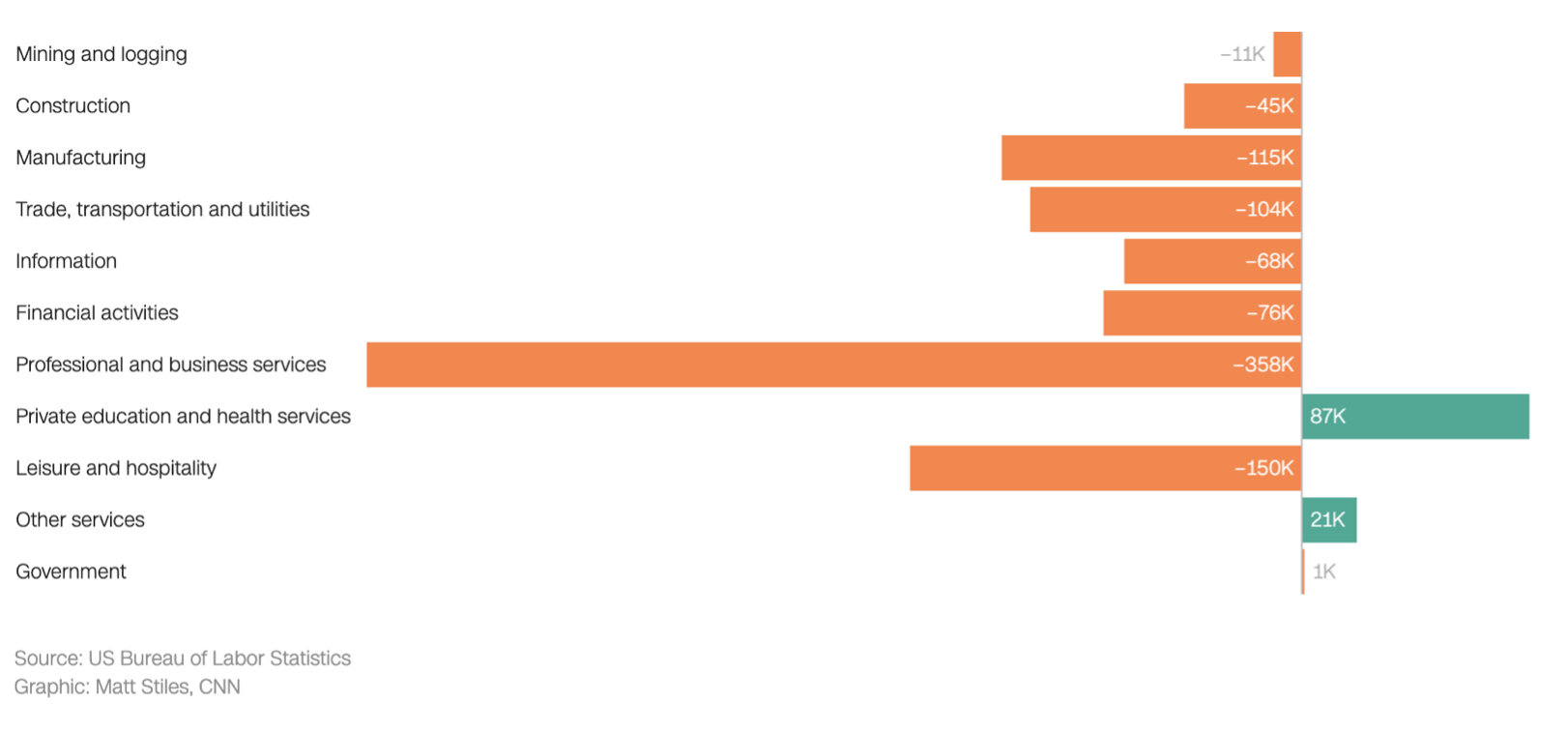
The most heavily revised sectors were professional and business services, with a reduction of 358,000 jobs, followed by leisure and hospitality, which saw a downward revision of 150,000 jobs. The only industries corrected higher were private education and health services (+87,000 jobs) and other services (+21,000 jobs).
Danger Zone
Boeing continues to face headwinds but now has a new leader at the helm.
Boeing has faced several significant challenges in recent years, ranging from aircraft incidents to financial struggles. (It's one of the companies cited by Jukic above as a casualty of having a string of non-engineering, "management type" CEOs.) Recent issues include airplane doors being ripped off, crashes in 2018 and 2019, two whistleblower deaths, and disappointing financial results in the last quarter. Second-quarter sales declined by 15%, deliveries remained flat year-over-year, and the company reported a $3.9 billion cash outflow from operations. Over the past five years, Boeing’s stock (BA) has declined by 50%, in stark contrast to the S&P 500’s 95% gain and a 12% increase by rival Airbus (AIR.PA).
In response to these issues, Boeing has brought in new leadership, most notably appointing Kelly Ortberg as CEO—an engineer—who replaced Dave Calhoun earlier this month. Ortberg, who has 35 years of experience in the aerospace industry, previously served as the CEO of Rockwell Collins, which was later acquired by United Technologies.
Ortberg has outlined several priorities for his tenure, including negotiating a new wage agreement with the machinists’ union, acquiring 737 fuselage supplier Spirit AeroSystems, increasing production, and improving relationships with U.S. regulators and lawmakers. Boeing’s headquarters, which previously moved from Seattle to Chicago in 2001, and then to Arlington County, VA, in 2022, may see further changes. In a letter to employees, Ortberg indicated plans to relocate his office, and possibly other non-production resources, back to Seattle to be closer to the company’s production lines and development programs.

"The map is not the territory is a reminder that our mental models of the world are not the same as the world itself. . . . Mistaking the maps for the territory is dangerous. Consider the person who has a great résumé and checks all the boxes on paper but can’t do the actual job. Updating our maps is a difficult process of reconciling what we want to be true with what is true." —Shane Parrish
“Managers who do not understand people's different thinking styles cannot understand how the people working for them will handle different situations.” —Ray Dalio
“The uncomfortable truth is that most of us don’t come across the way we intend. We can’t see ourselves truly objectively, and neither can anyone else. Human beings have a strong tendency to distort other people’s feedback to fit their own views. We know this intellectually, and yet we rarely seem to recognize it as it’s happening.” ―Heidi Grant Halvorson