


One marker of a great manager is their ability to individualize their approach to each employee.
In other words, the great manager understands this basic maxim of business:
Each of your employees is a unique collection of behaviors, preferences, and strengths. Only by understanding this mix for each person can you manage, lead, and coach them effectively.
This is a stark contrast to the mediocre manager, who assumes all their employees have the same strengths and working style, and it often just so happens to be the manager’s own strengths and working style!
Big mistake. Treating everyone like clones frustrates your team members and leaves a lot of value on the table. Consider how this plays out in real situations.
Recognizing achievement: The introverted data analyst on your team might be mortified by public recognition at an all-hands meeting, while your extroverted business development manager lives for that moment in the spotlight.
Assigning work: Your detail-oriented team member might thrive on complex, multi-step projects requiring precision, while your big-picture thinker might excel at strategic initiatives and conceptual work that others find too ambiguous.
Communication style: Your analytical team member might want comprehensive background context before meetings and decisions, while your action-oriented employee might prefer bullet points and diving straight into next steps.
Delivering feedback: Your direct communicator might appreciate straight talk and want you to cut to the chase, while your relationship-focused team member might need private, gentle coaching with specific examples and reassurance.
A good place to start with individualization is learning one of the many existing frameworks for talking about human behavior. One of my favorites is DISC. (You can get your DISC type and much more at MyUserManual.com.)
As you may know, DISC maps a person’s behavior along four dimensions:
High-D (Dominance) people are motivated by results, challenges, and authority. They get frustrated by indecision, excessive detail, and lack of autonomy.
High-I (Influence) people thrive on recognition, relationships, and enthusiasm. Isolation, excessive detail work, and lack of social interaction drain their energy.
High-S (Steadiness) team members value stability, teamwork, and appreciation. Sudden changes, conflict, and unclear expectations create stress for them.
High-C (Conscientiousness) team members are driven by quality, accuracy, and expertise. Ambiguity, rushed decisions, and criticism of their work frustrate them.
Understanding the DISC type of each employee gives you a lot to go on (whether they’re a pure D, I, S, or C or a mix), but you can take it even further by understanding your DISC type and how it interacts with theirs.
To help with that, I have created a DISC Management Adjustment Matrix, which you can download a copy of below. It lets you start with your own type and then understand the chemistry you likely have with each of the four core types.
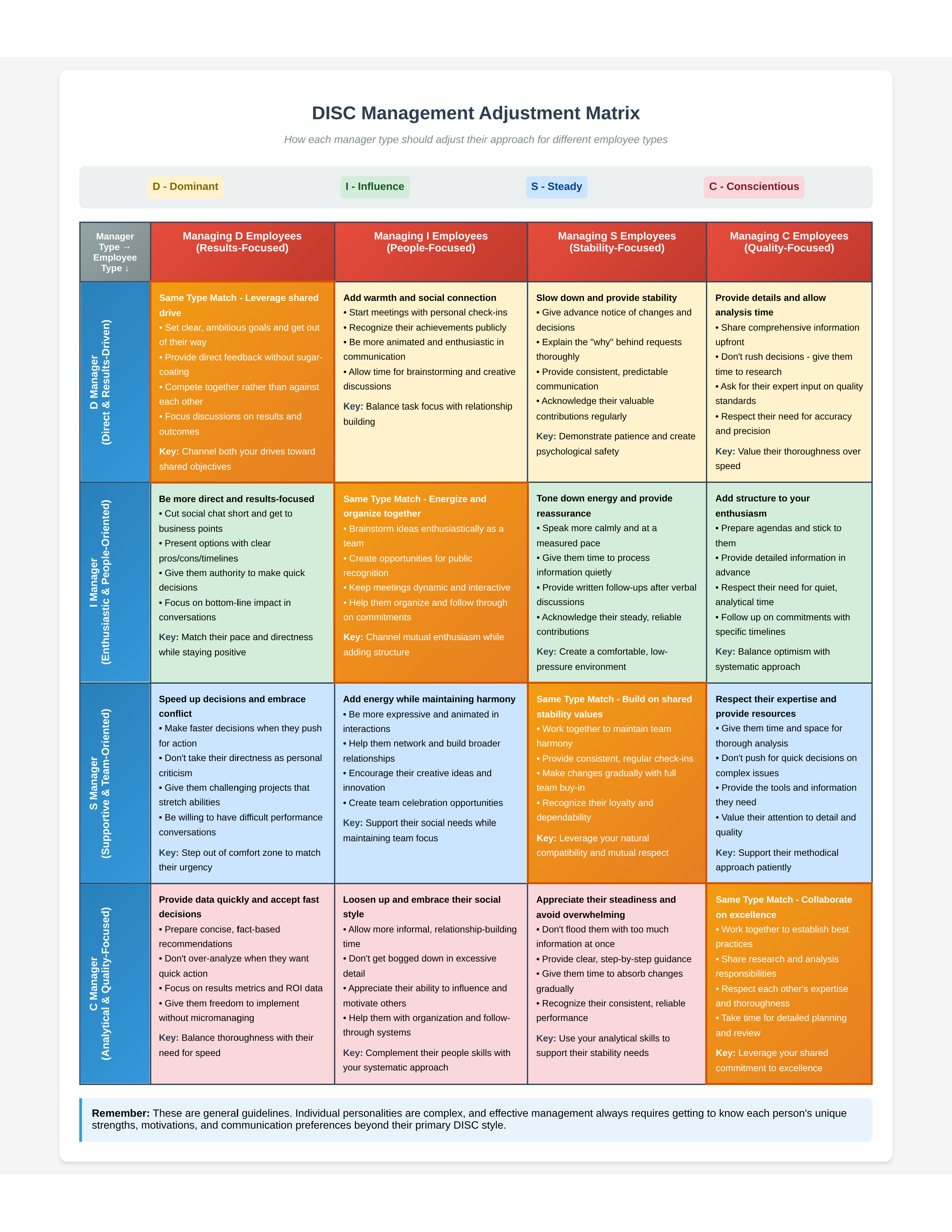

If you have feedback on whether these recommendations ring true for you, I’d love to hear it (along with any other suggestions or additions).
At the end of the day, the manager who develops awareness of themselves and of each of their team members is poised to deliver far superior outcomes than the one-size-fits-all-manager.
Incredibly helpful! Thanks for sharing the visual guide as well. Saved it for reference