



When it comes to guiding CEOs to success, two terms often get tossed around: coaching and training.
They might sound similar, but they’re fundamentally different in approach and impact. Let’s break it down.
What Is CEO Coaching?
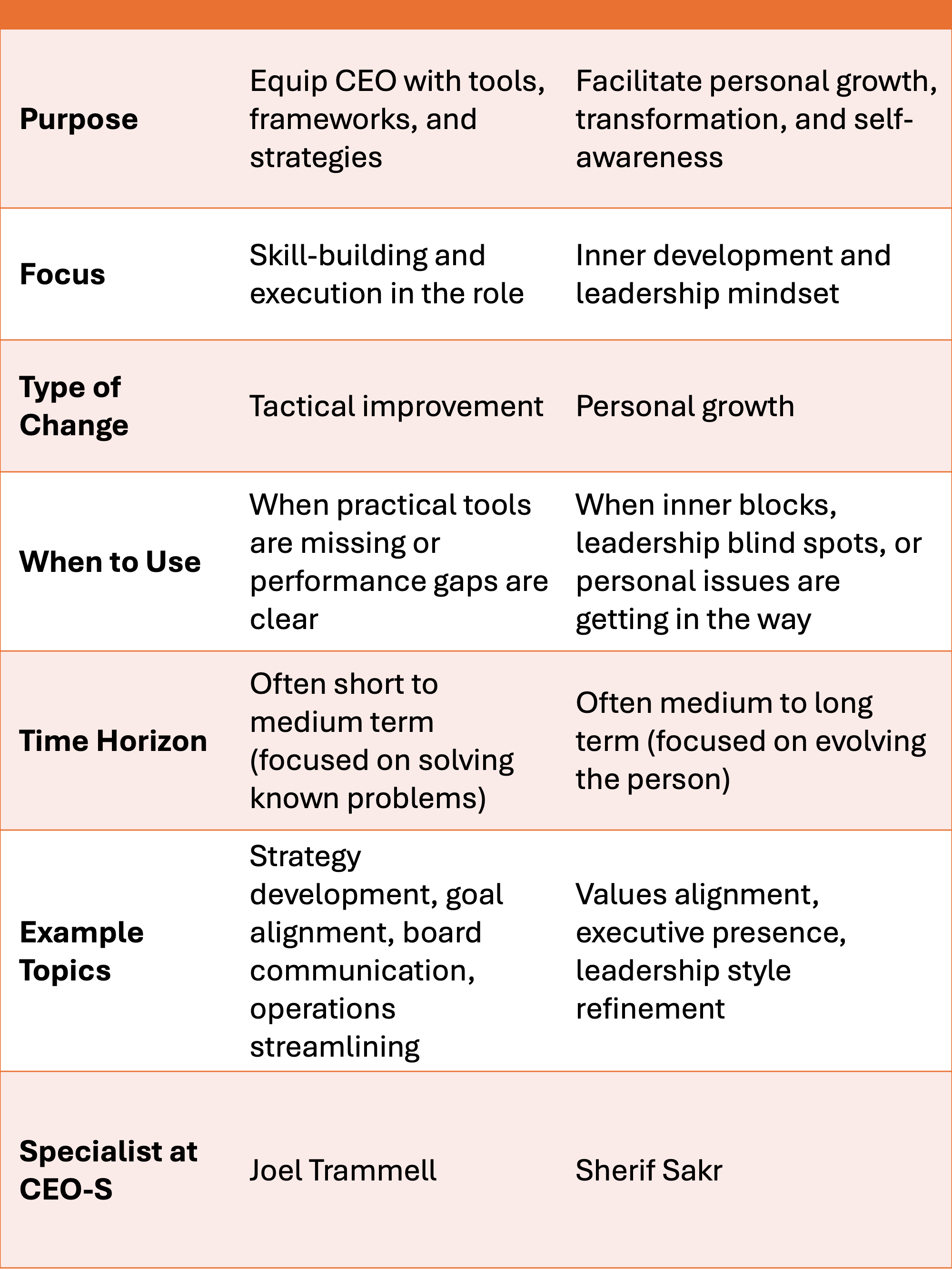
CEO coaching is about individual transformation. A good coach makes the CEO better by helping them evolve as a person. It’s deep, introspective work. The coach helps the CEO explore who they are, what their values, mindset, and habits are, and where change and improvement are required. The coach challenges the CEO to shift how they think, how they lead, how they show up, then holds them accountable for making progress in those areas. The coach holds up a mirror to the CEO and says, “Let’s refine who you are and create a better version of you as a leader”—and maybe even as a person.
A well-coached CEO comes to see their blind spots, clarify their goals, and develop the inner strength to make progress on what’s most important. It’s about becoming a better version of themselves.
What Is CEO Training?
CEO training is about equipping the CEO with new tools, mental models, and strategies to succeed in a very challenging role. The trainer teaches the CEO how to be more effective by integrating these resources into an existing leadership approach. You can think of it like handing the CEO a tailored playbook. The trainer makes the CEO more effective without getting into the close personal work and accountability of the coaching process.
Training might focus on specific topics like developing company strategy, leading effective board meetings, streamlining operations, or influencing a company at scale. Training is practical, actionable, and builds on their existing strengths. The goal isn’t to put the CEO on a new path of personal development but to give them the know-how to amplify their impact.
What’s interesting about training is that it’s much rarer than coaching. This is for a few reasons:
A good trainer typically needs extensive CEO experience. As in professional sports, a good coach can hold the player accountable without having done the position themselves. But a trainer needs to have been in the seat to really hand off tools and tactics for doing the job itself.
A good trainer needs their own duplicable process. A trainer can’t just hand off generic leadership frameworks. Ideally, they need a fully fledged system that has proven to work for them and their trainees. (This is what I have developed with the Chief Executive Operating System.)
A good trainer must be able to teach. Whereas coaching often boils down to a series of conversations, training involves the teaching of concrete material that the trainee must fully grasp and implement. CEO coaching is not an easy job, but CEO training involves a different skill set.
While many coaches see themselves as quasi-trainers, they usually offer more of a mixture of coaching and business consulting. That’s different from training, for the reasons above—but I do believe that many CEOs would benefit from direct training. The CEO job is so unique that it’s hard to pick up that specific set of skills from previous leadership roles.
An Example
Let’s say a leader struggles with public speaking. A coach might dig into why that struggle exists (maybe it’s a fear of vulnerability or memories of a bad experience long ago) and work on building their confidence and presence from the inside out. They might work with the leader on their self-perception and what internal obstacles prevent them from speaking confidently. They will then set development goals with the leader on how they can make progress overcoming this fear and ensure the leader stays on track.
A trainer, on the other hand, would teach the leader specific techniques around public speaking: how to structure and pace a speech, how to articulate and project effectively, and strategies for using body language, all while working with the CEO’s natural style.
Both the coach and the trainer can be powerful in the above situations, but they serve different purposes. Also note that, for public speaking, it’s important to know whether you need coaching or training in the first place. Coaching won’t be of much use if what you need is practical tools, while training will be misplaced if your struggles are fundamentally internal.
The same goes for the CEO. Coaching reshapes the CEO’s core, fostering growth that ripples through their leadership and their personal development. Training sharpens their skills, giving them the edge to succeed in the role they’re already playing.
How Do You Know What You Need?
The best approach often depends on the CEO’s needs: Sometimes they need more transformation, sometimes they need a new set of tools. This is a good opportunity to ask yourself: At this point in your leadership career, what do you need more, coaching or training?
Do you feel that you know what you need to do but are struggling to do it? If that sounds like you, a coach is likely a better fit. What you really need is an accountability partner to help you work through the factors holding you back personally.
What if, instead, you feel that if you knew what to do, you could execute it? If you look around at your business and feel like you simply need better tools for driving results, you probably need a trainer. That trainer will be able to show you how the tools work and help you adapt them to your situation.
I consider myself a CEO trainer. I enjoy the process of sharing my management system with CEOs and showing them how the pieces fit together to drive predictable performance. But that's different from a true CEO coaching engagement that would include weekly or monthly calls. One of the advantages of my partnership with my CEO-S cofounder is that this is exactly the type of support he specializes in. We’re thus able to offer training or coaching—or a customized mix—for our CEO clients.
Would you like a free 30-minute training session? Schedule a call with me, Joel.
How about a free 30-minute coaching session? Schedule a call with Sherif.
Being CEO can be lonely, but we’re here to help regardless of the type of support you need.