



Your board should be rooting for you. If you win, they win.
But most CEOs say it doesn’t feel that way. Amid the strife of the job, it is easy to slip into negative thoughts. “My board doesn’t understand.” “They have no faith in me.” “They’re gonna fire me!” According to Spencer Stuart, only 37% of CEOs said their board had their back. (Meanwhile, 47% of directors believed their boards had the CEO’s back — a telling misalignment.)
Boards are hardly blameless here. Some are dysfunctional and meddle incessantly. But in the majority of cases I have seen, there is a lot of unnecessary worry in the CEO’s head, sometimes to the point that it becomes a self-fulfilling prophecy. The CEO can sink so far into concerns about what the board is thinking that they don’t take a breath and do the #1 thing that would help them in the next board meeting: proper preparation.
Blindsided by the board
I visited recently with a CEO who was thoroughly demoralized by his board’s reaction to a plan he presented. He had walked into the meeting feeling optimistic about what he wanted to accomplish, but then the directors responded with a level of skepticism he hadn’t anticipated. He felt shot down.
As he told me what happened, I found myself thinking that I could have predicted much of the reaction. Not because I’m some sort of board whisperer, but because I have spent enough time on both sides of the table to recognize the kinds of objections that naturally arise. Plenty of experienced directors and CEOs would have seen them coming.
I suspect that if this CEO and I had talked before the meeting, we could have worked through those objections and refined his approach. He might have come away from the meeting energized by a productive discussion instead of questioning whether his board had any faith in him.
The lesson is that CEOs shouldn’t be discovering how the board will react to a key message as they are presenting it. A bit of anticipation, preparation, and scenario modeling goes a long, long way.
What comedians know about preparation
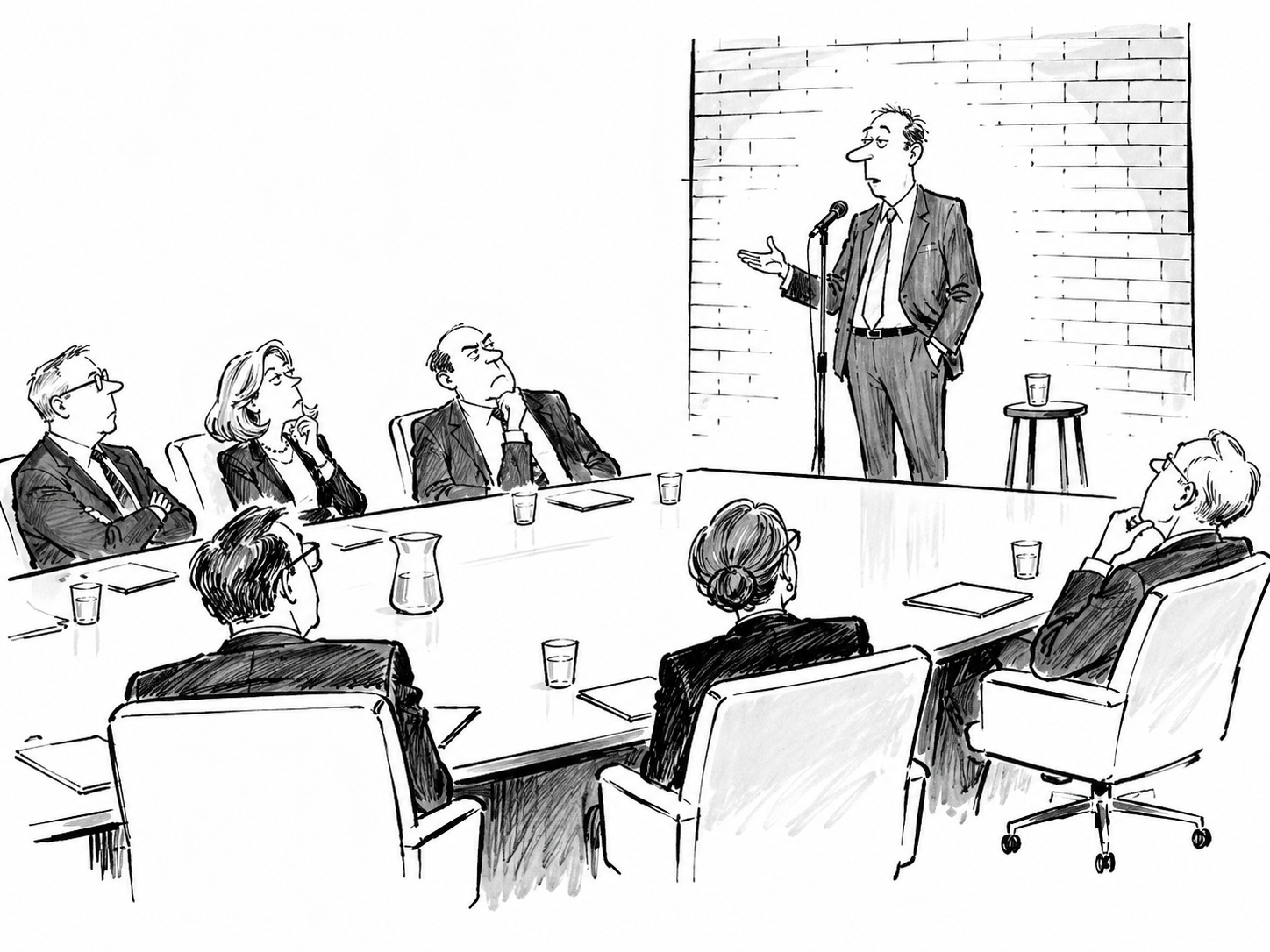
Comedians have a tough gig: they walk onto a stage night after night and must induce an involuntary response from a roomful of people. You can explain why a joke ought to be funny, but the audience laughs or it doesn’t. Period.
It looks spontaneous, although it’s anything but. Even pros at the level of Chris Rock and Jerry Seinfeld go through a rigorous trial period with new material, testing and tweaking and often bombing in smaller clubs. By the time it’s on the HBO special or your YouTube algorithm, it’s been finely tuned for the best impact.
Comedian Yannis Pappas had a bit about his girlfriend telling him she needed space, which he translated for the audience as “I need you to help me break up with you.” It didn’t get laughs. The breakup was still raw, and the crowd felt sorry for him. So he changed one word. “Girlfriend” became “girlfriends,” and suddenly the joke was about everyone who has ever been dumped. It started landing, and the bit went on to anchor his first Comedy Central special.
In my view, CEOs are wise to bring that preparatory discipline to their board meetings.
Every director arrives at your conference table with a different set of experiences, priorities, and mental models. One may have lived through a disastrous acquisition and consequently view your growth plan through a skeptical lens. Another might be concerned about the balance sheet, while a third is primarily interested in the strength of your executive team. They aren’t immersed in your business every day, and they don’t necessarily see the logic that seems self-evident to you.
That’s why I strongly encourage CEOs to practice important board discussions with someone capable of playing devil’s advocate. More on that momentarily.
Improv in the boardroom
Once you’ve anticipated how your message is likely to land, you can also prepare for what comes next: the questions, objections, and unexpected turns in the conversation.
To return for a moment to the world of comedy, consider the rising popularity of crowd work. Some of today’s most popular comics have built enormous followings through clips of these impromptu interactions. The exchanges look entirely off the cuff, and sometimes they are. But experienced comics also know the kinds of responses they’re likely to get and have developed ways of steering the conversation depending on what comes back.
There’s a reason improvisational comedy has become a discipline of its own. Its best-known principle, “yes, and,” encourages performers to accept what another person introduces and build on it rather than shutting it down. In fact, a 2020 study found that just 20 minutes of improv exercises could make people more comfortable with uncertainty, an effect that wasn’t observed in a comparison group doing scripted exercises.
CEOs can benefit from a similar mentality when dealing with their boards. Many a CEO has walked confidently into a board meeting only to break out in a sweat at the first pointed question. Suddenly they are arguing over a director’s premise, correcting a perceived misunderstanding, or hurrying to the next slide. A perfectly reasonable challenge becomes an uncomfortable confrontation.
Many a CEO has walked confidently into a board meeting only to break out in a sweat at the first pointed question.
The better approach is to remain genuinely open to what the director is saying. You might acknowledge the concern, explain how you’ve thought about it, or explore what circumstances would cause you to change course.
Board members are looking for evidence of sound judgment. A CEO who can discuss the risks candidly, entertain alternative scenarios, and still articulate a clear recommendation does far more to build confidence than one who delivers a polished sales pitch and becomes defensive when questioned.
A little bit of practice goes a long way
Before your next board meeting — especially if you will be presenting something new or uncomfortable — find a trusted adviser, an experienced board member, or another CEO who can examine your presentation without sharing all your assumptions. (Heck, I’m happy to work on it with you.) Have them challenge the weakest parts of your plan, question your evidence, and raise the objections you least want to hear.
A trusted chief of staff can play the role of a skeptical director. So can a mentor, an experienced CEO, or anyone who has spent a lot of time in boardrooms. The trick is finding someone willing to be candid with you, not just tell you that your presentation looks great.
Note: AI opens up fascinating possibilities for CEO rehearsal.
One of the capabilities now available in ChatCEO is the ability to model a CEO’s specific board, drawing on what we know about each director’s personality, career history, industry experience, and priorities. We can then put the CEO through a series of rehearsals, with the AI taking on different directors’ perspectives and challenging the proposal accordingly.
This goes beyond generating a generic list of tough board questions. You can practice how you would respond to a particular director’s objections, test different ways of presenting a sensitive issue, and discover where your arguments may need work. You can even practice changing direction when the conversation doesn’t go as planned.
The idea is to do the stumbling and revising before the actual meeting, so you’re better equipped to think on your feet when it counts.


Ask for the support you need
There is one more thing worth remembering if you don’t feel that your board has your back. You can actually tell your directors what kind of support you need from them.
I recommend establishing a Board-CEO Operating Agreement that clarifies which decisions belong to the CEO, which require board involvement, and how the two sides will communicate. It’s a way of getting expectations out in the open rather than leaving each side to guess what the other wants.
The Spencer Stuart research I mentioned earlier found that 68% of CEOs who had explicitly discussed with their boards the support and input they should expect felt effectively supported. Among those who hadn’t had those conversations, the figure was just 50%.
That’s a pretty good argument for having the conversation rather than sitting around worrying about what your directors think.
P.S. If you’d like to see how ChatCEO can help you rehearse for your own board, I’m happy to show you what we’re doing. You can get started here or reach out to me directly.