


The guiding principle of the CEO job is balance. Trade-offs. Making decisions that create the most value for your three key stakeholder groups: employees, customers, and shareholders.
You will never make everyone happy… but you have to look at the whole picture and find the path that creates the most value shared by these groups.

Easier said than done, as any CEO will tell you.
We have an object lesson in that this week as New York Times tech workers begin a strike—right at a very high-traffic moment for the paper.
Times CEO Meredith Kopit Levien has previously argued in leaked memos that she does not feel unionization serves the paper’s stakeholder groups, including employees themselves. From her vantage point, the current strike means that customers will not be able to rely on the paper’s journalism and that shareholders will not see maximum efficiency, while employees themselves will end up about where they would have been anyway.
The guild, of course, does not agree. Like each stakeholder group, they would like the lion’s share of the value.
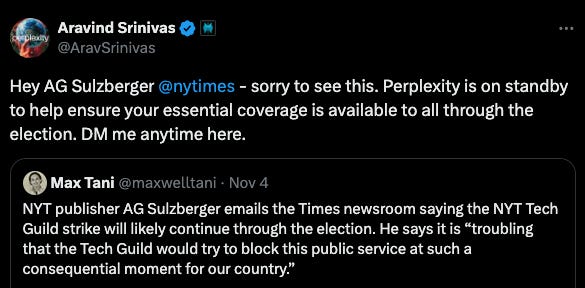
Aravind Srinivas—CEO of AI search company Perplexity—caught flak for publicly offering his company’s services to the Times on X to help through the strike. Though he’s otherwise at odds with the Times, Srinivas’s offer highlights what happens when employees believe they can capture more of the overall value balance than is feasible. The company can replace them. With the rise of GenAI, that’s more of a real threat to employees than ever.
Employees will always remain one of the three key groups the CEO serves. If you are not giving your talent opportunity and treating them fairly, your company is not sustainable. At the same time, it’s not the CEO’s job to offer employment opportunities that degrade the value of customers and shareholders long-term. The CEO should be aware of technology and the part it plays in the balance of the company.
Srinivas later walked back his offer, clarifying he didn’t mean for his AI tool to “replace” striking workers. (Whether it’s wise for a CEO to make such offers publicly is a topic for another post.) But the controversy highlights a dynamic CEOs will increasingly have to contend with. Tech tools, AI especially, have the potential to skew the value balance between groups.
Services Sector Looking Good
Per MarketWatch, the services sector is taking a sanguine view of the world:
An index of service businesses climbed to 56% last month from 54.9% in September, the Institute for Supply Management said. It’s the highest reading since July 2022.
Numbers over 50% are viewed as positive for the economy.
Service companies such as retailers, banks and hospitals employ most Americans and dominate the economy.
“Business is booming, nothing slowing down,” an executive at a utility told ISM. “Business is good,” said another executive at a construction firm.
It will be very interesting how Christmas plays out from a retail perspective—whether American consumers share this feeling.
Can Texas End-Run the Wall Street Rigmarole of Going Public?
The Texas Stock Exchange (TXSE) is set to launch next year. The exchange’s CEO, James Lee, hopes to give companies access to public markets without all the expense and procedural barriers of Wall Street.
He notes that fewer companies are going public in the US, though companies globally aren’t following that trend. He intends the TXSE to both clarify and simplify the regulatory barriers to accessing a public market while also raising the standard for companies that do come on. This clears out the lower end of companies trading on exchanges like the NYSE and NASDAQ—companies that Lee believes “distort” the market.
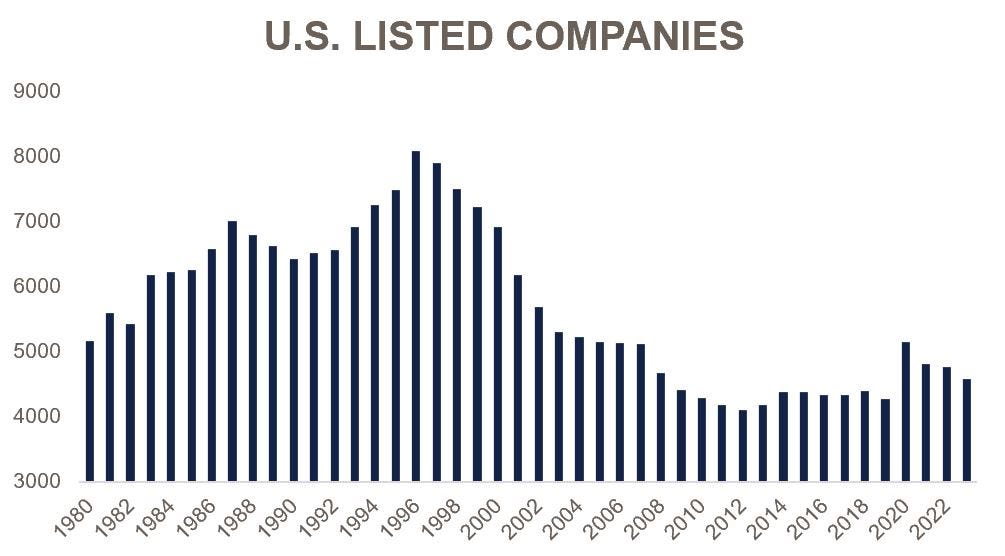
Says Lee: “We’re limiting access of public markets, and we have to have, in a capitalist society, functioning public capital markets. And so it’s something that we aim to change.”
I think TXSE bodes well for the continued trend of company relos to Texas. The latest include:
YTexas does a great job chronicling these moves if you’re interested.