


In the age of ESG, CEOs face constant pressure to “take a stand” on the issues. As we await tonight’s outcome, here’s my regular reminder to resist this pressure.
It feels like you’re damned if you do, damned if you don’t—but the damnation for NOT doing it is overstated.
Once you wade into the fray, you can’t wade out.
Sometimes you get pressure from one stakeholder group to say something… whether it’s about climate change, women’s issues, DEI, national political figures—the list is endless. Other times, you might personally feel strongly convicted about something and feel it’s your duty to speak out.
But we all see the fallout. It happens on both the left and right, whether you’re Howard Schultz at Starbucks opining on same-sex marriage in 2013 or Robert Unanue at Goya speaking at CPAC in 2021. “Bud Light” is still a rallying cry. For all he’s achieved, Elon Musk has also placed a huge target on his companies’ backs by becoming politically active.
My case for holding your tongue is pretty simple:
Your responsibility as CEO is to balance the interests of your customers, employees, and shareholders. If speaking out on a political issue does not create value for these groups as a whole, it’s incumbent on you to resist. You are not in the role to be a pundit or have a political microphone. You are there to deliver results for these three groups.
Someone will always be angry. The second you touch a third rail, you make someone mad. Even the people who wanted you to speak up probably won’t be happy. (“She didn’t say enough,” etc.)
People, including Zoomers, are more sensitive to “woke-washing” than you probably think. People see through facile statements meant to appease one group and generally react better to neutrality. From Boston University:
At a time when consumers are both wiser and more jaded about the motives of a company taking a sociopolitical stance—according to a 2019 Edelman Trust report, 56 percent of people believe that too many brands are guilty of “woke-washing,” using social justice issues to get in the public’s good graces with the sole intent of selling more—that consistency is vital.
Where do most CEOs fall on the political spectrum? There have been shifts in the past two decades, with the number of left-identifying CEOs increasing (via FT):
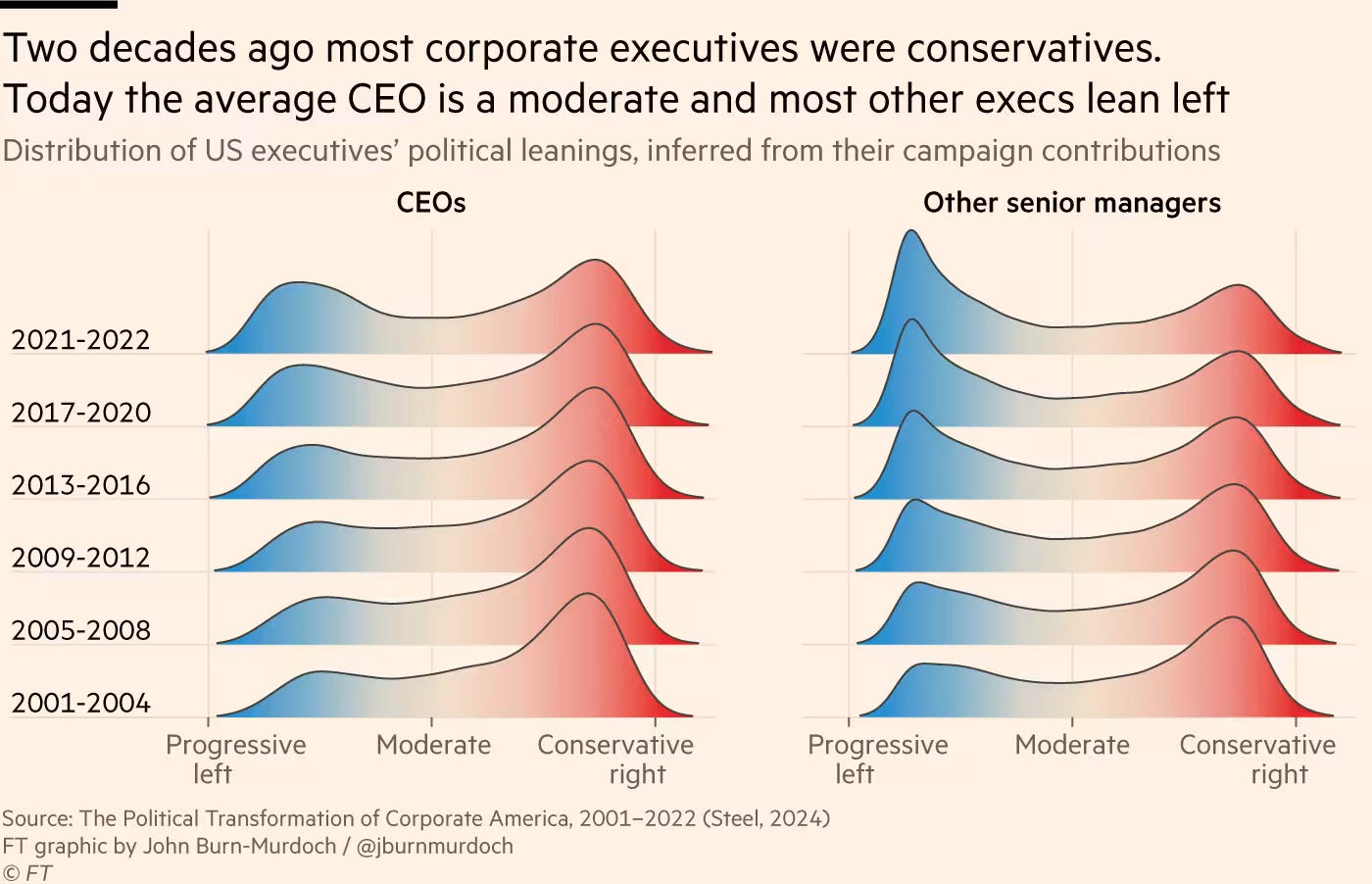
But this doesn’t have much bearing on the basic truth: The consequences for getting political as a CEO usually outweigh the benefits.
I can think of two exceptions:
The issue affects your core business, and thus your three stakeholder groups (shareholders, customers, employees). If you are the CEO of ExxonMobil, your company obviously has a stake in energy policy.
The issue is one you feel so strongly about that you cannot morally be silent on it. In this case, decouple whatever you say from your official position and be aware that backlash is likely to come anyway. If you feel you must ethically become involved in the issue, you may compromise your ability to lead the company—which is a valid decision.
What’s your philosophy on the CEO’s role in the political sphere? Let me know below.