


Happy Monday, reader.
Here’s a reminder of a few of the CEO tools you’re welcome to take advantage of:
Create or refine your 1-Page Strategic Plan with our custom AI agent
Build your leadership User Manual
Grab a complimentary CEO advisory session with me

Several years ago, I met with an executive team that felt they were really good at setting company goals.
I was there in a consulting capacity. The CEO told me that it wasn’t him or the other C-suite folks who needed help with goals. They were all totally aligned on the objectives.
(As he told me this, he interwove his fingers to emphasize the point.)
Rather, this CEO explained, it was the lower layers of the company who were really struggling. Despite the crystal clarity at the top of the organization, employees tended to drift off and do their own thing. I was there to hopefully help them realign and execute.
I was a little surprised by this team’s confidence. If they were already aligned, could I really help?

So I walked up to the whiteboard and asked them to tell me what the most important goal was.
Sure enough, like a chorus, they chanted:
“Grow 40 percent!”
In a world where most executives can’t name their company’s goals, this was impressive.
But then I asked the critical next question. “How are we measuring that?”
A few glances around the room, and then the CEO said, “Revenue.”
The head sales guy frowned. “I think it’s billings.”
The supposed alignment started to fracture as this discussion played out, and it became clear they had fundamentally different mental models of success.
You can probably see the issue already, but measuring growth by revenue vs. billings is a distinction that actually matters.
Revenue recognition happens when you've delivered value to the customer, i.e., the service is performed or the product is shipped. Billings represent the cash you've invoiced, regardless of when you'll recognize it as revenue.
For a company with annual contracts, this distinction matters enormously. If you bill customers $120,000 upfront for a yearly subscription, you've booked $120,000 in billings on day one. But you'll only recognize $10,000 in revenue each month as you deliver the service.
These different metrics incentivize different behaviors. A billing-focused sales team might push for longer contract terms and bigger upfront payments, even if it means discounting heavily. A revenue-focused organization might prioritize monthly recurring revenue growth and customer expansion, even if it means smaller initial deals. The sales team was optimizing for one thing while the CEO was measuring success by another.
But the problem with this overconfident team got even deeper. As the discussion went on, it became clear the marketing leader wasn’t thinking of “growth” in terms of revenue or billings. She was focused more on racking up new customer logos, the more recognizable the better.
Meanwhile the other execs in the room (including HR and the head of product) technically had goals at the company level, but this poorly defined 40% growth goal was clearly the only one the CEO cared about.
Thus we see how this team actually wasn’t very good at company goal setting after all. They all just knew “40% growth” and could repeat it on cue.
This is one of the more typical scenarios when it comes to company goal setting. Usually when I go into a company, it either:
has no measurable goals to speak of
has goals, but it’s more a laundry list of 20 different activities
has decent goals, but they’re gathering dust in a folder somewhere
has a revenue/sales goal that’s the only thing anyone cares about
Getting It Right
If you’ve read this Substack before, you may be familiar with the goal-setting model I use. It’s pretty simple, but it’s the one that I recommend without fail, because it does work to keep people aligned across the whole business
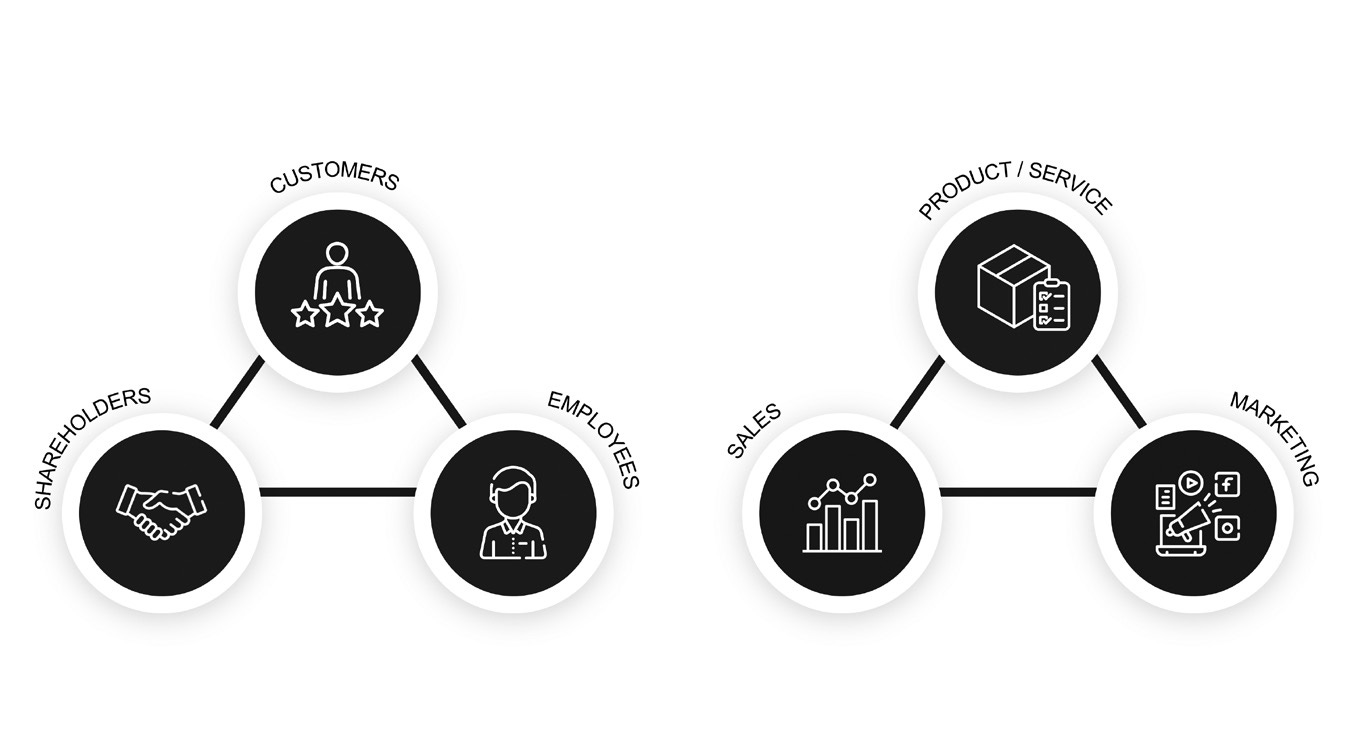
Step 1: Each of the six core areas of your business gets a company-level goal each quarter.
This reflects the fact that you must deliver value to each of your three stakeholder groups (the left triangle) through clear activities in the core functional areas (the right triangle). You can read more about that model here.
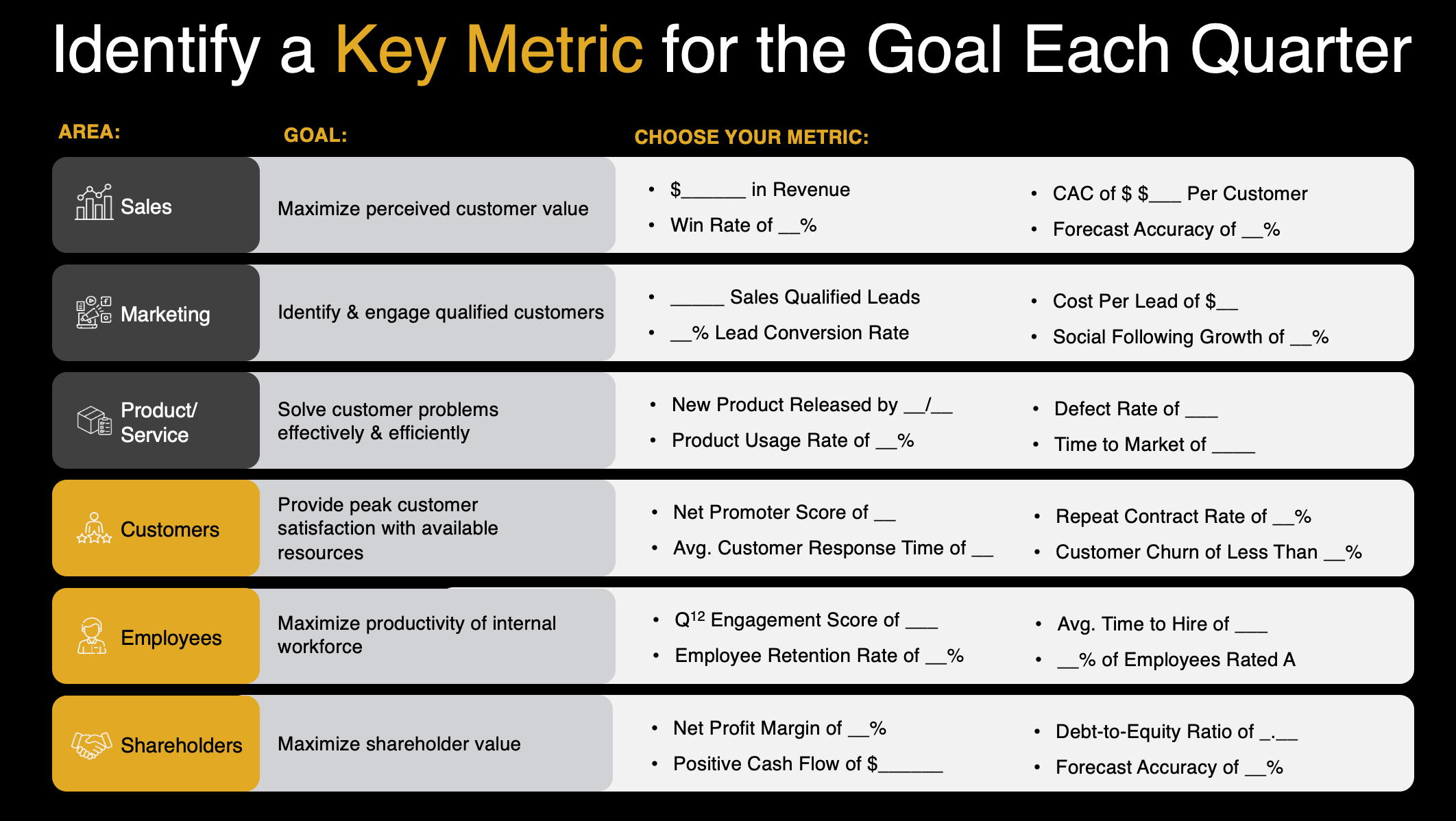
Step 2: Every goal gets a defined measurement.
Pin down exactly which metric spells success for each goal. If there are disagreements, hash it out before people get to work on the goal.
Step 3: Review the goals weekly.
The executive team must revisit the goals weekly together to discuss progress, forecast likelihood of achievement, and move aside roadblocks.
Only when you’ve got these essentials covered do I believe you can say your executive team is good at goal-setting. The good news is that once you do, you’ll put yourself far ahead of the competition. Because goal clarity is a rare thing indeed.