


“Managing is easy, except for the people part!” —Geoff Smart

There may be no one in the modern organization more overlooked than the middle manager.
They usually don’t get much love from the top of the organization. Few companies offer middle managers robust support, training, and tools. Without that backing, the middle manager doesn’t get kudos from their team either. They’re still “one of them.” A figure to be tolerated, or maybe griped about at happy hour.
The middle manager finds themselves caught in the middle.
Some predict a storm coming. As HR executive Shana Storey wrote recently in Fast Company:
Recent data shows a staggering 75% of middle managers report being overwhelmed by their workload, while 40% of newly promoted managers are already considering leaving their positions. More than half admit they’re too swamped to give their direct reports adequate attention. Most alarming: Only a small fraction receives proper development upon promotion, with even fewer receiving ongoing development.
Now, this week, Fortune reports on a predicted “manager crash” in 2025, where these stressors may come to a head. Burnout and turnover are likely results:
Employees who don't feel supported by their managers tend to struggle during times of transformation. Workers—at any level—are more than four times as likely to quit their jobs, and twice as likely to report poor overall wellbeing when they don’t feel supported, Fincke warned.
This “manager crash” prediction is one small study from a digital coaching provider, so take it with a grain of salt… but it does align with general trends I think all of us are seeing. With many managers trying to navigate return-to-office, layoffs, disruptive tools like GenAI, they need support more than ever.
Should you find yourself caught up in the spirit of Thanksgiving this week, I recommend apportioning some of your gratitude to your managers. They don’t have to be an afterthought. The best-run companies I’ve seen in fact treat managers very different than the average company does.
It really does matter.
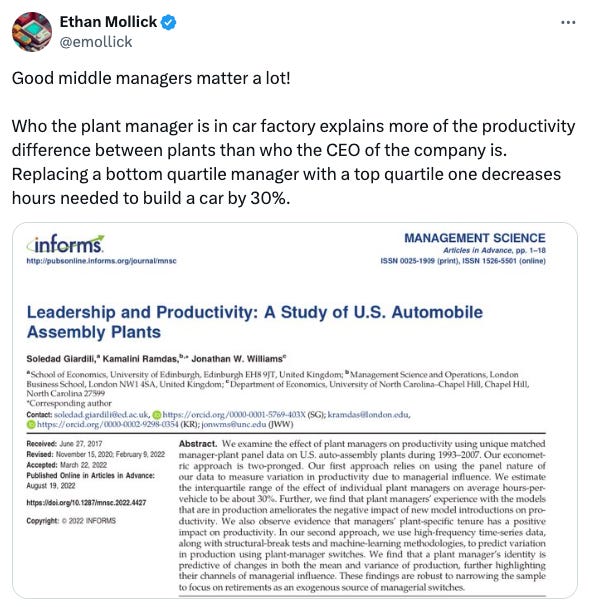
One study found that “who the plant manager is in [a] car factory explains more of the productivity difference between plants than who the CEO of the company is.” Maybe we CEOs even need a dose more humility about how distributed leadership needs to be in order for our companies to succeed.
The bottom line is that no organization can thrive long term without a system for its managers, including:
Clear expectations around how people managers operate at your company.
Focused skills training as a person moves from individual contributor to manager.
Coaching and recognition around good management.
(By the way, if you need some help getting that system set up, my team can help. Email me.)
Also on my radar…
Government assistance isn’t a business plan. If you’re a CEO or business owner, you should take advantage of government programs that could help your company. No reason not to. But never operate your company in such a way that it relies on them. Things like this will happen: Intel is “disappointed” at how long the Biden administration is taking to release funds from the CHIPS Act. Intel has been waiting for two years, and now the administration is scrambling to roll out the $39B in funding before Trump takes office. “Only two deals, worth $6.6 billion, are fully finalized, according to the Commerce Department.”
Newsflash: Headlines are misleading. Take this one from the NY Post, “Disney CEO Bob Iger sold $42.7 million worth of company stock.” The average news skimmer sees that and pictures Iger pocketing all that money, having lost faith in Disney’s future. A read of the story reveals Iger in fact is exercising a routine maneuver, and that he had to buy the stock first so he could sell it. He’s exercising the right granted in 2014 to a strike price of $92.24 per share, set to expire in December. He earns only the difference between that strike price and the current share price. He comes away with about $8M, before taxes. A nothingburger of a story with a clickbait headline.
Another skewed headline. You may have also seen this headline about an irate CEO who fired 90% of his staff for missing a morning meeting. The headline is clearly meant to get people worked up—“Wow, this CEO is unhinged” or “Employees are so lazy now!” But if you read the story, most of the people “fired” were in fact part time volunteers. You can’t really fire a volunteer; you can just no longer let them work for you for free (something already limited heavily by regulations).