



There’s a stat floating around the internet that high-performing CEOs read 60 books a year.
As far as I can tell, there’s no actual data to back that up. File under: Don’t believe leadership statistics you come across on the Internet.
That being said, great leaders and business minds do read a lot. Warren Buffett said that he “reads and reads and reads. I probably read five to six hours a day.” Asked how he learned to build rockets, Elon Musk reportedly said, “I read books and talked to people. . . . That's kind of how one learns anything.”
For every book I read, I typically come away with a key idea I can put to work in my business or apply to my leadership practice.
Reading is also worthwhile because it:
Builds your focus muscle. Paying prolonged attention is a skill that can be applied to other facets of your life as well.
Drives curiosity. Reading reminds you that there’s a vast universe of people, ideas, and events out there. There are few quicker ways to broaden your view of the world than immersing yourself in a book.
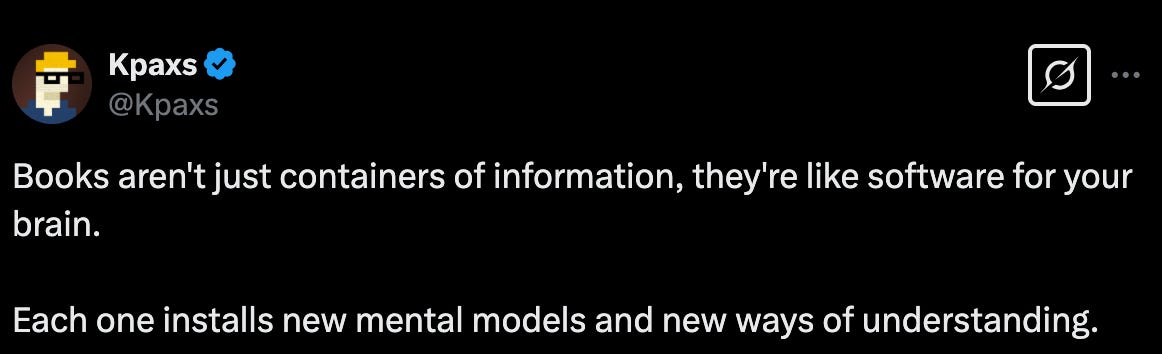
Gives you access to new thinking models. Great X post I saw recently:
Here are five reading topics for CEOs. Each of them can round out your ability to be an effective leader:
1. Business & Business History
Obviously it’s a good idea for CEOs to keep up with business reading. There are a lot more “fluffy” books in this genre than some of the others below, so you have to be discerning. But a great business book—for example, The Art of Action by Stephen Bungay or The Advantage by Patrick Lencioni—can be a game changer. Business history (a crossover with number 3 below) is also a fruitful subcategory. Reading about epic downfalls can be just as instructive as reading about the big successes.
Recommended read: Barbarians at the Gate: The Fall of RJR Nabisco, Bryan Burrough and John Helyar
2. Game Theory & Decision Making
In the book Game Theory: Analysis of Conflict, Roger B. Myerson defines game theory as “the area of mathematics that studies conflict and cooperation between intelligent, rational decision makers.” Clearly, this field is applicable to business and can help you make better decisions. It often involves analyzing how to make the best possible decision with incomplete information.
An excellent application of this is Colin Powell’s 40/70 rule. He said that a leader should make a decision with no less than 40 percent and no more than 70 percent of the information available. If they make the decision with less than 40 percent of the information, they are merely guessing. However, those who are afraid of making a decision and wait for more than 70 percent of the data delay the decision needlessly. For important decisions, this can grind the organization to a halt. Game theory can help you capitalize on that 70 percent.
Recommended read: Decisive: How to Make Better Choices in Life and Work, Chip Heath & Dan Heath
3. History & Biography
Harry Truman said, “There is nothing new in the world except the history you do not know.” Great leaders know the histories of their industries and lots of others. They read business-related histories and biographies to understand how different industries developed and draw parallels to today.
Knowing your history will make you better able to deal with rapid changes as they occur in your industry and discipline—and give you some great ideas in the process. And understanding the successes and failures of the leaders who came before you gives you a more sophisticated understanding of how best to react to the challenges you face. For example, I found Plain Speaking, the oral biography of Truman himself, to be not only fascinating but instructive to anyone in a leadership role.
Recommended read: The Splendid and the Vile: A Saga of Churchill, Family, and Defiance During the Blitz, Erik Larson
4. Communication & Emotional Intelligence
With my engineering background, I used to think all organizational problems could be solved analytically. But I’ve come to realize that 90 percent of running a business is the hazier, more subjective people stuff. (As they say, “the soft stuff is the hard stuff.”) Learning to understand the people around you and let that understanding guide your interactions with them is a key skill of any successful CEO. While people skills can’t be learned purely from the pages of a book, mining the rich vein of knowledge that followed the 1995 publication of Daniel Goleman’s Emotional Intelligence gives you a solid foundation to work from.
Recommended read: How to Know a Person, David Brooks
5. Mindfulness
My CEO-S cofounder Sherif is the guy to talk to when it comes to the mental and spiritual side of executive leadership. Sherif’s message resonates with so many of the CEOs we work with because if you can’t master yourself, you’re going to find it really hard to lead others. What Sherif teaches can be summed up with the word mindfulness, the practice of staying present, aware, and calm under pressure. No doubt you can see how this is a needed tool in the leader’s belt.
Recommended read: The Untethered Soul: The Journey Beyond Yourself, Michael Alan Singer
Don’t have much time to read? Consider…
Audiobooks. Listen rather than read using services like Audible. Try switching to book-listening while you drive or work out.
Book summaries. I encourage you to build the discipline to read whole books, but you can also quickly gather key ideas with Blinkist or Shortform (or just ask ChatGPT, Claude, or Grok to give you the key takeaways from a book you’re interested in). I find these summaries to be helpful reminders for after I’ve read the book.
Quote organizers. I do a lot of reading on Kindle and use Readwise to organize and revisit my notes regularly.
Looking for your next read?
The CEO Library catalogs books recommended by figures ranging from Richard Branson to Naval Ravikant to Eric Schmidt.
Feel free to DM or email me for the reading list we share with attendees of CEO Masterclasses.
Have a great week, and get reading!
Great recommendations!