


This week, Intuit—provider of TurboTax, QuickBooks, Credit Karma, and Mailchimp—announced it is laying off 1,800 employees, about 10% of its total headcount.
CEO Sasan Goodarzi made a point to note that the purpose of the layoff is not cost-cutting. Rather, it is a simultaneous culling of underperformers (about 1,000 of those let go were “not meeting expectations”) and a decisive shift to an AI focus. To replace the outgoing employees, about 1,800 new people will be hired in AI-related areas, with more investment in the company’s AI-powered financial assistant, Intuit Assist.
From a corporate messaging perspective, I see how shareholders and to some degree customers—two of the three key constituent groups whose interests a CEO must balance—will be pleased to see the company keeping pace with AI. But many Intuit employees, those making up the third key constituent group, are likely puzzled by the packaging of this development. Layoffs are always difficult, but the bundling of several messages such as “We had a great deal of C-players,” “This is not a cost issue,” and “We must invest more in AI” is likely to confuse and frustrate some employees, perhaps reading as a message crafted primarily for investors.
To be clear, Goodarzi’s tenure at Intuit has delivered excellent results, and overall this seems like a positive move for the business. But the scattered message is a good reminder that in everything we do as CEOs, we must have a three-part mind. How will each of our three constituent groups—employees, customers, and shareholders—view decisions and the messaging we place around them? What solutions balance their needs properly?
In this case, one simple solution offers a good rule of thumb for CEOs: When announcing layoffs, don't tie it to other news. Let it stand on its own. It's a sensitive enough issue for employees—those leaving and those staying—that the message should not be diluted or placed alongside competing messages. Intuit is offering generous severance packages to those being laid off; letting the announcement be solely about the layoff and giving more focus to these benefits may have helped significantly. A separate, later release could then discuss the company's investments in AI.
You’ll never be able to please everyone. Particularly around developments like layoffs, employees will always be, understandably, upset. But running major comms through the employees-customers-shareholders filter often prevents needlessly alienating one of the three groups.
The Rundown
Consumers Are Spending—and Suing
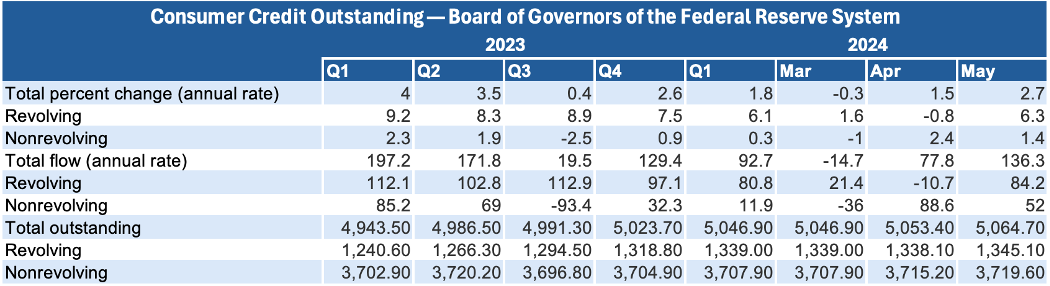
Consumer credit is now up $41 billion from the end of last year.
Data released by the Federal Reserve earlier this week showed that consumer credit has jumped by $11.3 billion in May following a rise of $6.5 billion in the previous month. The largest gain was in revolving credit, which increased by 6.3% and was mainly due to credit card spending. This rise was well above economist forecasts of ~$8 billion. (It’s important to note that the data provided by the Federal Reserve omits mortgage loans, which is the largest category of household debt and typically the largest debt expense for borrowers.) Total outstanding consumer credit has jumped by nearly $41 billion since the end of Q4 2023.
Interestingly, there is also a litany of lawsuits currently targeting the credit reporting agencies Experian, Equifax, and TransUnion. In the first six months of 2024 the number of claims citing the Consumer Financial Protection Bureau have almost doubled compared to 2023. Claims citing the Fair Credit Reporting Act have also risen by 23.3% in the same period. Higher interest rates have caused many borrowers to pay closer attention to their credit reports, and there is an unprecedented number of unrepresented plaintiffs in these lawsuits. Some legal experts believe this could be due to a rise in reporting errors on the side of creditors; others blame social media influencers who allege that they know the law and cause consumers to believe they have legitimate claims.
The spate of lawsuits is, I think, a sign that Americans are increasingly feeling the crunch—getting turned down for credit and seeing cash reserves (if they exist at all) dwindle.
When Is Too Much, Too Much?
Can anything be done about the gargantuan cost of servicing the national debt?
The US consumer isn't the only one in a debt crisis. The United States government’s debt balance stands at $34.86 trillion (as of today). With a monthly interest rate of 3.27%, the government's cost of servicing this debt is at an all-time high relative to its national income—it's projected to be 3.1% of GDP in 2024. This would put the estimated debt payments for 2024 around $1.5 trillion. As we refinance more of the debt, I expect that 3.27% interest rate to go the wrong direction (up). It's an unsustainable trend. Will the US dollar have to totally collapse for Washington to do anything about it?
The problem could be addressed with a relatively small budget cut. But that requires stepping out of the current paradigm. Right now, we assume the budget will go up by, say, 5%, and when it only goes up 4%, we call that a 1% budget cut. But the situation we're in requires an actual budget cut, not a slight brake-tap on overspending.

The Southern US Stocks Up on Housing
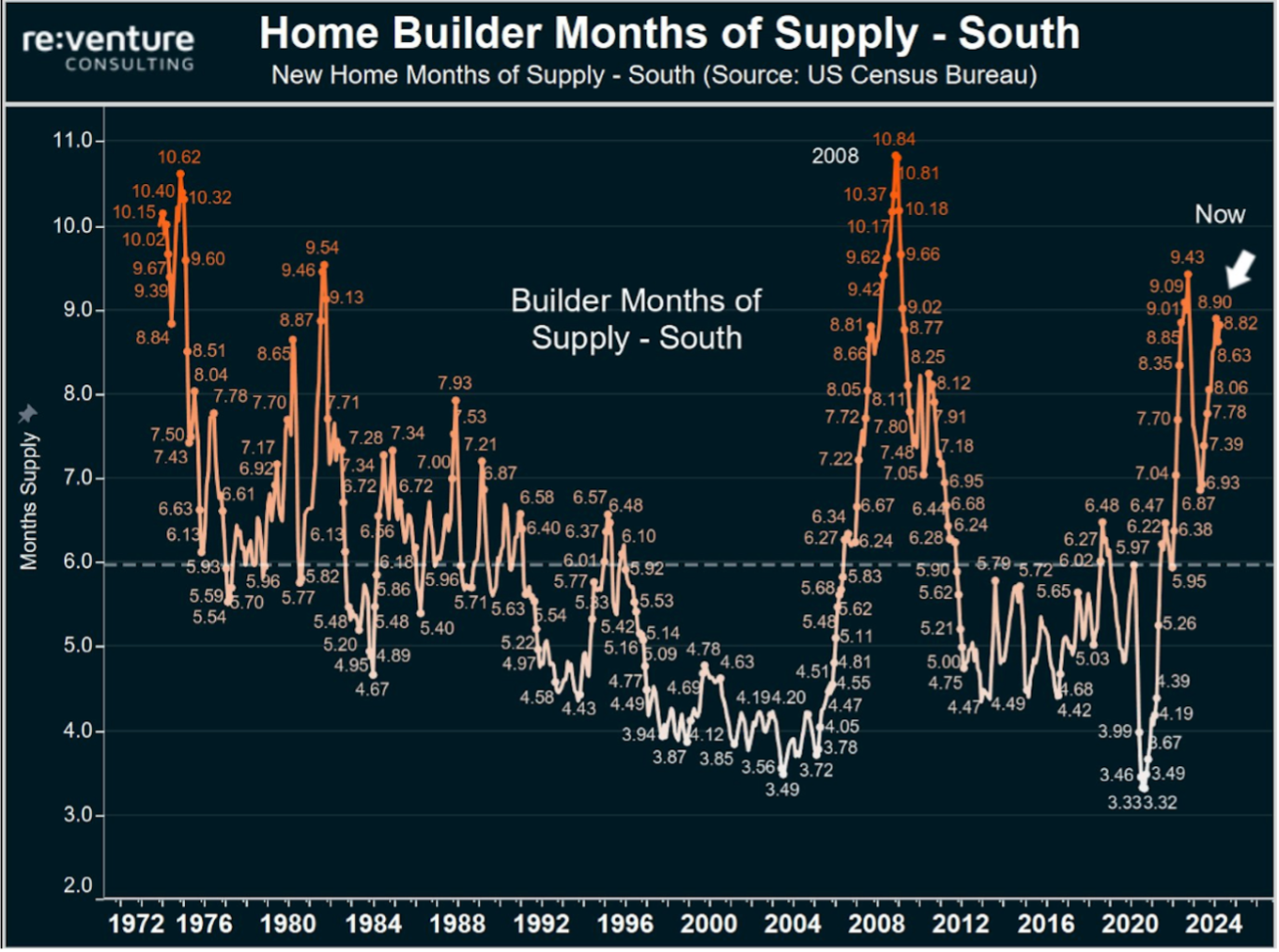
Southern states now have 9 months of supply in homes.
The American South currently has 300,000 new homes for sale, which is the highest amount on record and tops the previous high of 291,000, which was in—you guessed it—2006, before the Great Financial Crisis. Texas, Florida, and Tennessee are historically in the top homebuilding states, and building there dramatically increased post-GFC and into the pandemic. But new home sales since 2020 have nearly halved in this region. Homebuilders are now sitting on 9 months of supply, above the 6 months considered “normal.” The record is 11 months of supply, which we saw in both 2008 and 1974. Home prices in the South are also the most overvalued in the country, with states like Georgia, Tennessee, and Florida currently 30% overvalued. Given the level of supply we’ve now hit, however, we’re likely to see downward pressure on those prices.
In other regions, most notably the Northeast and Midwest, circumstances are different. These are currently some of the most undervalued regions and have limited homes for sale. Both regions have also seen new home sales remain within +/- 5% since 2020.


"Good management is the art of making problems so interesting and their solutions so constructive that everyone wants to get to work and deal with them." —Paul Hawken
"As much as people say they love change, they love it when you change—not when you want them to change. Even when it comes to processes they don't like, they're afraid of change." —Safra Catz
"The job of a CEO is to build an organization that can surpass the leader." —Michael Porter