


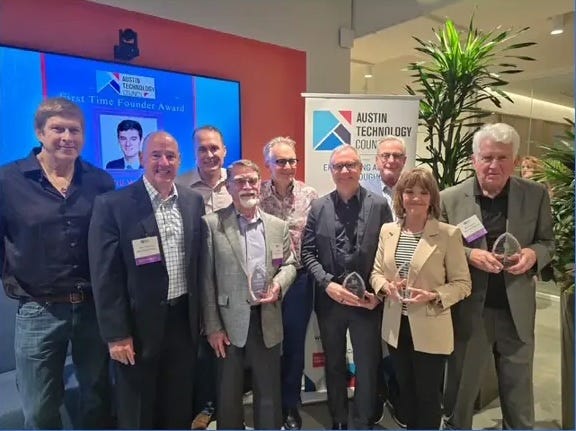
Last month, I was honored to be inducted into the Austin Tech Hall of Fame. When I first came to Austin decades ago, it was already a home to a vibrant tech community. Since then it has only grown, and grown, and grown. It has been a privilege to be here to see it, and to meet so many generous founders, entrepreneurs, and leaders in this space.
Below are the short remarks I gave at the ceremony last month.

Tonight I want to talk about inspirations.
I’m going to take you back to 1970 in a small town in the hills of North Louisiana, a town called Ruston. I was five years old, walking across the Louisiana Tech University campus with my dad, who was a professor there. Ahead of us is this monstrous 16-story building that has just been constructed. That was a big deal at the time, because the next-tallest building in Ruston, Louisiana, was three stories. For us, it was like the Empire State Building going up in our town.
I said, “Dad, what’s that?”
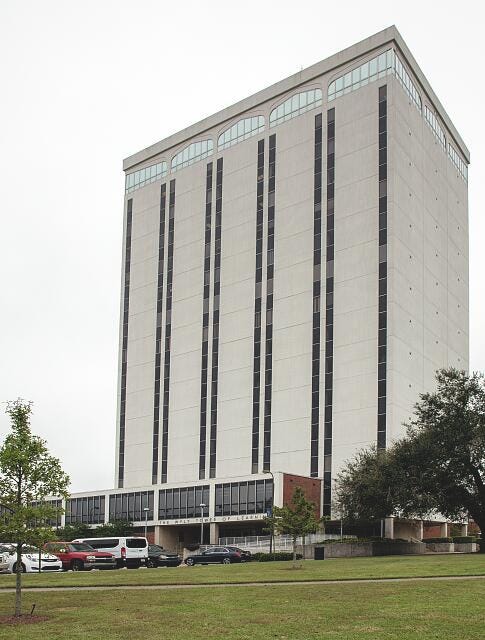
And he said, “Well, these two brothers from Tallulah, Louisiana”—a town even smaller than Ruston—“went to Louisiana Tech, made a bunch of money in the computer software business in Dallas, and donated money to build that building.” Those two gentlemen were Sam and Charles Wyly, who some of you may have known. If you’re interested in entrepreneurship, you ought to read their stories, because they had some great ones, and they were important in the US economy. That moment of hearing about them was my first inspiration. It was the spark that told me, Maybe some kid growing up in a small town in North Louisiana can be in the computer business. Who knew! It was mostly a mainframe business at the time, in the beginning stages, much like AI is now.
Later, in high school, I met a couple of entrepreneurs. We didn’t use that word in those days, but these were people who started and bought and sold small businesses. I learned that, hey, that’s another thing a person can do. I don’t have to go be a university professor like my dad wanted me to be. I could actually start my own business if I wanted to.
Then, years later, I came to Austin with my wife, who’s the brains of the operation. I’m not being humble there. She’s a 4.0 PhD in electrical engineering, a distinguished engineer from the University of Texas. In Austin, there was more inspiration. There was Michael Dell, who was already well on his way to becoming Michael Dell. That showed me you could build a world-class company right here. Then we got involved in the Austin Software Council.1
I moved out to Bastrop the other day and as I was packing everything, I came across a set of notes from a Software Council symposium in the year 2000. This was my chance to learn about how to do a software company. Back then, there weren’t a bunch of books and internet resources on that. You had to talk to people. You had to go to meetings.
There were some hugely inspiring people at that event. There was Ellen Wood from vcfo presenting on how to finance a business. And there was Mike Maples from Microsoft telling us how to build software. And many more in that vein.
From there, we got my company, NetQoS, funded, which was based on my wife’s work. Unfortunately, we didn’t get the funding from Austin Ventures—you passed on that one! But a company out of New York funded us, led by a guy by the name of Tom Greig, who had run the DLJ’s investment banking practice on Wall Street. And they invested $11 million in us in June of 2000.
For those of you who remember the business climate in June of 2000, it wasn’t great. The internet bubble was starting to burst. Then 9/11 hit and all heck broke loose. I remember going to a Fortune 500 CIO who had a billion-dollar budget and pitching him our product. He said, “Joel, that’s the best product I’ve ever seen from a startup, but if it costs a dollar, I can’t buy it.” That’s when I realized, Damn. This is tough. I didn’t know what to do.
By the time of our board meeting in September 2002, we had $3 million in the bank. I was ready to tell the board that if it was my money, I’d take it and go home. I knew we had a great product and a great team, but we couldn’t sell anything. So I walked into the board meeting, and as the first item on the agenda, I told them exactly that: “If it was my money, I’d take it and go home.” Tom Greig looks me in the eyes and says, “We have a checkbook. If you need more money, let me know.” If it had gone otherwise, I wouldn’t be standing here today. I still get emotional about that today. Tom and the other people in that room inspired me.
Then as we got Austin Technology Council going, there was a lot of camaraderie and inspiration among the Austin Tech CEOs. It seemed like every CEO in Austin that was in technology, right? People like Mark McClain, Rod Favaron, Larry Warnock, Jan Ryan. We had Joe Liemandt, who brought so much talent to Austin. And people like Josh Baer, who’s done so much to create startups.
Then, being in the networking business, Bob Metcalfe was my hero. I mean, he invented Ethernet, founded 3Com, and was a tennis player for the Beavers, just in case you didn’t know that.
All these people offered so much. They were all willing to talk, willing to share what they knew. They were willing to open doors and give you time. Those of us who have been around a long time understand that the most valuable thing we have is time. Those people were willing to give it.
My hope is that 20 years from now, standing here, someone might say, “There was this old guy named Joel Trammell who inspired me to do something.” Whatever that is, that’s the legacy that matters.
Thank you to the Austin Technology Council and Thom [Singer] for doing this. It’s a great event and I’m honored to be part of it.
As the Austin Technology Council was known upon its founding
Dang. I've heard that Tom Greig story about 100 times over the years, and I still get choked up about it... and I wasn't even in the room! Congrats on your induction, Joel. You have been one of the great unsung heroes in the Austin tech community for a long time. What you now teach in your CEO and executive workshops about leadership is so powerful; so many executives have benefited from it over the years, including me.
Congratulations, Joel!