



Ever since Paul Brown started playing back film for the Cleveland Browns in the 1940s, game tape has been an indispensable tool in professional sports.
Nothing helps you learn faster than looking back at an objective record of reality. If you’re a player, you can see your performance reflected with the unblinking eye of the camera. If you’re a coach, you can analyze how your team is playing from a standardized view of the game, like the all-22 view for football coaches.
The eye in the sky, as they say, don’t lie.
Watching tape is key. I basically watch every game. It's the only way to break down your opponents. —Tony Parker
Game tape allows you to analyze, pause, rewind, and understand exactly what happened on the field. You can follow the thread from kickoff to finish and see how it all came together. The objective, of course, is to understand what’s working and what isn’t, and how to improve for the next game.
As leaders in the business context—specifically, as managers and coaches of our direct reports—we really need some kind of game tape to do our jobs well.
Unfortunately, you can’t watch a recording of Steve typing at his laptop for hours and figure out why he missed two of his goals. That’s not how knowledge work works.
The way most managers conduct their performance reviews reminds me of what it must’ve been like to be a pro football coach before the 1940s.
There’s no objective record of performance, so perception trumps objective reality.
There’s a big reliance on memory, which can be distorted by emotions.
Blame can easily be shifted. There’s no eye in the sky to keep the team accountable.
This is a BIG part of why performance reviews are so universally mocked and dreaded. Because managers lack a concrete record of the employee’s performance over the past quarter (or even year), they rely on perceptions, memories, vibes, assumptions, and sometimes vanity metrics that don’t really correlate to the business outcomes the employee produced.
This adds up to a performance review that feels strangely lacking in substance and, if you get a critical review, very unfair.
Your next question is probably, “Well, if we can’t just record people working, what does game tape for a manager look like?”
I believe it comes down to three items:
A set of meaningful, measurable goals for the employee at the start of each quarter.
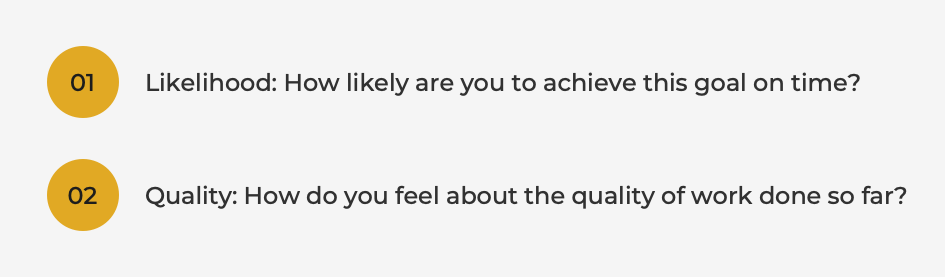
A weekly record of the employee’s rating of those goals. Specifically, how they feel on a scale of 1-5 about the Likelihood of the goal’s achievement and the Quality of the work done so far. (Read more about Likelihood and Quality.)
Short supplemental notes from the weekly 1-on-1.
With this setup, your quarter becomes the current game, your team are the players on the field, and the weekly goal update and notes are the game tape.
Each week, you're capturing a snapshot of where things stand, straight from the employee. What’s going well? Where are they struggling? What risks do they see? Are they happy with the work so far, or are trade-offs happening to keep the goal on track?
When you add your own brief notes during the 1-on-1 (what you observed, what you advised, what action items either of you committed to) you start to accumulate a reliable, rolling log of the quarter. That record becomes your playback footage.
Then, at the end of the quarter, you have a rich record to review in the performance review.
You can go back to week 3 and remember that a project was delayed by a vendor issue.
You can see that in week 6, they self-reported a quality drop and asked for help.
You can watch how the trajectory of a goal changed over time—and whether your interventions helped.
Instead of just saying…
You didn’t hit the goal. Try harder next time.
…you can say things like…
You reported high Likelihood until week 10 of the quarter, but then the goal wasn’t achieved. Let’s talk about what happened and how we can catch that earlier next time.
The conversation becomes less about judging and more about learning. You get to actually coach the employee, because you have some good, objective material to work with. It makes all the difference between the typical fluffy nonsense red-tape performance review and an in-depth collaboration on how to improve performance.
By getting that game tape each week, you’ll feel more confident you’re helping your team perform at their max. And just as important, you’ll build a lot of loyalty and appreciation from your team, who see you taking the time to help them get better too.
Shoot me an email if you want a lightweight system for capturing game tape (or having all the managers in your organization do so).