


Today’s article makes the case that managers who put people on PIPs are probably failing at one of their core duties: continuous coaching of their direct reports.
As I argue below, organizations where managers actually do this well end up with an unfair advantage in the market.
This means that CEOs should care a lot about how coaching gets done in their organizations. If you’re a currently serving CEO based in the US, I am happy to send you a complimentary card deck of 1:1 questions to use or share with a manager in your company. The deck contains what I think are the best questions to ask in 1:1s, and many directly support good coaching.
Just email me at joel@ceosys.co with your mailing address.
I cringe every time “PIPs” come up. It’s usually a manager asking, “Should I put my low-performing employee on a PIP?” — a performance-improvement plan.
To my mind, the question itself points to a pre-existing failure in the manager. Every manager should be working on improving the performance of every employee, all the time. Their whole job is essentially to keep the team on a performance-improvement plan.
So when I hear that question, “Should I put so-and-so on a PIP?” the question behind the question is, “How do I justify firing this person?”
This is a failure of the manager, not the employee.
That’s because every manager should be in a genuine coaching relationship with every one of their direct reports. PIPs happen when that coaching relationship is absent or has failed.
The Difference Between Managing and Coaching
Coaching is a distinct tool from managing. (You can read my short article on the core three tools of managers on RealLeaders.)
Managing is about making decisions. It’s about answering concrete questions based on your positional authority on the team: What should our priorities be? Who should we hire? How do we change the process? These are necessary decisions, and no one is suggesting you stop thinking about them.
Coaching, on the other hand, is an ongoing, structured dialogue designed to develop the person sitting across from you into someone more capable than they were last quarter. It’s about supporting the person who executes those decisions you make as the manager. What’s holding them back? Where are they coasting on talent instead of growing? What would their work look like if they operated one level above where they are today?
Most managers use the management tool much more than the coaching tool. They answer the “what” of the team’s work but don’t help with the “how.” They check in on projects, clear roadblocks, and allocate resources. When performance is strong, they leave it alone, which is its own kind of neglect. When performance lags, they address it, but usually bluntly, and after it’s already too late.
A better mental model is to think of each member of the team as a dynamic asset, not a fixed one.
The mental model here is essentially “The status quo is decent performance. My job is to step in when someone doesn’t meet that bar.” That’s where you start getting PIPs.
A better mental model is to think of each member of the team as a dynamic asset, not a fixed one. The real job of the manager is to continuously develop those assets and keep them working in concert, making sure performance is on a steady, predictable incline every single week.
Why Managers Resist Coaching
Why are so many managers slow to pick up the coaching tool day to day, making them have to rely on PIPs later? A few common reasons:
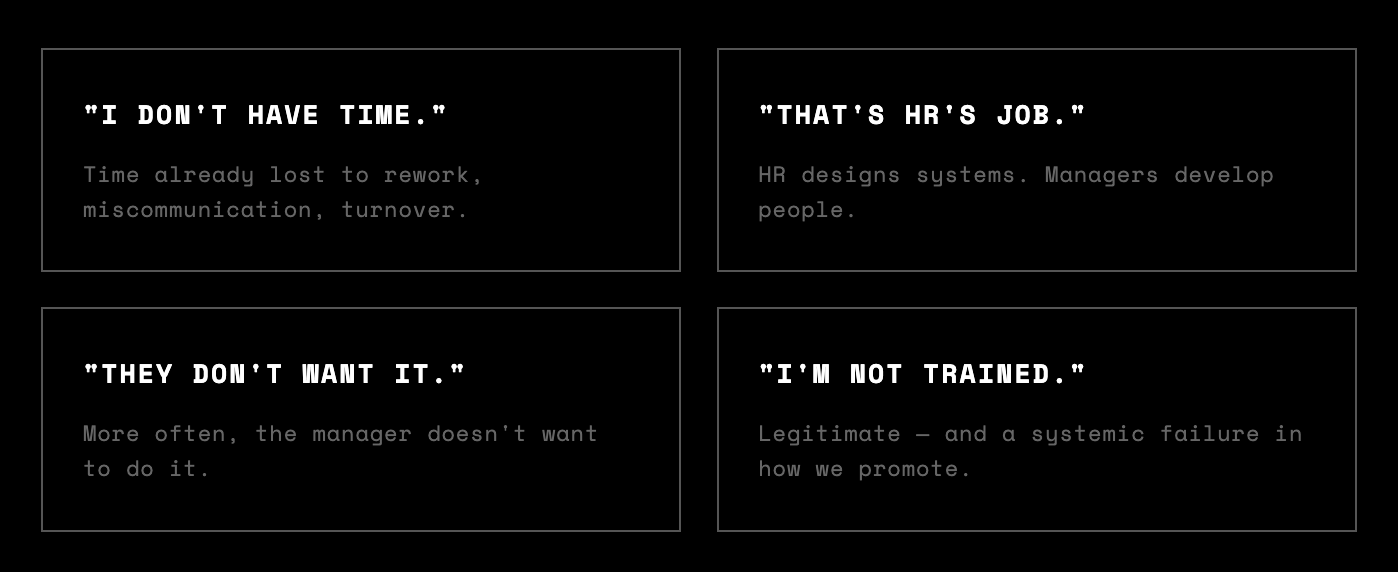
“I don’t have time.”
This is the most common excuse and the least defensible. The average manager spends an extraordinary amount of time dealing with the downstream consequences of underdeveloped people, including rework, miscommunication, turnover, disengagement. Coaching is not an additional time cost but a reallocation from reactive firefighting to proactive development.
“That’s HR’s job.”
No. HR designs systems. Managers develop people. The confusion between these two functions has done more damage to organizational capability than any single management fad of the past thirty years.
“Some people don’t want to be coached.”
Some people don’t want to exercise, either. That doesn’t make fitness optional for athletes. If someone on your team is truly resistant to development, that’s important information about their trajectory at your company. It is not a reason to stop investing in everyone else. More often, it’s secretly the manager who doesn’t want to do the coaching.
“I’m not trained for this.”
This objection is legitimate, and it points to a systemic failure in how we promote people into management. We take high performers and put them in charge of a team without ever teaching them how to develop other humans. Then we act surprised when they default to task management.
What a Coaching Relationship Actually Looks Like
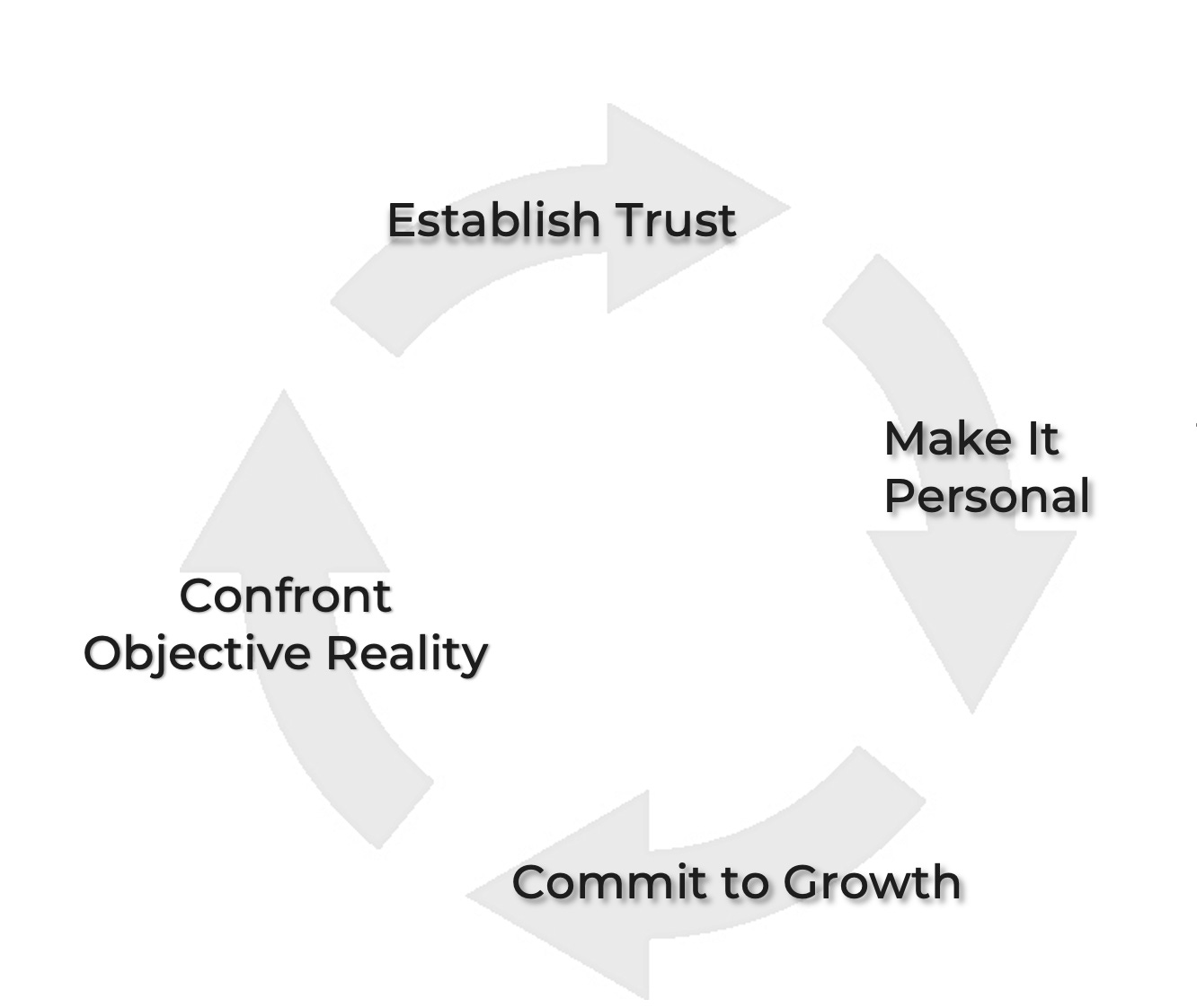
Here is the short version of the coaching process I cover in all trainings, including for CEOs:
1. Establish Trust
You can’t begin coaching until trust is built. Learn each employee’s personal story: how they got there, their long-term goals, their personal situation. Only once they truly trust you will they engage in a coaching relationship.
2. Make It Personal
Apply the Platinum Rule: every person is unique and needs to be coached uniquely. Notice individual strengths and reflect them back. Consider key dimensions: people vs. things, introverted vs. extroverted, tactical vs. strategic, management vs. individual contributor.

3. Commit to Growth
Ask questions that peel back the layers to reveal their desired path. Help them set growth goals that get them further down that path. Your best employees will be on a journey of growth over their entire career.
4. Confront Objective Reality
Hold the employee accountable for commitments made during coaching and as much as possible show them the objective reality of their performance and development path. Take strong notes, remember what the employee is trying to achieve, and ensure real, meaningful steps are being taken. Unless you show this discipline, you cannot expect discipline from the employee in carrying out a growth plan.
Good Coaches as Multipliers
A single manager who coaches well creates a compounding effect. Their direct reports get better, which means those reports’ teams get better. Decision quality improves. Execution tightens. The manager spends less time intervening because the people beneath them are operating with greater judgment and autonomy.
Now multiply that across an organization. If every manager at every level is engaged in real coaching relationships, you have a fundamentally different kind of company. You have an organization that develops talent faster than it loses it, that promotes from within because it actually can, and that attracts ambitious people because the reputation for growing careers precedes the recruiter’s pitch.
The companies that figure this out will have an almost unfair advantage in the next decade. Talent markets are tightening. AI is reshaping every role. The organizations that can continuously develop their people to meet new challenges will outperform those that simply try to hire their way through every transition.
The Real Barrier Is the Manager’s Identity
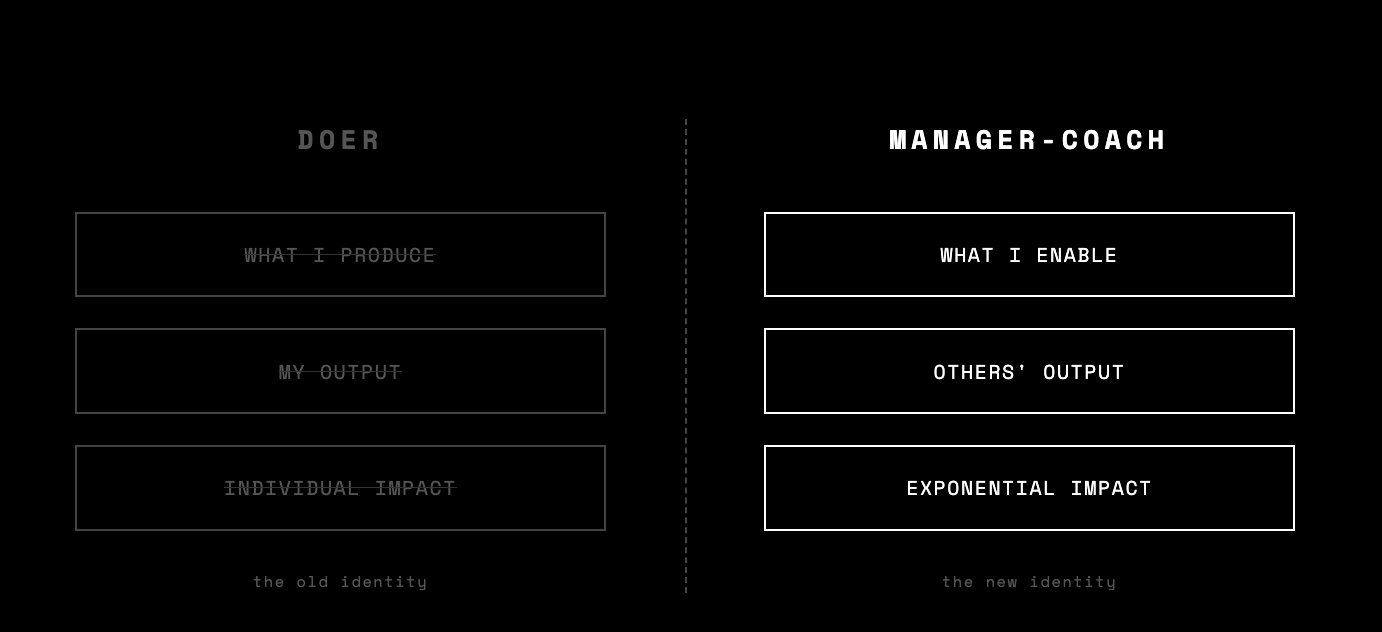
If we’re being fully candid, the deepest reason managers don’t coach is that they don’t see it as their job. Their mental model of management is only decision making, telling people what to do, not development. They were promoted for being doers, and they still see themselves as doers who happen to have people reporting to them.
Becoming a coaching manager requires an identity shift. It means accepting that your value is no longer what you produce, it’s what you enable others to produce. For many high performers, this is a genuinely difficult psychological transition. It feels like giving something up. The better way to look at it is the more accurate one: you’re exponentially growing your impact in the organization by getting work done through people.
If you manage anyone, open up a coaching and development conversation in your next round of 1:1s (which I hope you are doing weekly or biweekly). Rather than doing simple project updates, talk about your employee, their strengths, their obstacles, their trajectory, their ambitions.
It may be awkward the first time. That’s fine. Coaching is a skill, and like all skills, it responds to practice. What matters is that you start.
Well said. A PIP showing up is almost always a signal that the coaching relationship was either never built or quietly abandoned somewhere along the way. By the time you're formalizing underperformance on paper, you've already missed the window where development actually happens. A PIP should be the absolute final straw, not viewed as a development plan itself. I've literally seen a company using a PIP plan as a development plan and it blew my mind. It should essentially be reserved to say "You need to do XYZ, or your going to be let go."
Anyway, I really liked the identity shift point at the end and it's exactly right. It's one of the main reasons why I write on here to be honest! The leaders who struggle most with coaching are usually the ones who were promoted because they were exceptional individual contributors, and nobody told them the job changed. Their value used to be what they produced. Now it's what they enable. That's not a small adjustment, that's a complete rewiring of how you see your role.
But we have to develop leaders before they get into that role, not just expect them to know what to do or to just be able to pick it up along the way!