
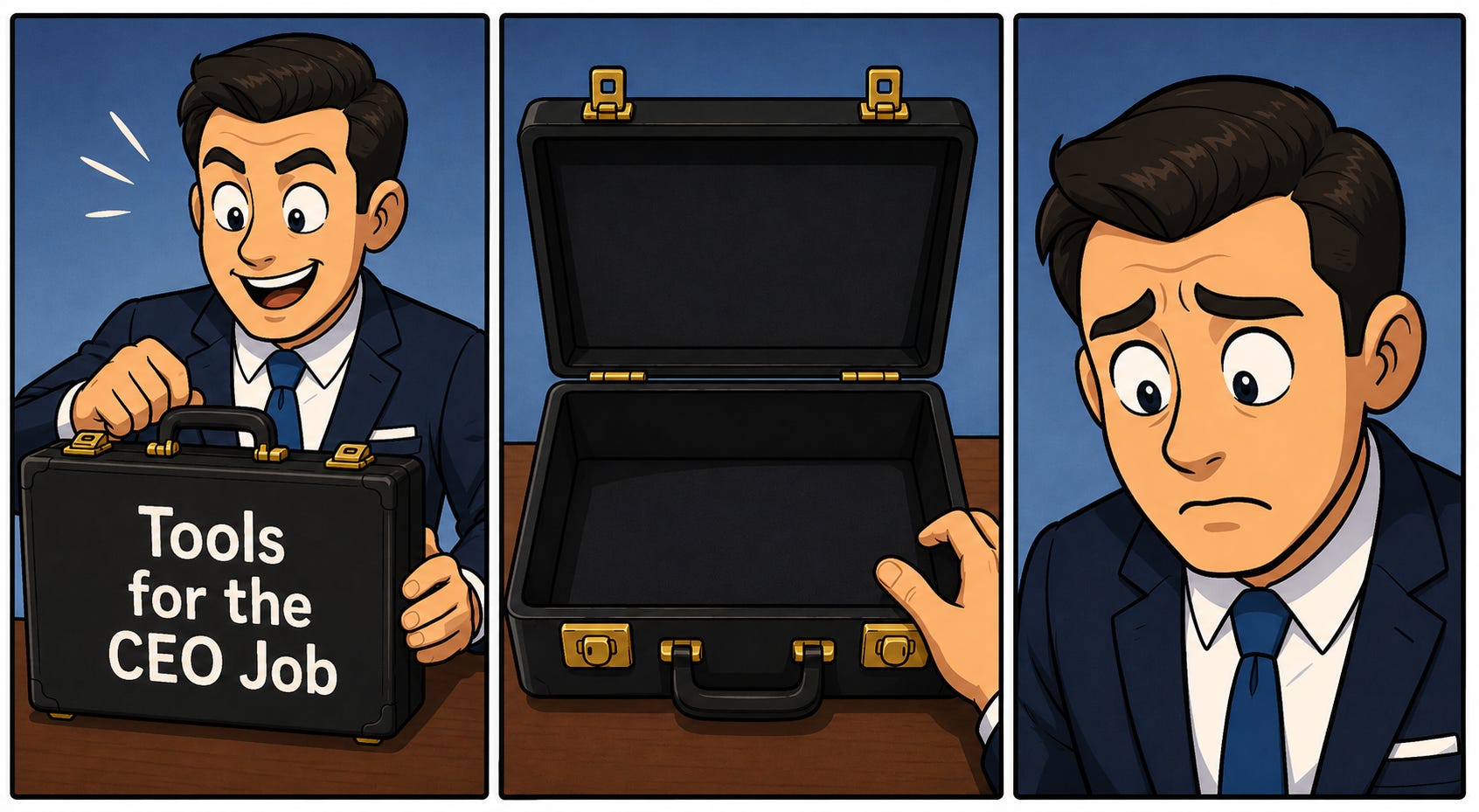
Every CEO Job Is a First CEO Job
Functional expertise is much more portable than CEO expertise.
When an experienced CFO takes a new job, they bring their entire playbook with them.
At this CFO’s new company, they’re working with a different set of accounts, maybe in a different industry, and they need to get up to speed on things like how their new employer recognizes revenue. But 90% of the job — the core CFO stuff like building the forecast, managing a close, etc. — translates from one job to another.
Most executive roles are similar in that regard. CFOs, CMOs, CHROs, etc. all have models of how their role creates value, and that model can move from company to company.
In other words, functional expertise is portable.
CEOs don’t have that luxury. Every time they step into a new role, they are essentially starting over. There are two related reasons this is the case:
Most CEOs just don’t have a good model. There are models for how to do the enterprise CEO job, with elements that do translate between companies. The model I built, CEO-S, is designed to give CEOs that playbook other execs have but they lack. (PS: if you want to learn it, join me for an upcoming CEO Masterclass.) Without such a system, it can feel like you’re re-learning the basics of business every time you start a new role. And if you don’t succeed at the first CEO gig, you likely won’t get another.
As integrators, CEOs have a job that resets in each organization. Though models like CEO-S codify the fundamentals of the CEO job, there is no denying that the role is still less portable than that of other execs. CEOs are integrators of the functional areas and balancers of the interests of shareholders, customers, and employees. That balance is going to look very different at a PE-backed industrial company at $200M in revenue than it will at a venture-funded SaaS business at the same size. Within those two businesses, each department head (sales, marketing, finance, etc.) can employ their usual playbook. Sitting outside as the integrator — even with a model like CEO-S — the CEO will have to learn and adapt and customize their system quickly.
These two realities point to two distinct factors that give CEOs an edge.
The first is, simply, know the fundamentals of the job. Develop a mental model for how the CEO role creates value, which stakeholders it serves, and which CEO activities have the biggest impact. I’ll note again that my career at this point is centered on equipping CEOs with such a system and I would love to talk with you if you are interested.
Learn on the Job… the Right Way
Paired with having a good model, the other thing CEOs need is the ability to learn quickly. Since the job isn’t fully portable, you’ll need to be a quick study on your new CEO position.
Start as the humble student. Don’t over-rely on old patterns that served you in the previous context. Talk to people at the new company and really listen, with both ears and an open mind. If you crash in laying down the law, you’re going to see in rather stark terms what it looks like when one CEO role doesn’t translate into another.
Apply your model to the new context. If you have a model like CEO-S, you can speed up your learning automatically. You can take the parts of the job that are portable and start adapting your approach to the new ecosystem. What is the basic vision here? What functional goals have been set, and are they still the right ones? How are my basic constituencies — shareholders, customers, employees — feeling in this business, and is the balance between them out of whack? With such frameworks to use, you’ll get up to speed a lot quicker.
Speed up your learning loop. Many of the CEO’s tools for learning operate on longer cycles (monthly peer group, quarterly board meeting, annual customer conference, etc.). Those rhythms aren’t fast enough on their own. Compress the cycle by adding higher-frequency inputs. Up your sessions with your coach to biweekly for a while. Schedule a customer conversation every week for your first three months. Sit in on a sales call, a support escalation, an engineering standup. Skip-level meetings are particularly useful here, because the layer below your direct reports usually has a less polished view of how things actually work. The point is to get in more learning reps, compressing what would normally be a year of pattern recognition into a quarter.
Treat it like a puzzle. Puzzles are fun. The CEOs I have watched succeed in unfamiliar situations tend to share a particular orientation toward not knowing things. They get interested rather than defensive. When a metric looks off, they want to understand why before they want to fix it. When a long-tenured employee describes how something is done, they ask follow-up questions instead of offering a counter-opinion.
And of course… use AI. No business-related article in 2026 can get away with NOT mentioning AI, but here it really does have utility. A new CEO shouldn't try to use AI as a substitute for the analytical work their executive team is paid to do. But there are narrower learning tasks where AI is well suited to a new CEO's situation. Pulling themes from the last several board decks before your first meeting. Getting up to speed on the competitive landscape, the regulatory backdrop, and the recent history of the industry you're stepping into. Keeping organized notes from your dozens of get-to-know-you conversations and surfacing patterns across them. These are the kinds of inputs that used to take weeks of evenings-and-weekends reading. A new CEO seat is also a natural moment to put a tool like ChatCEO — the AI chief of staff platform I've built specifically for the CEO role — into your workflow from day one. (Interested in being an early user of ChatCEO? Email me.)
Every CEO job is a first CEO job. This is why it’s a role that has always rewarded the fastest learners. CEOs who are willing to approach the job with curiosity and humility and equip themselves with the proper tools — those will be the CEOs who leave behind a legacy of success.
If you want the kind of mental model that makes a new CEO role less of a cold start, consider joining me for an upcoming CEO Masterclass.
This is a small-cohort program where I walk through the CEO Operating System with leaders who want a structured approach to the job, not generic leadership pep talks. In the Masterclass, we work through the framework, the responsibilities, and the practical tools you can put to use the day you get back to the office.
See dates and get a brochure here.
“The CEO Masterclass gives you a mental model for thinking about all of your best practices running the business. It gives you a pattern and a system for thinking through all of your structural decisions.”
Tim Bushaw
CEO, IQC


