



Most CEOs I work with do not buy diesel.
They run software companies, professional services firms, specialty manufacturers, healthcare practices. When they see headlines about refining margins, they file it under “energy sector problem” and move on. This week, I think that is a mistake.
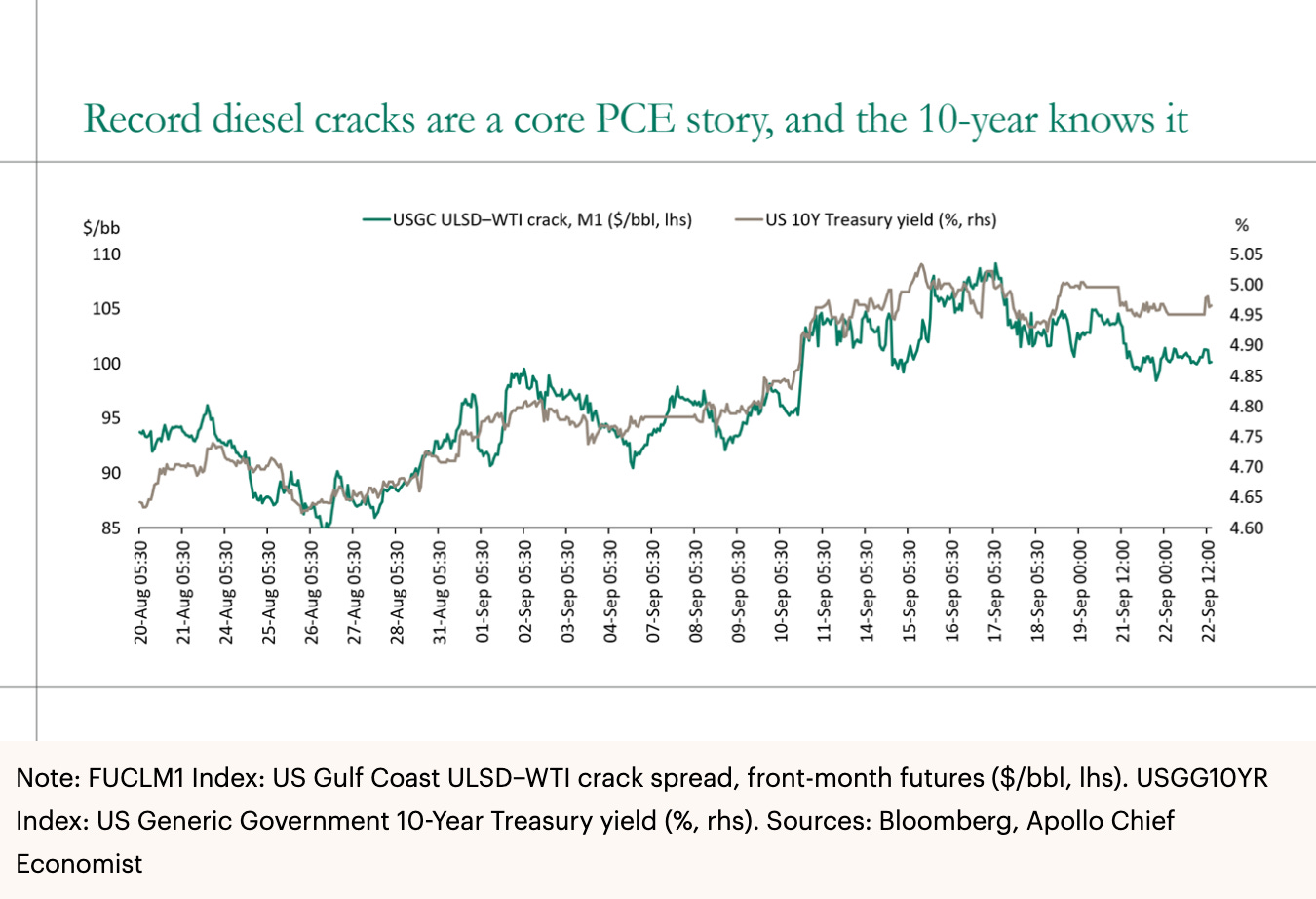
Torsten Slok, chief economist at Apollo Global Management, published a short note on Wednesday that highlights one remarkable number. In August, the spread between the price of diesel and the crude oil it is refined from, what traders call the crack spread, went above $100 a barrel on the U.S. Gulf Coast for the first time on record. The normal range is $15 to $30. S&P Global reported this week that the spread remains near record levels.
Slok’s concern is what happens after diesel gets expensive. Diesel underlies freight, rail, agriculture, construction and much of the physical economy, so higher diesel costs work their way through supply chains and eventually into the prices of goods and services. In other words, the inflation does not necessarily remain neatly contained in the energy category. “Diesel margins are now setting the long end of the curve,” says Slok, because the market sees them as a signal of future core inflation.
All CEOs should pay attention to that.
The P&L impact arrives late
A diesel shock does not appear in your P&L all at once. Some suppliers will absorb higher freight costs for a while. Others have fuel surcharges that reset periodically. Still others will wait until a contract renewal or annual price increase and try to recover the accumulated cost then.
That delay can make the problem easy to miss. The economics underneath your vendors can be changing for months before anything obvious changes in your own numbers. By the time the increase reaches you, the budget may already be set and commitments to the board already made.
So I would use the lag. Ask your operating and finance teams to trace the exposure one level deeper than they normally would:
Where does diesel enter our cost structure?
Freight is the obvious place, but it can also sit inside the cost of raw materials, packaging, facilities maintenance, waste removal, field service, construction and any vendor whose people or products spend a lot of time on the road.
The point is to know where the pressure will surface before a supplier tells you.
Your customers are doing the same math
Then turn the analysis around and look at your customers. Many of them are dealing with the same problem, and some may have much more direct exposure than you do.
This is the kind of external shock that puts the CEO’s three constituencies, customers, employees and shareholders, into tension at the same time. If your own costs rise, protecting shareholder returns pushes you toward higher prices. Your customers, meanwhile, may be facing their own cost increases and looking for places to cut. Employees will have their own response if those higher costs begin showing up in everyday living expenses.
Start with the customer. Raise prices too quickly or too broadly and you may give a competitor an opening. Wait too long and you can give away margin that will be difficult to recover later.
There is no formula for that judgment. I would decide your pricing posture before the first big increase lands rather than improvising in response to it. Which costs will you absorb? Which will you pass through? Which customers are especially price-sensitive? Where would you rather trade some margin for share?
And if an increase looks likely, talk with your largest customers early. A price change discussed as part of a business conversation is very different from one discovered on an invoice.
Employees may feel it next
If Slok is right about higher diesel costs feeding into core inflation, the pressure eventually reaches employees as well. They experience inflation through groceries, services and household expenses long before anybody on your executive team is discussing the latest CPI release.
That matters when you build next year’s compensation plan. A budget based on the wage pressure you have experienced recently may prove too neat if inflation remains elevated. I would at least model the higher-compensation case now and understand what it would do to margins and hiring plans.
You do not need to change the budget today. You should know what you would change if the assumptions behind it do.
Higher rates change the capital math
Slok’s chart points to another consequence that can reach your company much faster. The bond market is already repricing inflation risk. The 10-year Treasury moved above 5 percent this week, reaching 5.18 percent on September 24.
That changes the arithmetic on capital decisions. The acquisition you were considering, the facility expansion, the debt you planned to refinance next year: all were evaluated against some assumption about the cost of money.
For private-equity-backed companies, higher long-term rates can matter twice, through financing costs today and through the exit math your sponsor is using for tomorrow.
I would go back to any major capital commitment approved under materially lower rate assumptions and run the numbers again. Some projects will still clear the bar. Others may look different now, and I would rather discover that in a planning meeting than explain it later in a board meeting.
Put some ranges around the risk
I do not know where the diesel crack spread will be six months from now. It could remain elevated. Additional supply, weaker demand or some easing of the disruptions in global fuel markets could also bring it down sharply. Crack spreads are volatile by nature.
For a CEO, the useful exercise is not to try and guess exactly what the numbers will be. Instead, it’s to put ranges around the exposure now.
What happens to our margins if transportation and supplier costs rise another 10 or 20 percent?
How much can we recover through pricing?
Which customers are most exposed themselves?
What would a higher compensation budget do to the plan? Which capital projects become less attractive if long rates stay above 5 percent?
None of those questions requires you to know where diesel will trade next March. They require you to know which decisions inside your company become different if it stays expensive.
That is the value of catching a signal like this early. If diesel prices settle back down, you have spent some time understanding an exposure in your business that you probably should have understood anyway. If they remain high, you have already had the pricing, customer, compensation and capital conversations before they become urgent.
Part of the CEO’s job is maintaining enough distance from today’s operating problems to notice the forces that may alter the next quarter or the next year. Most of those signals will not arrive with a memo addressed to the CEO. Sometimes they show up as a strange number in a market you have never paid attention to before.
So here is the question I would leave you with:
If freight and supplier costs rose meaningfully next quarter, would your leadership team already know what to do, or would you be starting the conversation then?