


For over a decade now, I have worked with CEOs to refine and operationalize their company’s strategy.
Doing this well requires building out goals each quarter. These are the clear targets that keep the team aligned, that keep everyone moving toward longer-term objectives.
But for some reason, the typical CEO balks when it’s time to set company goals. Sometimes their mind goes totally blank. Other times, it’s filled with a storm of tasks and activities that don’t resemble actual well-crafted goals.
My message recently for CEOs is this: Don’t make company goal setting more laborious than it needs to be.
When you have the right mental model, the process is in fact simple. It requires that you understand the following principles:
A business at scale consists of six core areas.
Each area operates with the same goal every quarter.
Good goal setting consists of choosing the most relevant way to measure this goal every quarter.
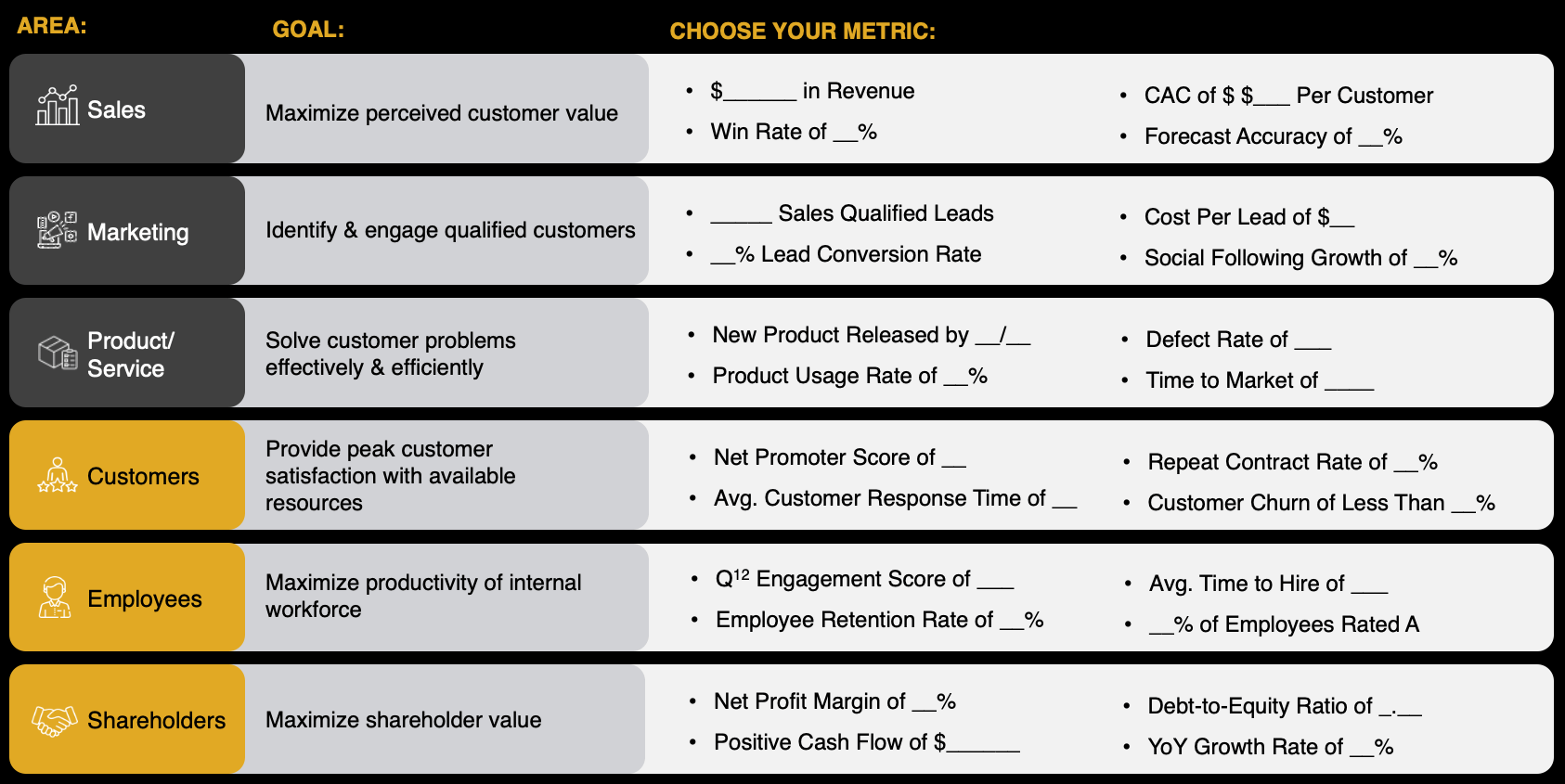
Your next question is probably "So, what are the six areas and their respective goals?" Here they are:
Sales: Maximize perceived customer value
Marketing: Identify & engage qualified customers
Product/Service: Solve customer problems effectively & efficiently
Customers: Provide peak customer satisfaction with available resources
Employees: Maximize productivity of internal workforce
Shareholders: Maximize shareholder value
With this understanding going into the goal-setting process, you can then simply choose the best way to measure each area’s goal over the next 90 days.
Below is a link to a diagram showing each area, its primary goal, and a few possibilities of how you might measure the goal over the next period:
This is a much more focused and productive process than staring at a blank page trying to decide what the company should achieve this quarter.
If you haven't set clear company goals for Q4 yet, this is your sign to do so. If you're a currently serving CEO, I'm happy to discuss further with you in an advisory session, which you can schedule just below.
The Rundown
Port Strike Ends, but Supply Chain Woes and Rising Costs Persist
Temporary resolution brings relief, but businesses face ongoing logistical challenges and higher expenses
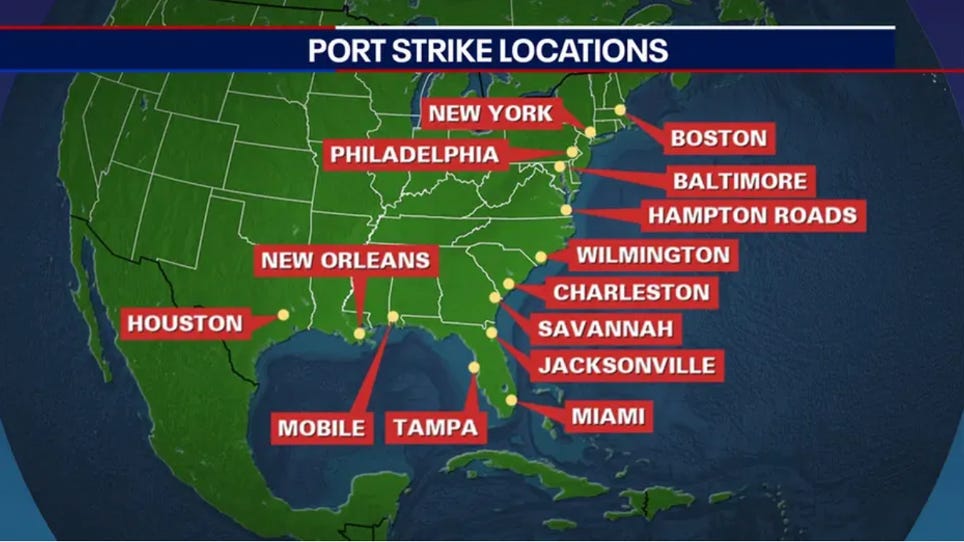
After a turbulent week that disrupted logistics and threatened the supply of critical goods, the International Longshoremen’s Association (ILA) and the United States Maritime Alliance (USMX) have reached a tentative agreement on wages. This resolution ends the strike at East and Gulf Coast ports, allowing normal operations to resume across 14 key port locations.
Despite the relief, the aftermath of the strike is still rippling through supply chains. Containers are misplaced at unintended ports, inland transportation costs are soaring, and companies are grappling with delayed shipments—all while a backlog of goods remains stranded offshore. The tentative deal marks a critical step toward restoring stability, but the underlying challenges in the logistics network may take weeks to resolve.
From Strike to Settlement: Key Developments
1. Tentative Deal on Wages:
The ILA and USMX have agreed to extend their existing contract through January 15, 2025. This extension provides both sides more time to negotiate the remaining issues, notably around port automation.
The ILA has achieved a 61.5% wage increase over six years under the tentative agreement, according to sources.
2. Strike’s Impact on Supply Chains:
During the strike, thousands of containers were offloaded at unintended ports, leading to an increase in logistical costs and complications.
Ocean carriers resorted to diverting shipments to ports in Canada and the Bahamas to bypass the disruption. This led to containers being relocated from their original destinations, significantly increasing inland transportation costs. For example, a 10-mile truck route in Savannah that once cost $300 jumped to over $2,000 when cargo had to be moved from Norfolk, VA.
3. A Narrowly Averted Supply Crisis:
While the strike only lasted a few days, it sent ripples through various industries, causing concerns about the availability of key consumer goods like fruits, automobiles, and medical supplies.
Retail giants such as Walmart, Amazon, and Home Depot had containers stuck in floating storage, delaying shipments of toys, electronics, and furniture—goods critical for the upcoming holiday season.
U.S. Labor Market Surges in September
Surging job growth and falling unemployment highlight continued strength in the U.S. labor market
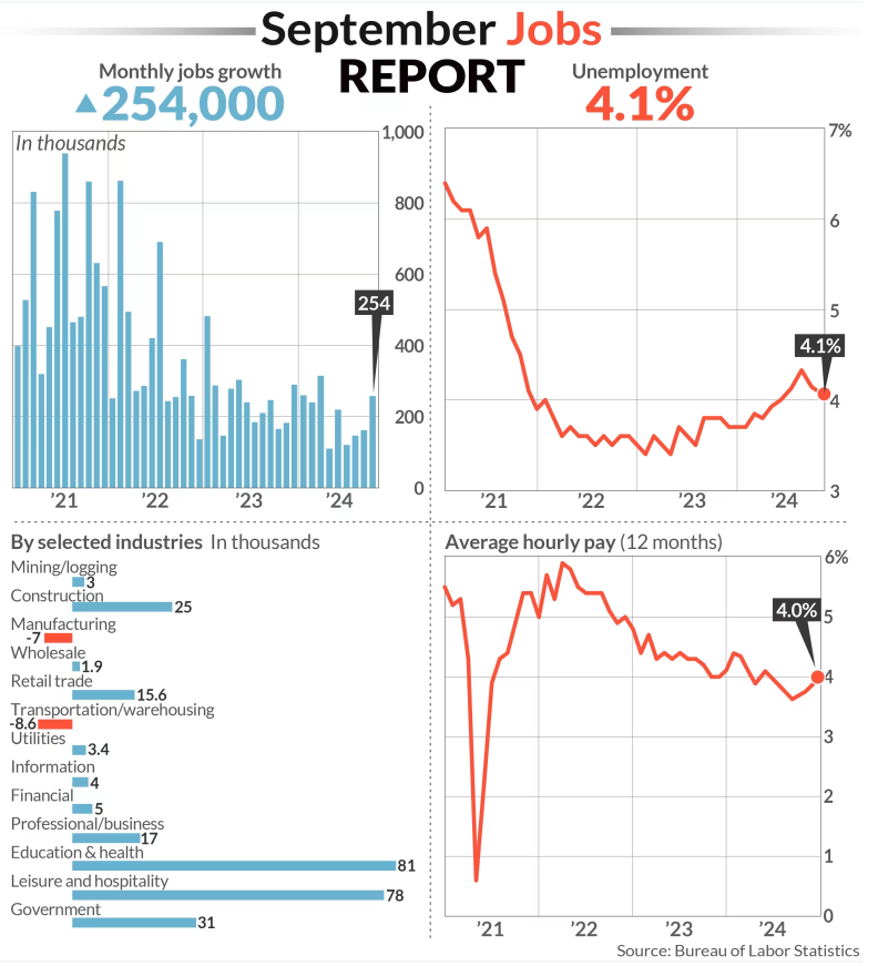
The U.S. labor market exceeded expectations in September, adding 254,000 jobs, significantly above the 150,000 forecasted by economists and marking the largest increase since March. This strong job growth, coupled with a drop in the unemployment rate from 4.2% to 4.1%, underscores the continued strength of the labor market.
Data from the Bureau of Labor Statistics showed that the unemployment rate fell for the second consecutive month, reaching its lowest level in two months and down from a recent three-year peak. Revisions to July and August job numbers also added 72,000 more jobs than previously reported.
Wage growth also picked up in September, rising 4% year-over-year, compared to 3.9% in August. This steady wage increase is being closely watched as a measure of inflationary pressure.
Implications for the Federal Reserve’s Policy
The strong jobs report is likely to influence the Federal Reserve’s approach to interest rate cuts. While the Fed has penciled in a quarter-point cut in a key U.S. interest rate at its next meeting, the strong employment data could make it less likely for the Fed to move aggressively in subsequent cuts. As the labor market continues to show strength, the Fed may consider a more measured approach, balancing the need to control inflation without undermining economic growth.
It looks to me like the "soft landing" story seems more correct with every catastrophe we dodge. Can we get to that happy ending? We'll see...
Consumer Sentiment Reaches Five-Month High as Inflation Expectations Ease
Americans’ confidence grows amid optimism for economic conditions
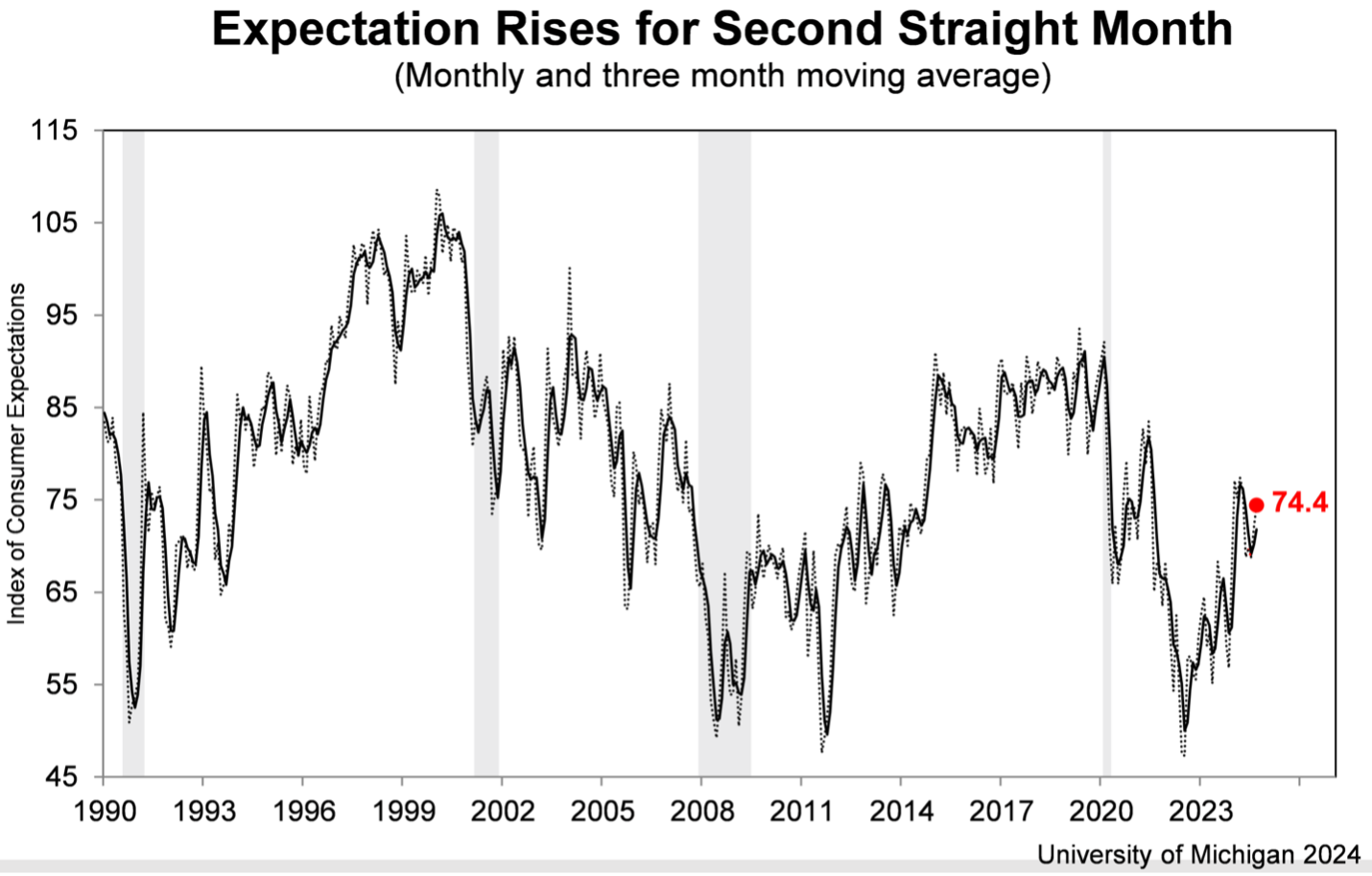
Consumer sentiment in the U.S. climbed to its highest level in five months in September, according to the University of Michigan’s final reading of its consumer-sentiment index. The index rose to 70.1, up from a preliminary reading of 69 and an August figure of 67.7. The result exceeded the expectations of economists surveyed by the Wall Street Journal, who predicted a final reading of 69.3.
Key Highlights
Sentiment Growth: The sentiment index is up by over 3% from August, reflecting a growing sense of optimism among Americans regarding economic conditions.
Inflation Expectations: Consumers expect inflation to average 2.7% over the next year, the lowest level since 2020. This is a positive sign, given the current inflation rate of 2.5%, based on the consumer price index. However, long-term inflation expectations rose slightly to 3.1% for the next five years, up from 3% in August.
Current Conditions and Future Outlook: The index measuring perceptions of current economic conditions rose to 63.3, compared to 61.3 in August, while the expectations index—which measures consumers’ outlook for the next six months—rose to 74.4 from 72.1.
What Experts Are Saying
“Sentiment appears to be building some momentum as consumers’ expectations for the economy brighten,” said Joanne Hsu, director of the University of Michigan survey. However, Hsu noted that consumers’ expectations are also influenced by the upcoming presidential election. Consumers across political parties are increasingly expecting Kamala Harris to win the election, she added.
Context and Implications
While the index remains well below its pre-pandemic high of 101, reached in February 2020, the upward trend suggests that consumers are gaining confidence as inflationary pressures ease. This positive sentiment could have implications for consumer spending and economic growth as the U.S. moves further into the year.

"Charisma is important in gaining followers in a political leadership context. That is a far cry, however, from the thinking, creative followers required in managerial leadership." —Elliott Jaques
"Leaders must wake people out of inertia. They must get people excited about something they've never seen before, something that does not yet exist." —Rosabeth Moss Kanter
“The very qualities that made you successful as a founder—like being a big thinker with tons of ideas, your risk-taking attitude with minimal regard for what could go wrong, and your 24/7 work ethic—are actually harmful as the company turns the corner [into the scaling process].” —Kurt Wilkin