


In my work with CEOs, I see a lot of documents containing the company’s “core values.”
You know what they usually look like: Integrity. Honesty. Commitment. And so on. It may not surprise you that most employees can’t name even one of their own company’s values.
The cynic asks, “Does it really matter?” Is the process of setting company values anything more than corporate virtue signaling?
I strongly disagree that values aren’t important, but there is a seed of truth in that critique. When some companies go through the core values exercise, they are indeed putting forth “virtues” rather than “values.”
Integrity is a great example. This was famously one of Enron’s core values at the time of its demise. Integrity is a virtue—something we expect as baseline in any company we do business with. Telling your employees “We don’t rip people off around here” doesn’t give them anything to work with and establishes a shockingly low bar.
Teamwork. Trust. Honesty. These are all virtues, which makes them poor core values. A virtue is a near universally accepted good that sets a floor for behavior. Conversely, a good value sets a bar that we strive for. It tells employees what differentiates the company from other organizations, what is distinctive about its culture.
A good company value:
Showcases a trade-off the company has decided to make. For a good core value, you can plausibly imagine a different company enshrining a competing or opposite value. Integrity fails this criterion because no company would advertise itself as a bunch of crooks.
Is specific and memorable. If values don’t lodge in your employees’ brains and guide their decision making, there’s not much point in establishing them.
What’s an example of company values that aren’t just statements of virtue? One of my favorites is Southwest Airlines, who have long touted three values: Warrior Spirit, Servant Leadership, and a Fun-LUVing Attitude. In combination, these three values paint a specific, interesting, and inspiring picture of what Southwest values in employees. (To be fair, Southwest now has a public-facing set of values on its website that include many virtues, including integrity. Once a company has gone public, the temptation to trumpet its virtues seems irresistible.)
Another example is a company value we upheld at my first company, NetQoS: “We underpromise and over-deliver.” This explicitly states a tradeoff that we wanted to distinguish our company from others. While other companies may have wanted to wow customers up front, we wanted to be conservative in our commitments and then give customers the surprise of getting more than expected on the backend. We held to that value internally, too, in our commitments to each other. The concept of “We underpromise and over-deliver” isn’t a universal virtue that fits everywhere, but it was a distinguishing feature of our culture.
I challenge you to take a hard look at your company’s core values. Are they really differentiating values, or are they more like universal virtues?
The Rundown
Inflation Slows and the Fed Isn't Cutting
The changes are tiny, but that didn't stop some people from taking a victory lap.
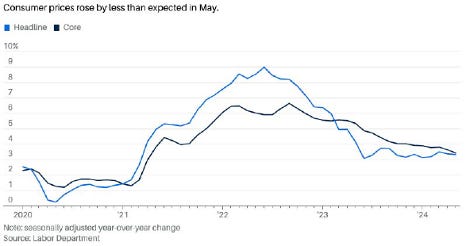
Headline and core inflation as measured by the Consumer Price Index both ticked slightly down in May . . . but many are touting this reading as a significant victory in the US inflation journey. (Being an election year, it’s hard not to see a political advantage for some in doing so.) Year-over-year headline inflation for May came in at 3.3%, which is a 0.1% drop month-over-month—hardly a victory. Core inflation had a similar reading and reaction as year-over-year core CPI sits at 3.4% as of last month, down 0.2% month-over-month.
“This is the best news we could’ve gotten this morning,” Philip T. Powell, executive director of the Indiana Business Research Center, told CNN on Wednesday. “The Federal Reserve has been watching to make sure this [monthly] number came in below 0.2%. If it did, that means inflation is going to come down, which means [the Fed] could lower interest rates,” he added. The Fed did not lower interest rates at the FOMC meeting earlier this week and is expecting to cut rates only once this year (down from 3 cuts).
Many prices across the CPI basket remained the same, but minuscule changes in transportation services (-0.5%) and motor vehicle insurance (-0.1%) are being cited as keeping inflation in check. Year-over-year transportation services are up 10.5%, and motor vehicle insurance is up 20.3% in the same timeframe.
Mortgage Applications Briefly Surge
As 30-year fixed mortgages briefly dropped below 7%
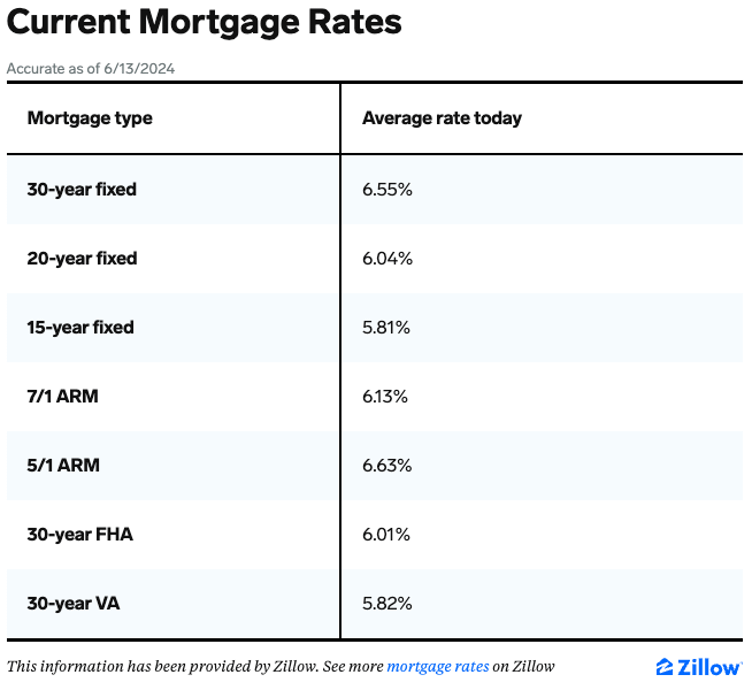
With inflation slightly decelerating, mortgage rates reacted favorably for potential home buyers. If the CPI trend continues down, rates are expected to follow for the remainder of the year. Last week, 30-year fixed mortgages (excluding refinance) went sub-7% and rates across the board began to drop after the better-than-expected CPI reading. This caused a surge in total mortgage application volume, up 16% last week from the previous week, with a 28% increase for refinance loans. While this was short-lived (rates jumped back up to 7.02% last Friday due to a stronger monthly employment report), rates are dropping again this week as shown in the below chart. Real-estate economists interpret these reactions as strongly indicating demand in the market, even though housing prices and rates have remained elevated. Housing inventory has also been lean, but some states such as Texas are starting to see inventory rise to above pre-pandemic levels. Other states seeing inventory loosen include Florida, Arizona, and Idaho, which are all almost back to pre-COVID supply.
I do expect inventory levels to remain relatively low, however, and housing prices to not go much lower than they are now. This is partially because of homeowners who are locked into appealing 2.5–3% interest rates, some of whom can rent their house for higher prices and see positive cash flow. People in that situation have very little incentive to sell.
Small Business Optimism Increases
Though business owners' outlook is still historically low.
Small businesses are responsible for over 40% of GDP and employment in the United States, and optimism among them recently hit the highest level of the year last month. The National Federation of Independent Business (NFIB) publishes a monthly Small Business Optimism Index that flashed a reading of 90.5 which is the 29th consecutive month below the historical average of 98, but almost a 1-point jump from April. Some highlights from the index include (1) owners' plans to increase hiring, (2) decreases in real sales expectations and inventory, and (3) inflation holding as the single largest concern among small business owners. The index comprises survey responses from members and partners of the NFIB.
At the same time, NFIB also produces a Small Business Uncertainty Index, which rose 9 points month-over-month to 85. This is the highest uncertainty reading the index has seen since November of 2020, but at least it’s an optimistic uncertainty. The uncertainty index shows that 6% of owners report financing as the top business issue in May, up 2% from April and the highest level since June 2010. That’s not surprising given business loan cycles and the interest-rate changes now making themselves felt.

"Nothing in this world can take the place of persistence. Talent will not; nothing is more common than unsuccessful men with talent. Genius will not; unrewarded genius is almost a proverb. Education will not; the world is full of educated derelicts. Persistence and determination alone are omnipotent." —Calvin Coolidge
"If you want to improve the organization, you have to improve yourself and the organization gets pulled up with you." —Indra Nooyi
“We do not see things as they are, we see things as we are.”
―David Brooks