



The other day I was driving in Austin and I hit traffic.
I know what you’re thinking. Wow, someone call the press.
But this was a strange clump of traffic, sprawling ahead for what seemed like a mile, in a spot that usually doesn’t back up like this.
It was also the kind of maddening traffic that inches along at a constant but IMPOSSIBLY slow pace.
After fifteen or so minutes, I finally got to the cause of the traffic jam: The stoplight up ahead had gone out. Rather than the usual green-yellow-red system, all four directions faced a blinking red light. This meant every few seconds there was a new negotiation between a new set of drivers. Whose turn is it? Did I get there first or did one of the other six drivers at the intersection? If the guy in the lane next to me is going, can I just go along with him even though I rolled up slightly later?
It was a hugely inefficient setup, as evidenced by the miserable miles of traffic that had built up on all sides.
As I finally got my turn to drive onto the blissfully clear road ahead, I realized that this broken stoplight reminded me of a phenomenon I see a lot in organizational decision making. Namely, rather than setting up a system for efficient decision making within the company, all decisions are handled individually and painstakingly. The result is the organizational equivalent of that highly irritating and wasteful traffic jam that all came down to one broken stoplight.

The Cost of Decision-Making Chaos
Many companies I work with have no systematic approach to decision making. Instead, they practice broken-stoplight decision making. Every decision becomes a negotiation, every choice requires a meeting, every resolution demands input from multiple stakeholders… who may or may not have the authority to actually decide anything.
You’ll be familiar with the signs:
Meetings drag on for hours without any clear outcome.
Projects stall while waiting for someone to deliver an approval.
Teams spend more time debating who should decide than actually deciding.
Decisions that should be simple ricochet around departments and maybe even disappear into the black hole of the CEO’s inbox.
Consider a typical scenario: A $50,000 software purchase that should take two weeks to evaluate and approve instead takes three months, involving twelve people across five departments in fourteen meetings. The direct cost includes the salaries of those people sitting in those meetings AND the opportunity cost of delayed implementation, the projects that get pushed back, the momentum that gets lost, the morale that is destroyed.
Here are my pointers for CEOs looking to keep the decision traffic flowing.
1. Make sure YOU aren’t the bottleneck
A certain type of CEO tends to labor over every decision, feeling that the more time they spend cogitating, the better outcomes will be. They believe that involving more people and taking more time automatically leads to better outcomes. This isn’t the case at all. The reality is that speed and quality aren't opposing forces in decision making. They're complementary.
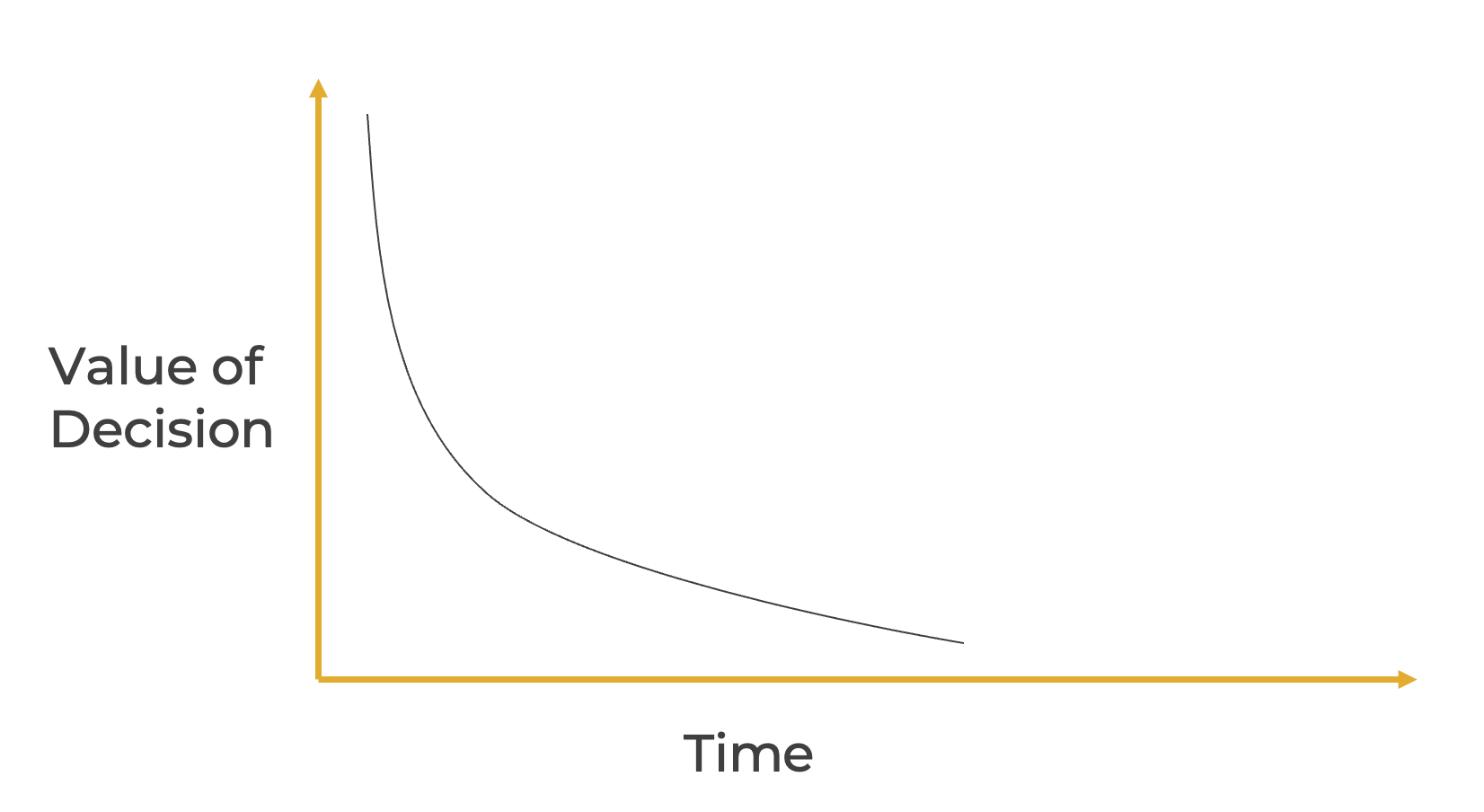
The longer you put off a decision, trying to gather as much information and input as possible, the more likely it is that you’re holding things up and will end up with worse outcomes than if you’d made the decision in a timely manner.
Read more on this dynamic in a previous post:

2. Set Authority Guidelines with employees
Just like a functioning traffic light eliminates the need for constant negotiation, a proper decision-making framework across your company eliminates organizational gridlock.
I recommend starting with the simple practice of ensuring every manager at your company sets Authority Guidelines with their direct reports. The Authority Guidelines are a short list of criteria showing when a decision should be owned by the employee (i.e., they can make it without consulting the manager). It should reveal things like:
Any specific recurring decisions they can make.
The $ amount they can spend without approval.
Benefits/discounts they can extend to customers or vendors.
External communications they can publish/send.
And so on. For example, a marketing manager’s Authority Guidelines might show that they can approve campaigns up to $10,000 without consultation, require VP approval for campaigns between $10,000 and $50,000, and need CEO sign-off for anything above that. The key is that everyone knows these boundaries in advance, just like everyone knows that green means go.
This written list of guidelines also helps push decision making down as close as possible to the work being done—which is typically where decision quality is highest.
3. Coach your team when decisions get bogged down
Each time one of your executives puts a decision on your desk that you believe they should make, you have a coaching opportunity. Rather than sighing and taking on the responsibility, open up a conversation about who really owns this decision. Is it covered by their Authority Guidelines? Should it be? Are they looking for input from you, or are they trying to delegate up to absolve themselves of responsibility?
The same goes for when you notice that a project or goal has ground to a halt. Investigate where the blocker is and whether a decision backlog is the culprit. If it is, help people properly categorize the decisions, triaging and batching them so they can be made efficiently and by the right person. You want to coach them on having a bias for speed, as well as on how to differentiate between significant decisions and those that have lower stakes. Hiring a new VP requires a different level of consideration than choosing a conference room vendor. Coaching on the Bezos concept of Type 1 and Type 2 decisions can be helpful here.

Systematic decision making is about ensuring that the right decisions get made at the right level by the right people with the right information. Sometimes that's you, sometimes it's not. A good system helps everyone understand the difference.
The broken stoplight in Austin was eventually fixed, and traffic returned to normal. But organizations don't have the luxury of waiting for someone else to repair their decision-making infrastructure. That responsibility belongs to you!