


I’ve written here before about generic corporate values like Integrity, Respect, and Excellence. They state positive virtues, not distinct values. And because nobody would ever argue with them, they don’t drive decision-making or culture. They don’t, as Jim Collins might say, “have teeth.”
In the current issue of Harvard Business Review, INSEAD’s Erin Meyer proposes a test for crafting better values: consider dilemmas.
Here is her example:
Say you’re managing a small team of marketers. You know there’s a 60 percent chance that the team will be reshuffled in four months due to a reorg. Do you tell them now or do you wait until you know whether it’s going to happen?
Meyer says that when she presents this scenario to managers, just under half say they would share the information, while just over half say they would wait. Both are reasonable decisions.
But if the manager belongs to an organization with sharp values and a unique culture, the answer could be a lot clearer, and much likelier to reinforce the ethos the CEO and leadership team has built. If one of the values is Radical Transparency, for example, that’s your answer for you. You tell them about the possible reorg. If, on the other hand, you’ve established Relentless Focus as a value, you probably don’t want to share something that, while still only a possibility, is likely to distract the marketers from their current goals.
Deliberately thinking through such dilemmas—and sharing the most instructive ones with your team—is an excellent way to bring your company’s core values to life. Remember that a dilemma is most enlightening when either side is supportable.
Here are some further examples:
Speed vs. Reliability. You’re a salesperson who has almost closed a huge new account, but the customer wants your IT solution faster than you would typically be able to deliver it. Do you (a) promise them a rush even though it will strain your team and cause some uncertainty? Or do you (b) stick firm with a delivery date that you feel confident your team can beat (and maybe even exceed, offering the customer a pleasant surprise)?
Growth vs. Profitability. You’re a CMO looking at a proposal from an employee who wants to produce a video series intended to increase brand awareness. To do the series right would require going well beyond your marketing budget for the year, but some people on the team feel that video content has massive potential to reach Gen Z consumers. Do you (a) greenlight the extra spend and hope it leads to expansion or (b) focus on the fundamentals and stay as efficient as possible?
Customer Satisfaction vs. Service Efficiency. You manage a team of customer service reps and one of your team is being tied up for hours at a time by one squeaky wheel of a client. They need a ton of handholding and, honestly, seem to just enjoy being on the phone with your rep. Do you (a) instruct the rep to continue giving dedicated service to the customer or do you (b) intervene to free up the rep’s time—reducing wait time for other customers but potentially upsetting the needy one?
In none of these cases will a bland term like Integrity or Respect guide your path. But a set of values that considers such trade-offs will. Specific, unique values (say "Underpromise and Overdeliver," "We Make Future-Driven Decisions" or "No Customer Issue Too Small") not only give your managers and you, the CEO, a mechanism for good decision making—they also create an internally consistent culture that helps you stand out as a business.
The Rundown
Strong GDP Growth in Q2
Will it continue through the second half of the year?
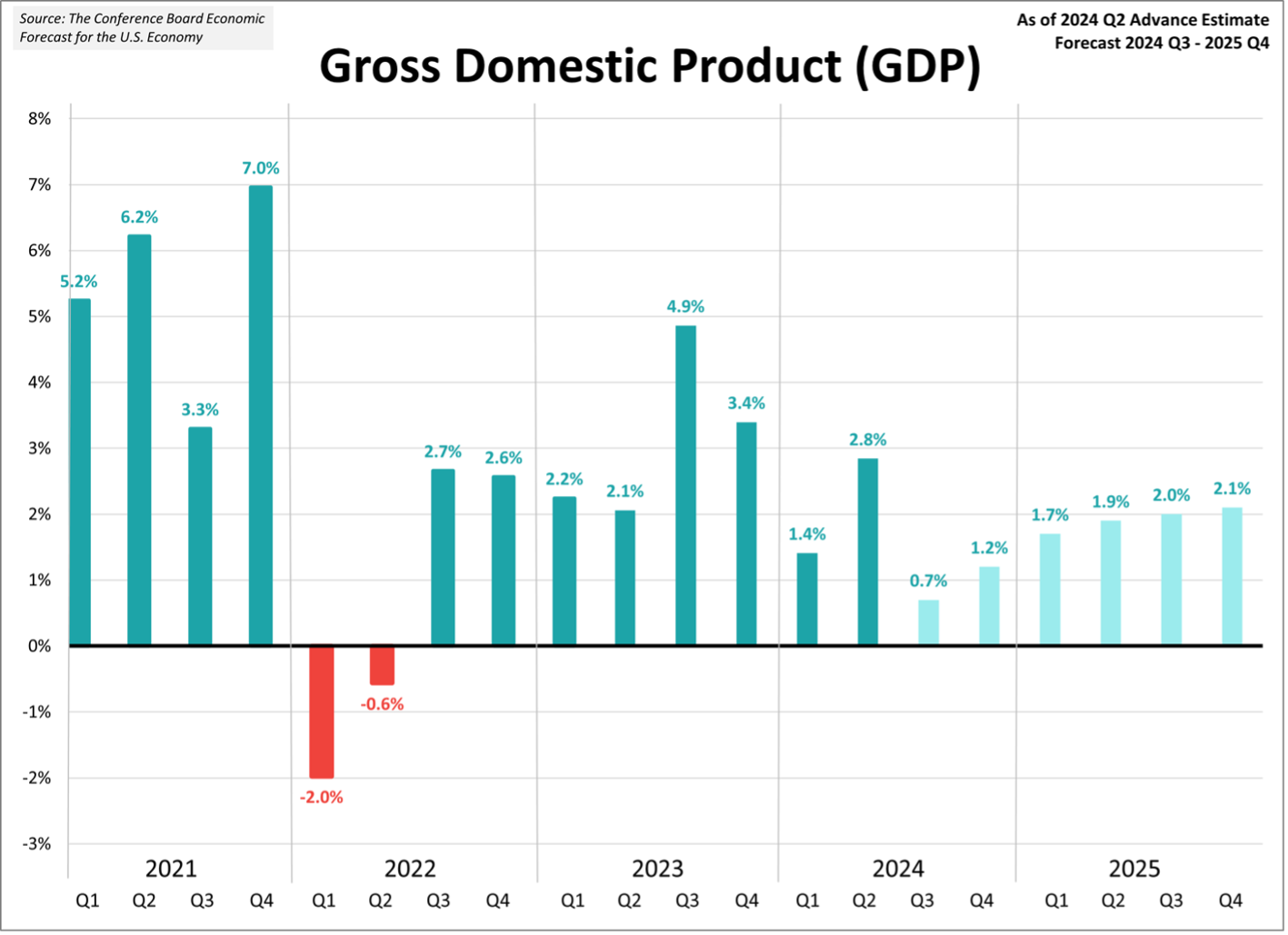
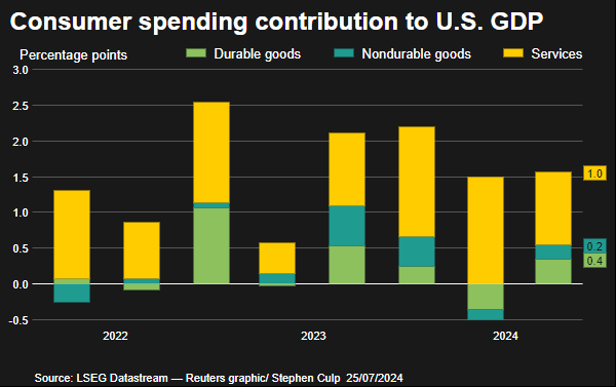
Gross domestic product in the United States grew 2.8% annualized in the second quarter of this year. This was mainly driven by consumer spending, which helped the 100% increase in GDP growth from Q1 (1.4%). Consumer spending rose 2.3%, and gross private domestic investment rose 1.46% in Q2. The largest increases in spending came from services, including healthcare, club memberships, and various entertainment (theaters, museums, gambling, and sports centers). Business investment was another key driver of GDP growth last quarter as spending on equipment jumped to 11.6% after a meager 1.6% in Q1. Nonresidential fixed investment, which captures money spent on commercial construction, intellectual property, and software, rose 5.2%. This is a component of business investment typically seen by analysts as an indicator for future productivity.
What remains to be seen for the second half of the year is whether modest growth continues—or whether consumers weaken because debt levels are getting excessive.
The Fed’s Favorite Inflation Gauge Eases
A September rate cut remains nearly certain, but follow-on cuts less so.
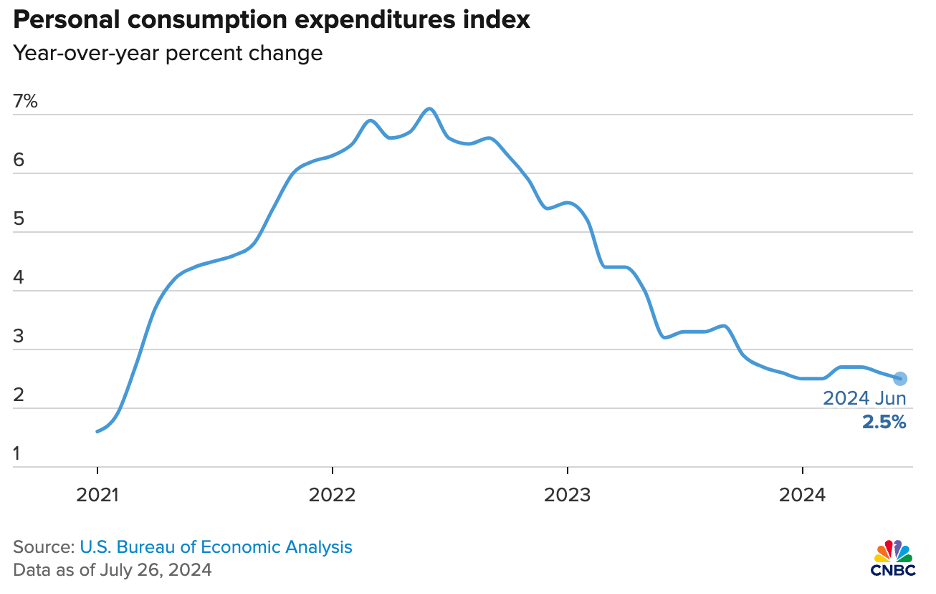
The personal consumption expenditures index (PCE index) increased 0.1% month over month and 2.5% year over year in June. Core PCE increased 0.2% and 2.6% in the same time frames. Personal income grew 0.2% while the personal savings rate decreased to 3.4%, the lowest since November 2022.
Inflation continues to remain above the Fed’s target of 2%, and while the PCE numbers are not that exciting, they are a good indicator of what the Fed might do later this year. “Overall, it’s been a good week for the Fed,” said Chris Larkin, managing director of trading and investing at E*Trade. “The economy appears to be on solid ground, and PCE inflation essentially remained steady. But a rate cut next week remains a longshot. And while there’s plenty of time for the economic picture to change before the September FOMC meeting, the numbers have been trending in the Fed’s direction.”
A rate cut in September is almost certain at this point. Futures markets are currently predicting a 90% chance of a decrease then, followed by further cuts in November and December. I’m not so sure those follow-on rate cuts are baked in at this point, however.
And while I don’t think the Fed cut(s) will necessarily be political, the election also plays a role here. For some, the period between now and November will be something of a slump as we wait to get past the uncertainty and distraction that currently reigns. Many will prefer to hold off on certain projects—particularly in sectors like oil and gas and development—until they know who’s going to take the Oval Office. The domestic-policy differences between the candidates are significant enough that it makes sense in some cases to wait and see.
Inverted Yield Curve Does Not Bode Well
But some think the metric has lost its predictive power.
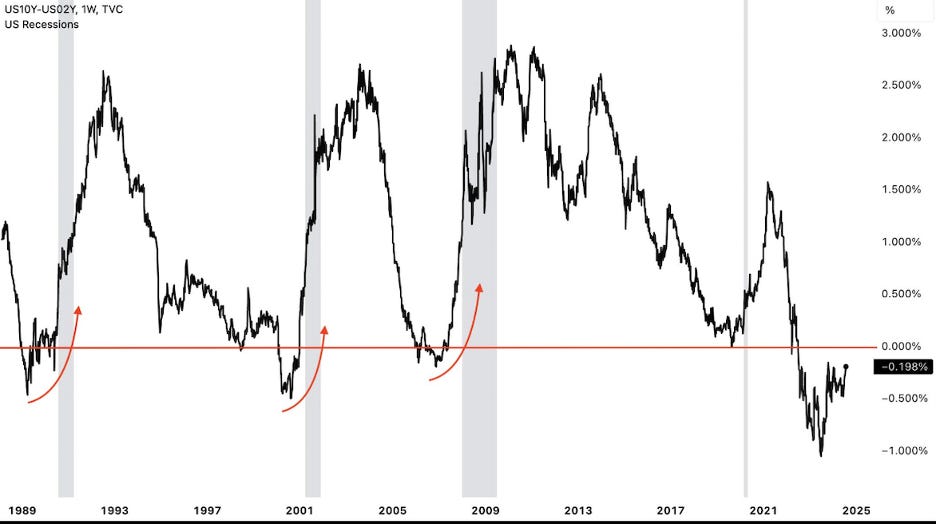
One of Wall Street’s favorite recession indicators has been flashing a warning since 2022, but so far it has not been correct. The yield curve has been inverted for the longest stretch in history without a recession, and typically it has been a rock-solid recession indicator (gray shadings below). This leads some to believe the indicator is broken and no longer accurate, but the New York Federal Reserve still assigns a 56% probability of a recession by June 2025 based on the below. Regardless of the viability of this indicator, we continue to venture into unprecedented territory.

"Leaders must wake people out of inertia. They must get people excited about something they've never seen before, something they'll never see again." —Rosabeth Moss Kanter
“Your most important task as a leader is to teach people how to think and ask the right questions so that the world doesn't go to hell if you take a day off.” ―Jeffrey Pfeffer
"When a clown moves into a palace, he doesn't become a king. The palace becomes a circus." —Turkish proverb