


🌟 Try ChatCEO
The AI-Powered Operating System for CEOs
Did you know that 80% of CEOs believe their job will be at risk by the end of 2026 if their AI strategy fails?
I think they are probably right. But many CEOs still aren’t maximizing their use of AI, and certainly not applying it to the core of the CEO job.
Enter ChatCEO, the AI-powered operating system built for the CEO role.
ChatCEO knows the CEO role like generic AI doesn’t.
ChatCEO keeps your company data secure and walled off from big models.
ChatCEO guides you on how to use AI in critical CEO responsibilities, from goal setting to stress-testing decisions to doing competitor research.
Even better, our ChatCEO Quick Start pairs you with a certified Operator who stands up your private system over 90 days and gets you in the habit of benefiting from purpose-built AI.

There’s a post that circulates online, often in poster form. It’s usually titled “10 Things That Require Zero Talent,” and it lists positive attributes that a person can use to get ahead, separate from whatever inborn or learned skills they have.
I couldn’t find the origin of this list, but it appears to have grown out of the sports coaching world before migrating to the business world. (It’s not uncommon to see it on LinkedIn.)
I saw it again this week and it struck me as a really good primer for any new employee. Despite its title, the list doesn’t negate the need for intentional recruiting. Your company can’t survive without talent. But it also can’t survive if employees don’t demonstrate the basic attributes on this list.
Below, I have adapted the list into a letter from a manager to their new employee. A letter like this to a new employee does several useful things: It shows intention in your onboarding process; it creates a foundation for collaboration between manager and employee; and it takes a lot of pressure off the employee.
Every new employee comes into a new role with some trepidation. This letter essentially says: I don’t expect you to be a genius on Day 1. Here are the things I do expect, and they are things anyone can do.
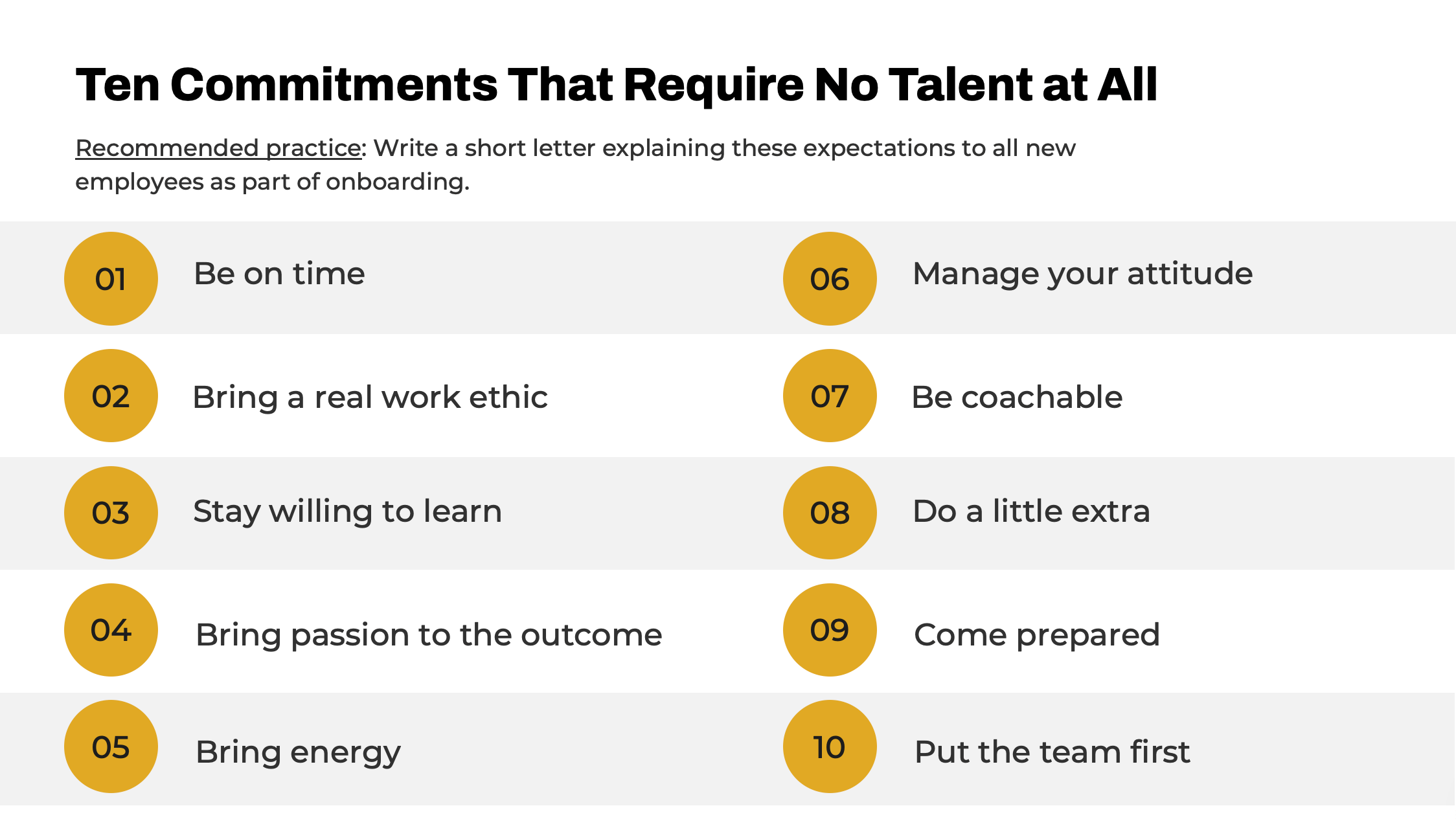
The variations of this letter are endless. My version below is geared toward a person earlier in their career, but you could make a version that comes from the CEO to a new executive and anywhere in between. You can also customize this letter with facets of your company’s differentiating values and culture. In fact, weaving in references to those values, along with the company’s mission and vision, makes this letter even more powerful.
Oh, and one final application. These things apply to you as well, no matter how high on the ladder you climb!
What I Expect from You: Ten Commitments That Require No Talent at All
To: [Employee]
From: [Manager]
Welcome to the team.
Before we talk about your role, your goals, or your first project, I want to talk about something more fundamental: the standards that apply to everyone on this team, from the newest hire to the most senior member. None of these standards require talent. None of them require experience. Every one of them is a choice you make each day. Together, they will shape your reputation here more than any credential on your résumé.
Here are the ten commitments I ask of you as a member of this team:
1. Be on time
When you arrive on time—to work and to meetings—and when you meet your deadlines, you communicate to everyone around you that their time matters. When you don’t, you are telling them the opposite. I will never ask you to be the most talented person in the room, but I will always expect you to be in the room when the meeting starts.
2. Bring a real work ethic
I ask that you do the work you committed to do at the standard you would want if the roles were reversed. Cutting corners may save you time, but that shortcut will then become one of your colleagues’ problem. By asking for work ethic, I do not mean working nights and weekends. I mean placing consistent focus on the work commitments you make.
3. Stay willing to learn
Your job description and goals will lay out how you contribute to the team and company, but they are not a limiting boundary. We value employees who stay curious and ready to learn. That could be learning a new process even though it was done differently at your previous job, or it could be gaining deeper understanding about our industry, our customers, the roles around yours.
4. Bring passion to the outcome
I don’t expect you to feel passionate about every work task you do. I do expect you to care about what the work adds up to: namely, how it serves our customers, your teammates, and the broader company itself. When you visibly care, the people around you try harder. When you visibly don’t, they notice that too.
5. Bring energy
Energy is not a genetic gift; it is a decision about how you show up day to day. It is one of the first things colleagues and leaders notice about anyone. On this team we value people who attack problems and opportunities with drive and interest. I don’t mean you have to be bouncing off the walls, but I do hope to see your unique energy applied to this role.
6. Manage your attitude
Nothing spreads through a team faster than a bad attitude. Nothing lifts a team faster than a good one. We all have frustrating days here, but we make a concerted effort to default to an attitude that brings us together and seeks the positive next step rather than wallowing in negativity.
7. Be coachable
The ability to absorb criticism without losing your motivation is what separates people who grow from people who plateau. If you can perform under pressure and stay open to correction, there is almost no limit to how far you can go in this organization.
8. Do a little extra
Doing slightly more than what is required is a predictable way to earn trust here. Sometimes the “extra” is for the company. More often, it is for the person next to you who is having a hard day.
9. Come prepared
Before the meeting, before the call, ask yourself, Do I have what I need? A few minutes of preparation can prevent hours of makeup work. Make a quick checklist. Think through what could go wrong. Preparation is the cheapest performance improvement available to you.
10. Put the team first
The best definition of a team player I know is simple: someone who puts the group’s ambitions above their own. You do not have to be best friends with everyone here, but I do ask that you support them. Teams that operate this way outperform collections of talented individuals every time.
A closing word
What is not on this list of expectations: intelligence, credentials, experience, natural gifts. We hired you in part because you have these things. But they are not what matters most in your first ninety days, nor are they what will determine your trajectory here.
I’m glad you’re here. Let’s get to work.
When you write your version of this letter, make it a standard part of onboarding. Paired with your User Manual, it puts you and your new employee on solid footing to do great work together.