


The cost of a bad mental model in business can be staggering. One I’ve been thinking about recently is the model we use to judge people in the workplace.
Long ago on the Saharan plains of Africa, we judged people simply. If one human ran into another, they applied a basic framework to decide quickly whether to run, fight, or interact (or even mate). The model was: Is the other person male or female? Are they big and dangerous-looking or small and nonthreatening? Are they from my tribe? Do they look like me?
These heuristics served us well when the mission was to simply stay alive.
But today, in the work environment, we often rely on relics of this primal mental model—and it doesn't work at all. In hiring, promoting, assigning work and more, we ask ourselves: What does this person look like? Are they imposing and confident, or are they meek and questioning? Do they look like me? Do they remind me of the people I most associate with?
These things tell us nothing about how well a person can help the business meet its stated goals. If we don't switch to a better mental model, we will operate with major blind spots and pass up huge opportunities.
Our tendency to regard surface-level traits as proxies for performance runs deep. Studies repeatedly show that hiring managers favor people who share lifestyle markers (like hobbies and group affiliations) with them, even though these lifestyle markers have no bearing on the person’s ability to deliver results in the job. Haircuts, clothing, accents, backgrounds, personality quirks—all these factors can drive us toward or away from a person despite their irrelevance to performance.
So what’s a better mental model for the work environment? I propose a model something like this: Each individual in the workplace consists of a combination of unique strengths and behaviors. As a leader, it is my job to understand which of those strengths and behaviors best serve our team’s mission.
How do you understand those unique strengths and behaviors of other people? One way is through simple observation and thinking, but tools like User Manuals, CliftonStrengths, and DISC can help you apply the more sophisticated model as well.
Because “getting the right people on the bus” is mandatory—and because those “right people” are scarcer than ever—CEOs are shooting themselves in the foot when they allow their animal brains to push them toward or away from certain people based on meaningless factors. Much better is to switch to a mental model that allows you to identify the people who will actually move your business forward, even if they look different than you expected.
The Rundown
US Continued Jobless Claims Highest Since 2021
Young people struggle to find jobs as employers dial back recruiting.
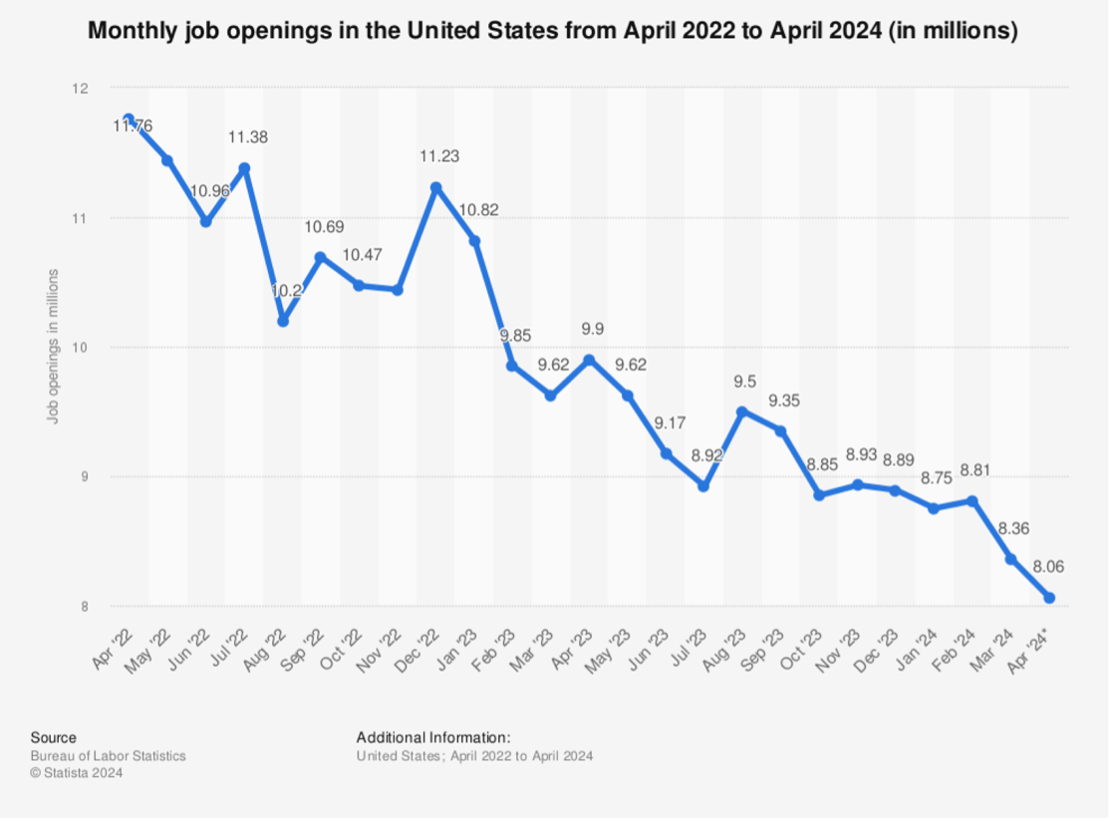
Last week, weekly US jobless claims dipped by about 6,000 applicants. This is typically good news, especially coming off 272,000 jobs added in May, but if we zoom out a bit, we see a growing number of continued jobless applications for the already unemployed. That number currently sits at 1.84M applicants, the highest level since November 2021. Although we’ve seen layoffs across the economy, American companies have only cut 332,043 jobs YTD, which is 4.6% less than last year through the same timeframe. The bigger issue, it seems, is that fewer companies are actively hiring. Monthly job openings are currently at the lowest level in the past two years. Most continued claims come from younger workers, aged 20 to 24 years old, followed closely by those aged 24 to 35 years old. If this dynamic continues, which I think it probably will, we’re likely to see a younger generation that grows very disillusioned.
Is There an AI Bubble Forming?
(Short answer: yes)
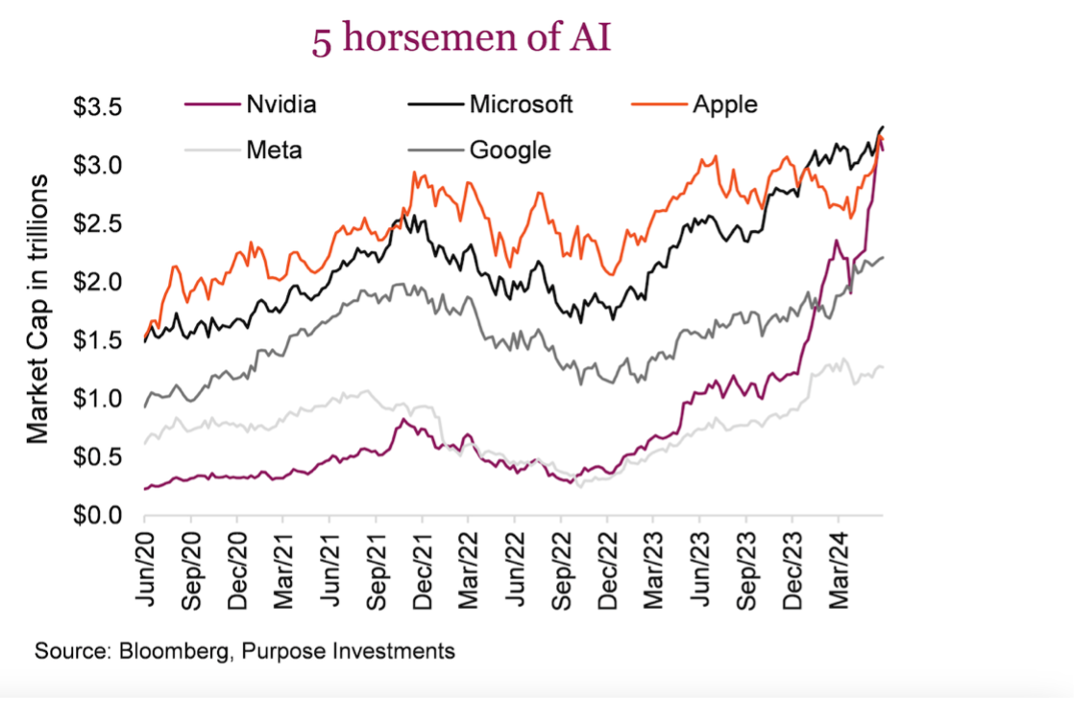
Over $167 billion has been spent on the artificial intelligence industry since 2021, most in the form of research & development, employment cost, and technical infrastructure. And executives of the largest technology companies aren’t just spending money on AI—they are even cutting costs to make room for AI expenditures. In a recent earnings call, Microsoft CEO Satya Nadella said, “By infusing AI across every layer of our tech stack, we are winning new customers and helping drive new benefits and productivity gains.” He also mentioned to investors that Microsoft is implementing “disciplined cost management across every team.” Microsoft CFO Amy Hood said they would prioritize “consistency of repivoting our workforce toward the AI-first work we’re doing without adding material number of people to the workforce.” Stocks like NVIDIA, AMD, and Microsoft have posted impressive gains this year, 160%, 17%, and 22% respectively. Specifically, NVIDIA has become the most valuable company in the world and is currently contributing to at least 30% of the S&P 500’s gains this year.
At the same time, Wall Street analysts are forecasting $60 billion in incremental capital expenditures on AI, while estimating collection of only $20 billion in incremental cloud revenue through 2026. It begins to beg the question: Is this a bubble? My answer is yes. This doesn’t mean that CEOs should not be actively leveraging AI in their organizations; quite to the contrary, it will continue to be a foundational technology in making people more productive. However, to use the language of the Gartner Hype Cycle, we’ve certainly reached the “peak of inflated expectations” with AI, and it’s something to bear in mind as we forecast the industry’s future.
PCE Index Indicates Prices Are Easing
Though high prices remain a stressor for consumers.
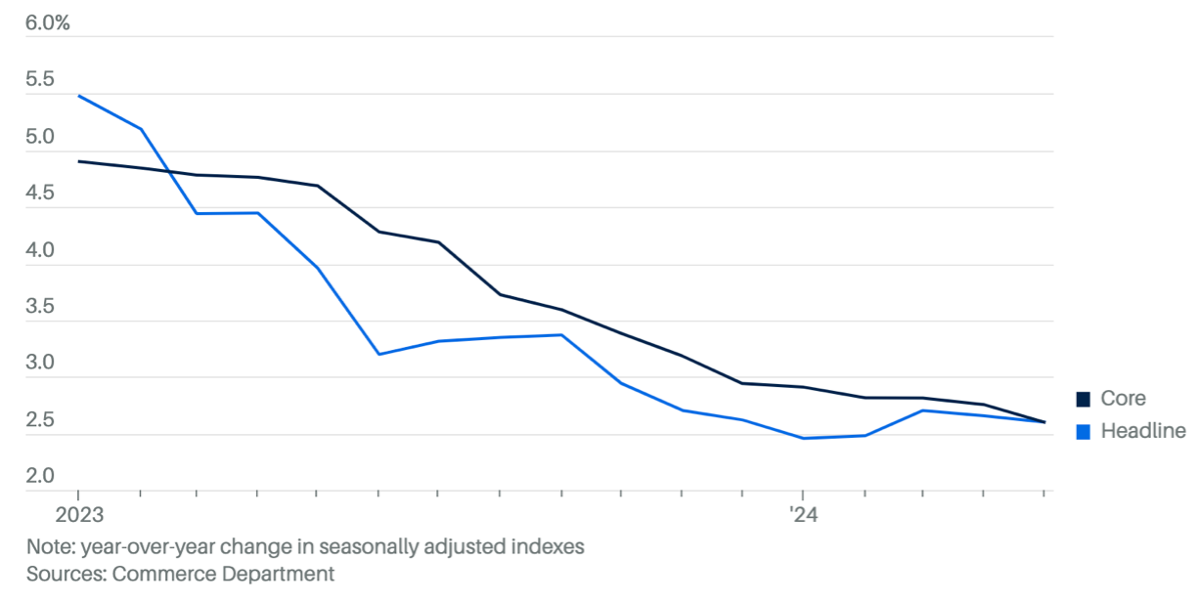
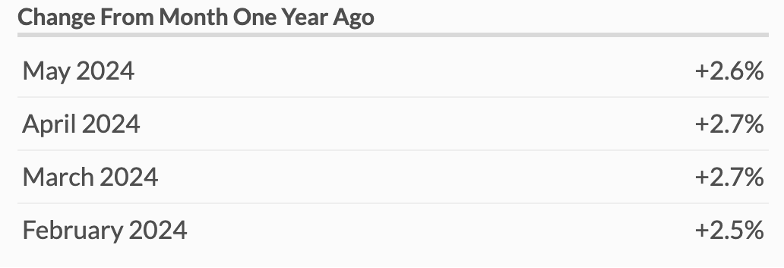
One of the Federal Reserve’s preferred inflation gauges, the Personal Consumption Expenditures Index, is showing some price relief as it remained unchanged in May compared to April 2024. This was in line with Wall Street’s forecast and the first month-to-month reading without an increase in six months. The lack of increase is largely being attributed to a drop in goods prices, including recreational goods, vehicles, gas prices, furnishings and durable household equipment. The core PCE Index, which removes food and energy, rose a mere +0.1%. Year over year, both core and headline PCE Index numbers show an inflation rate of +2.6% for May, down 0.1% year-over-year from April. The index also showed a consumer spending gain of +0.2% and an increase in personal income of +0.5% on a monthly basis.
With inflation around 2%, we’re close to the Fed’s target. But I wouldn’t expect us to stabilize here, and many Americans are far from breathing easy. People experience inflation very differently based on life circumstances (including home ownership, the interest rate of their mortgage, marital and family status, age, geography, and much more)—and if you talk to Americans, most will tell you that the crunch in their personal economics is still very much present.

"Strength lies in differences, not in similarities." —Stephen R. Covey
""The leader’s job is not to provide energy but to release it from others. This means recognizing and nurturing the unique strengths and potential of each individual." —Frances Hesselbein
“Your ability to build trusting, human connections with the people who report directly to you will determine the quality of everything that follows.” ―Kim Scott