


Ten years ago this month, I published my first book, The CEO Tightrope.
My goal with Tightrope was to give CEOs something I saw lacking in the business literature: a holistic framework for mastering the CEO job.
In the decade since, I’ve worked with hundreds of CEOs on applying the framework I laid out in the book. This work—and some of the drastic changes in the world around us—has prompted all sorts of insights, refinements, and ideas. Here are a few things I’ve observed since the book came out, in no particular order:
1. Awareness of the central problem is growing. I have long believed we should “professionalize” the CEO job like we have every other functional area of the business. I think we need a set of best practices and tools and training mechanisms to help leaders master the CEO job, just like we have for positions like a sales executive or a CFO. We’re not there yet, but I do see more awareness of the issue, and awareness is the first step. Many elite business schools now offer CEO-specific programs (even if they are primarily taught by academics). Publications like Harvard Business Review run more pieces on dynamics of the CEO role than they used to. And while books on the topic remain relatively rare, there have been several strong ones published. I particularly recommend The CEO Next Door. Perhaps in another ten years we’ll have more robust, standardized resources available to CEOs, but we’re at least taking steps in the right direction.
2. Widespread confusion about the nature of job hasn’t gone away. Many smart people think that the CEO of a 10-person company and the CEO of a 200-person company have essentially the same job. But there is an exponential increase in complexity that happens around the 100-employee mark of the scaling process. It requires the CEO to become a particular type of leader (a generalist, a forecaster, a coach and guide to people he or she rarely sees) that I think of as the shift to the “professional CEO,” the type of CEO I’m concerned with in Tightrope. Once you have made the jump, the changes from a 200-person company to a 1,000-person company and beyond are real, but nothing like that initial step toward scale. Until we really understand what the professional CEO job requires, we are likely to pick people who aren’t suited to the role and/or fail to train them for it properly.
If you need to hire a CEO of a 1,000-person company, previous experience as CEO won’t translate if it was at a much-smaller operation. At the same time, experience leading a 1,000-person department within a larger company won’t translate either. The professional CEO is a unique combination of scale and total responsibility for the business that is not broadly acknowledged (yet).
3. People are hungry for practical solutions. I have found that leaders are drawn to the ability to operationalize quickly when it comes to learning CEO skills. Tightrope is a practical book and grew out of my real-world experiences, but in courses I taught and conversations I had, people wanted even more guidance on how to apply ideas quickly to see an effect. This prompted a follow-up book with my CEO-S partner, The Chief Executive Operating System, that distills the framework from Tightrope into an operating system. In the CEO Masterclasses I teach a few times a year, these usable tools that link up to a purposeful structure are what really make the difference for practicing CEOs.
4. The path to the CEO job is unpredictable. People end up in the CEO seat in so many different ways. It’s not like becoming an airline pilot, where you start out in flight school, earn your hours, become a junior pilot, and so on. Few leaders I know set out with the CEO destination in mind. It’s usually that many factors conspired, the opportunity arose, and the person took it. This means people like me (who believe competent CEOs are the bedrock of organizational health) need to broaden who we talk to, making sure the right people know what the CEO job is and how to get there. One clear trend in recent years is the rise of the internally appointed CEO, which reached a peak in 2023. To me, this signals that more organizations are thinking intentionally about CEO succession and building a training pipeline.
5. The pressure to “take a stand” is real. Tightrope touches on the public-facing aspects of the CEO role but, wow, pressure for CEOs to address hot-button political issues has grown intensely since then. We hear a lot today about customers and employees (especially Gen Z) wanting to work with businesses that “reflect their values.” But I remain confident that the smartest path is for CEOs to keep grandstanding to a minimum, speaking only on these issues when they are directly relevant to the core business. More often than not, putting your voice into a conversation that’s unconnected to your job as CEO results in backlash. And Gen Z is highly sensitive to falsity, including tactics like “greenwashing.”
6. I see personality dynamics as even more important than I once did. One concept I added more intentionally to my second book on the CEO role was how personality types affect leadership. In working hands-on with CEOs, I saw repeatedly how the biggest and most intractable problems were rooted in basic lack of awareness of the “soft” dynamics at play. Using DISC terms, a hard-driving Dominant CEO can easily alienate the more introverted and intentionally paced executives on their team, just as a highly Conscientious CEO can drive their team mad with rigor and minutiae. The CEO must effectively lead everyone. This requires understanding your natural leadership style and adjusting so you avoid the pitfalls so many others fall into.
7. AI is a great helper to the CEO. Generative AI isn’t going to replace CEOs anytime soon, but the CEOs who don’t learn to use it will indeed be left behind. (It would be something like a CEO in the 1990s refusing to get on email.) I personally use GenAI almost daily. It’s a great way to think through ideas, generate possibilities, customize communication, and a lot more.
I’m pleased to say that ten years did not change the core framework presented in The CEO Tightrope. If anything, I think CEOs need a framework more than ever, especially as we head into uncharted waters and potential economic upheaval.
To celebrate the anniversary, here’s a special offer. If you are a currently serving CEO, you can get a complimentary signed copy of the book here. Just use code FREEBOOK.
The Rundown
Home Sales Hit the Brakes
High prices and borrowing costs keep buyers on the sidelines.
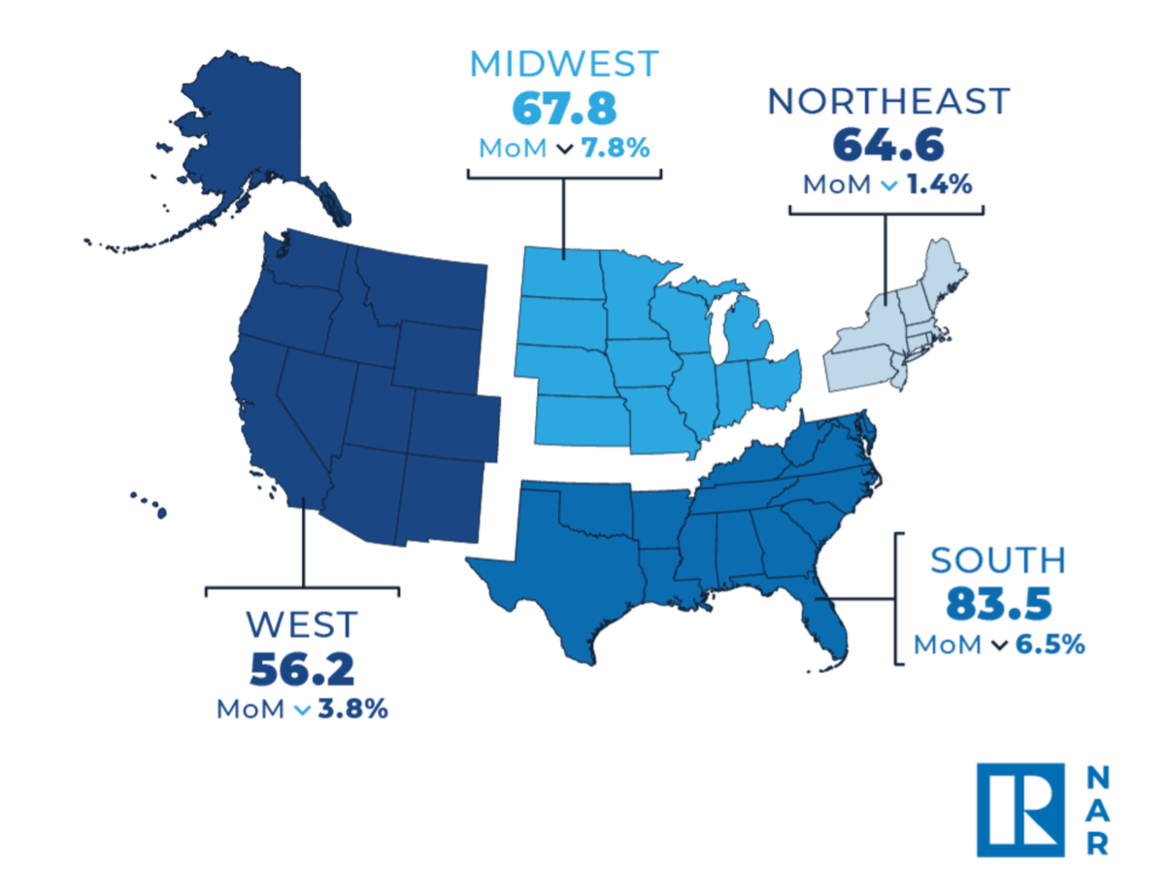
U.S. pending home sales reached a historic low in July 2024 due to a combination of high home prices and elevated borrowing costs, leading to significant buyer reluctance. The National Association of Realtors (NAR) reported a 5.5% decline in its Pending Home Sales Index, which dropped to 70.2, the lowest level since the index began in 2001. Year-over-year, pending transactions fell by 8.5%, and all four regions in the U.S. experienced declines in home-sale activity. The Midwest saw the sharpest decline, with sales dropping 7.8% month over month, while the Northeast showed more resilience, with a modest decline of only 1.4% during the same period.
Home prices remain elevated, though the rate of increase has slowed. A report from the Federal Housing Finance Agency revealed that home prices rose 5.1% year over year in June, marking the slowest growth in nearly a year, following a 5.9% increase in May.
While declining mortgage rates may provide some relief in the coming months, experts suggest that the current rates are still too high to significantly drive new listings or market turnover. There was a period in my lifetime when a 5% or 6% interest rate wasn’t outrageous, but whether we can maintain those interest rates with current levels of government spending and not see huge inflation—that remains to be seen.
Ultimately, the best cure for high prices is high prices, as they say. People will be spurred to build more and eventually inventory will catch up. This would be a better outcome than for home prices to quickly crash right now, as such a decline would take a lot of Boomers’ net worth with it.
Job Market Cools Off, But Wages Hold Steady
Job growth slows for the fifth consecutive month, while wage gains remain stable across sectors.
U.S. private-sector employment grew by 99,000 jobs in August according to the latest report from ADP, marking the fifth consecutive month of slowing job creation. Annual pay increases remained steady at 4.8% for job-stayers and 7.3% for job-changers, signaling stability in wage growth after a post-pandemic surge.
Job Growth by Industry:
Goods-Producing Sectors saw an overall increase of 27,000 jobs, driven by construction, which added 27,000 jobs. However, manufacturing lost 8,000 positions, reflecting ongoing challenges in that sector.
Service-Providing Sectors added 72,000 jobs, led by education/health services, which contributed 29,000 new jobs. The financial activities sector also performed well, adding 18,000 jobs. In contrast, professional/business services lost 16,000 jobs, and the information sector shed 4,000 jobs.
Regional Employment Trends:
The South led job growth with 55,000 new positions, driven primarily by a gain of 48,000 jobs in the West South-Central region.
The Northeast followed with 24,000 jobs added, concentrated in the Middle Atlantic region (30,000 jobs), while New England saw a decline of 6,000 jobs.
The West added 20,000 jobs, while the Midwest saw modest growth, adding only 7,000 jobs.
Job Growth by Establishment Size:
Medium-sized businesses (50-499 employees) contributed most new jobs, adding 68,000 positions.
Large establishments (500+ employees) saw solid gains, contributing 42,000 jobs.
Small establishments (under 50 employees) experienced a decline, losing 9,000 jobs, with the bulk of losses concentrated in businesses with 20-49 employees.
Wage Growth Insights:
Wage growth for job-stayers held steady at 4.8% year-over-year, while job-changers continued to see higher gains, with a 7.3% increase.
The construction sector saw the strongest wage growth among goods-producing industries at 5.2%, while education/health services led service-providing industries with a 5.1% increase in pay.
Medium-sized firms saw the highest wage gains, with pay increasing by 5.0%, while small firms (1-19 employees) experienced the slowest wage growth at 4.0%.
Nela Richardson, ADP’s chief economist, remarked on the labor market’s gradual cooling: “The job market's downward drift has brought us to slower-than-normal hiring after two years of outsized growth. The next indicator to watch is wage growth, which is stabilizing after a dramatic post-pandemic slowdown.”
For employers, this means you can probably find people to work for you more easily than in the recent past—though of course that doesn’t mean they’ll all be great people. However, given the general unsettling of the job market, it may be possible to get conversations with talent (even currently employed talent) that is looking for new opportunities.
Q2 Real GDP Revised Upward
While the economy expands at a strong pace, declines in personal savings and uneven corporate profit growth hint at underlying pressures.
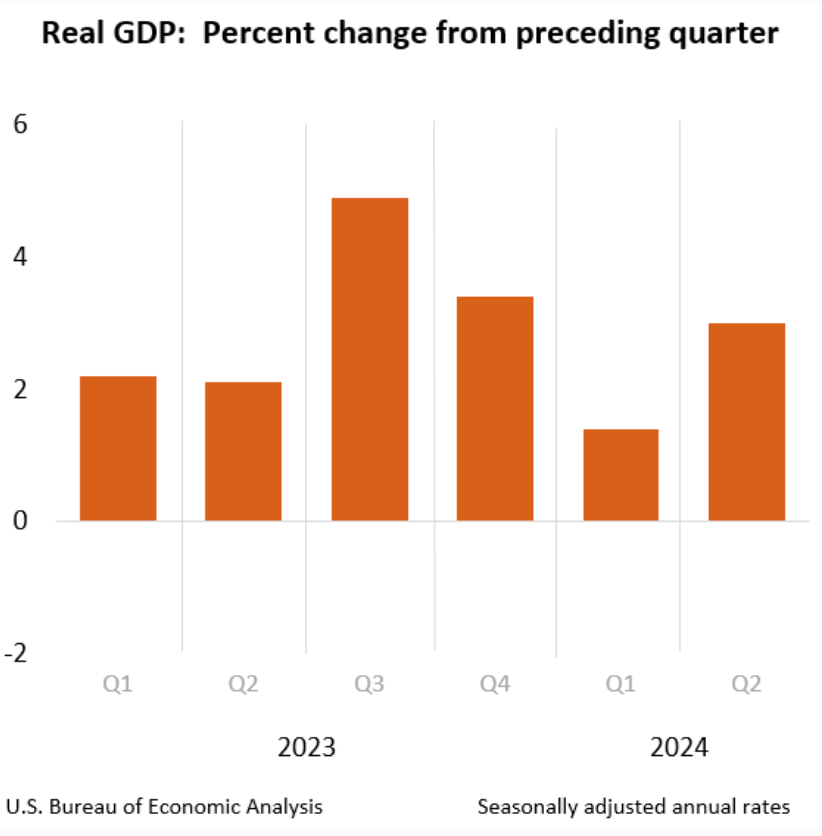
The U.S. economy showed solid growth in the second quarter of 2024, with real GDP increasing at an annual rate of 3.0%, an upward revision from the 2.8% initially estimated. This marks a notable acceleration compared to the 1.4% growth in the first quarter, largely driven by stronger consumer spending and private inventory investment.
Corporate profits increased by $57.6 billion in Q2, rebounding from the $47.1 billion decline in Q1. Domestic nonfinancial corporations experienced a significant recovery, gaining $29.2 billion in profits after a steep drop in the previous quarter.
Current-dollar personal income rose by $233.6 billion, supported by gains in compensation and personal transfer receipts. The price index for gross domestic purchases increased by 2.4%, while the core PCE price index (excluding food and energy) rose by 2.8%, indicating inflation remains steady within the Federal Reserve’s acceptable range.
However, residential fixed investment declined, reflecting ongoing challenges in the housing sector. Additionally, the personal savings rate dropped to 3.3%, a downward revision from earlier estimates, raising potential concerns about consumer resilience.
Federal, state, and local government spending were all revised downward, limiting their contribution to overall GDP growth. While financial corporations saw profits rise by $46.4 billion, this represents a slowdown compared to the previous quarter’s increase of $65.0 billion. Lastly, imports, which negatively affect GDP calculations, were revised up, while exports were revised down, slightly impacting the net trade balance.
Does the upward revision in GDP mean all is well economically? Not necessarily. I see it as a lagging indicator (while the downward jobs trend is more forward-looking) and more slowdown likely ahead.

"A leader who believes that he can make a positive difference through continual personal interventions is usually deluding himself. He thereby takes over things other people are supposed to be doing, effectively dispensing with their efforts, and multiplies his own tasks to such an extent that he can no longer carry them all out. The demands made on a senior commander are severe enough as it is. It is far more important that the person at the top retains a clear picture of the overall situation than whether some particular thing is done this way or that." —Stephen Bungay
“Don’t be intimidated by what you don’t know. That can be your greatest strength and ensure that you do things differently from everyone else.” —Sara Blakely
“It’s amazing what you can learn when you ask people who know more than you to share their knowledge." —David Novak